What an AI Governance Policy Looks Like for a Fashion Brand
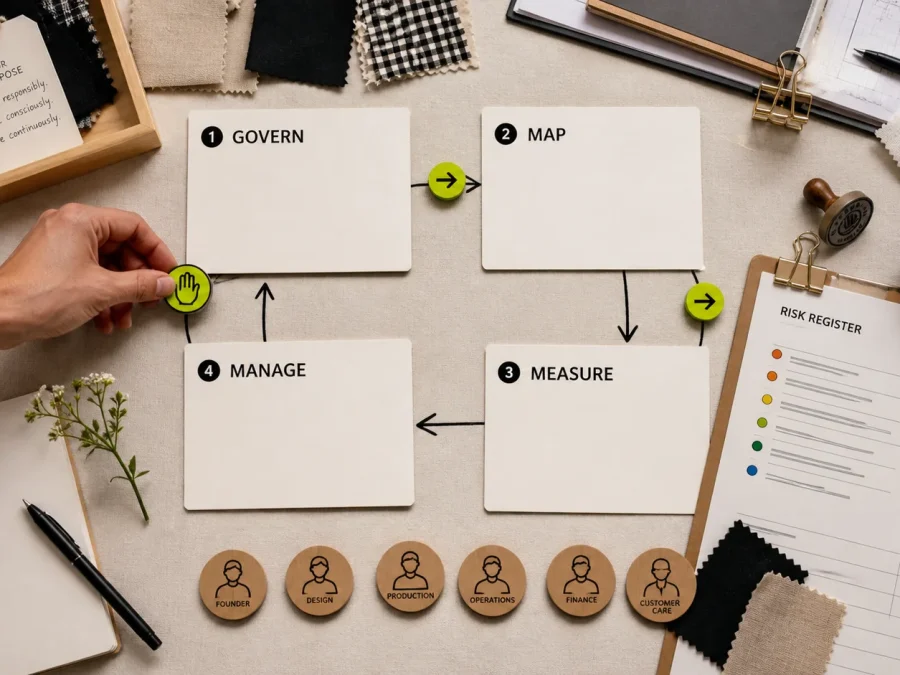
A usable policy names owners, inventories tools and data, separates low- and high-impact uses, sets evidence and disclosure rules, and gives people authority to pause or appeal a system.

What fashion technology can actually do. Explore workflows, evidence, costs, and the limits behind the claims.
A usable policy names owners, inventories tools and data, separates low- and high-impact uses, sets evidence and disclosure rules, and gives people authority to pause or appeal a system.

Treat vision as a documented triage layer inside the existing quality system, with controlled capture, defect definitions, group-level evaluation, human release authority, and audited misses.
Start with the fashion use case and data flow, demand evidence for claims and controls, run a bounded test, align promises with contract language, and design the exit before the tool becomes essential.
AI can organize a sourcing search, but a match is only research-ready when criteria, dated evidence, risk review, direct verification, ownership, and disqualifying facts remain visible.
Compare the problem, data, integration, control, talent, lifecycle cost, and exit—not feature lists alone. Buying may still require substantial internal work, while building creates a permanent operating obligation.
Synthetic people can expand creative options, but they cannot quietly impersonate documentary photography, customer experience, or product truth.
The correct comparison includes loaded labor, review, correction, tools, production, rights, disclosure, adaptation, and failed outputs—not only the price of a generation subscription.
A scalable image workflow begins with rights, product truth, a source hash, approved transformations, accessibility ownership, and provenance—not a prompt that quietly invents the rest.
There is no reliable one-line answer. Human authorship, generated material, source rights, contracts, publication, trademarks, design patents, territory, and the exact asset must be reviewed separately.
A fair test must freeze the brief, hide authorship, preserve source facts, separate quality dimensions, count editing labor, and publish failures. Our current result is a synthetic protocol fixture, not a reader study.