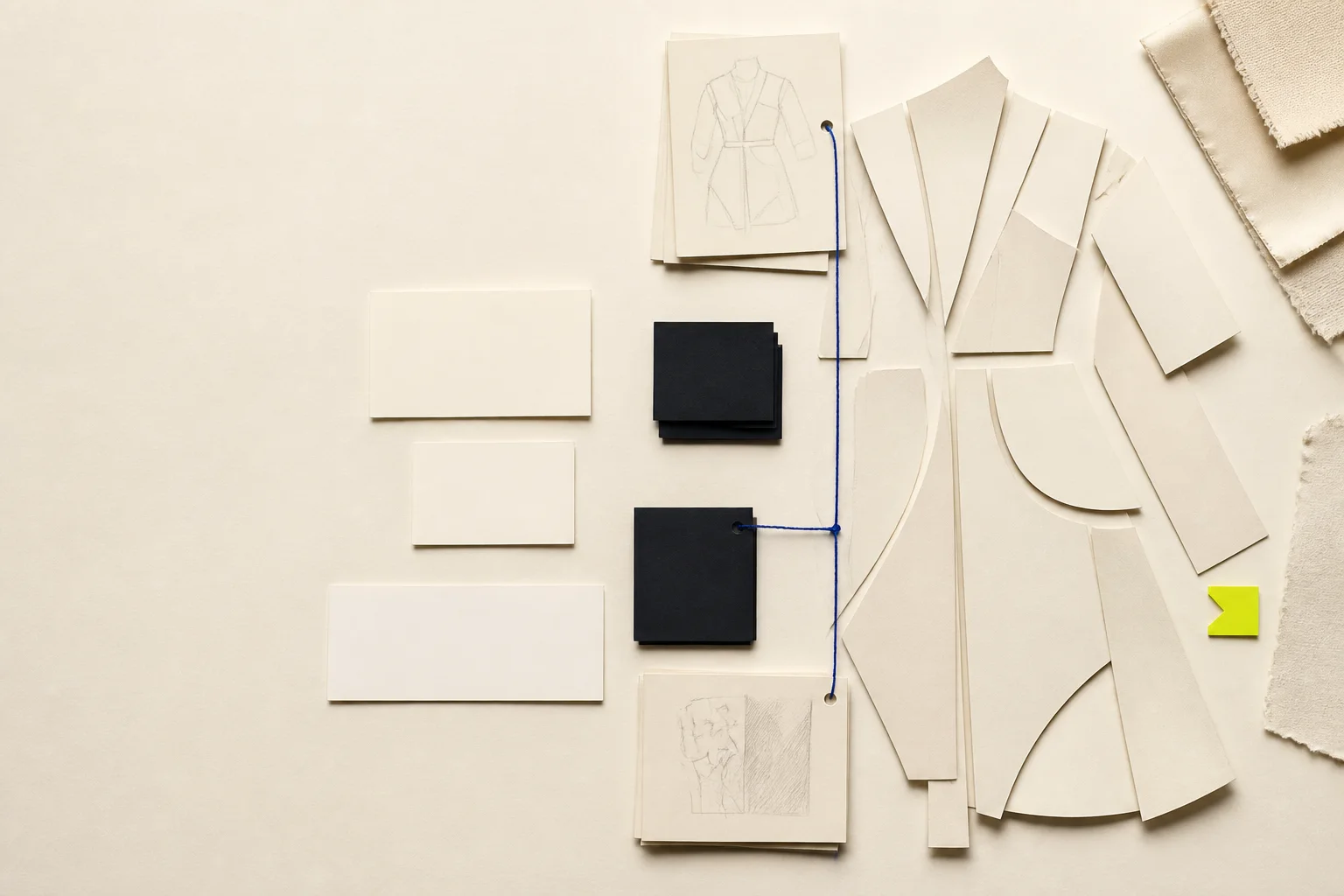
“Who owns it?” sounds like one question. An AI-assisted fashion project may involve several different assets and several different bodies of law: a human sketch, generated variations, a garment shape, a surface print, a logo, a photograph, a campaign layout, code, product data, and confidential business information.
The answer depends on facts, contracts, jurisdiction, and the right being discussed. This article provides a documentation workflow for U.S. counsel review. It is not legal advice and does not decide whether any fashion design is protected, owned, clear to use, or non-infringing.
Identify the exact asset
Do not open an intake with “AI design.” Create a separate record for each output:
- original human sketch or pattern;
- input photograph, artwork, block, reference, or dataset;
- raw generated output;
- selected output and selection record;
- human redrawing, arrangement, edit, or pattern development;
- final garment, print, logo, packaging, photograph, or campaign;
- prompt, settings, model, version, seed or generation identifier;
- technical and production files derived from the concept.
Preserve dates and hashes. Record who made every contribution, in what employment or contractor relationship, under which agreement, and before or after publication. A final composite may contain protected, unprotected, licensed, and disputed elements at the same time.
Copyright begins with human authorship
The U.S. Copyright Office’s January 2025 report on generative AI states that existing copyright principles can apply to AI-assisted work. It explains that copyright protection may cover human-authored expressive elements perceptible in an output or creative selection, coordination, arrangement, or modification, depending on the facts. It also concludes that prompts alone generally do not provide sufficient human control over expressive elements.
That does not mean every edited output is protected or that an entire fashion design falls within copyright. Counsel must identify the claimed human expression, exclude unclaimable material where required, and consider the relevant category of work.
The Office’s 2023 registration guidance requires applicants to disclose appreciable AI-generated material and describe the human-authored contribution when seeking registration. Applicants should not name an AI system as an author. The Office has indicated that the use of AI as an assistive tool does not by itself prevent protection for human-authored work.
Save process evidence while it exists: dated sketches, editable files, layer histories, pattern changes, selection notes, rejected outputs, correspondence, and a plain explanation of human choices. Do not manufacture a contribution log after a dispute begins.
Source rights are a separate question
A claim to human authorship does not establish permission to use every input. Record whether a source is project-owned, licensed, public domain, supplied under written permission, or unresolved. Save the license version and permitted uses, including modification, commercial use, territory, duration, confidentiality, model training, and sublicensing.
A mood board is not automatically a rights-cleared dataset. Do not upload confidential designs, unreleased samples, customer photographs, agency images, logos, artworks, or licensed patterns without confirming the intended tool use is permitted. A model’s terms are one part of the chain; they do not grant rights another party owns.
Perform similarity and clearance review appropriate to the asset and market. An output that was generated without an intentional reference can still resemble protected or source-identifying material.
Contracts allocate rights and responsibility
Determine whether contributors are employees or independent contractors and review written agreements. The relevant questions can include ownership of human work, assignment language, work-made-for-hire provisions where applicable, licenses, moral rights where relevant, confidentiality, warranties, indemnities, approval, reuse of rejected work, portfolio display, model training, and responsibility for clearance.
Record the tool account owner and whether a personal or enterprise plan was used. Save the terms and privacy settings that applied on the generation date. Contract language can allocate rights between parties, but it cannot create statutory protection that the law does not recognize.
Do not rely on a checkbox labeled “commercial use” as a complete legal opinion.
Copyright is not the only design right
USPTO guidance explains that a U.S. design patent concerns a new, original, ornamental design embodied in or applied to an article of manufacture. Its drawings or photographs define the visual disclosure, and filing practice is specialized. Public disclosure and filing timing can matter; obtain patent advice before launching when design-patent protection is under consideration.
Trademark law addresses source-identifying words, symbols, designs, or combinations used with goods or services. A generated brand mark requires a search and legal analysis before adoption. A visually pleasing output is not trademark clearance, and a federal registration symbol cannot be used merely because a concept exists.
Other issues may include trade dress, contract, unfair competition, right of publicity, privacy, design protection outside the United States, and trade secrets. Keep those screens distinct. A copyright conclusion does not answer them.
A reproducible fictional rights intake
FashionMember created five fictional asset records in content/data/FM-018-ai-design-rights-intake.json. The script scripts/fm018-ai-design-rights-intake.php checks for jurisdiction, a human-contribution log, identification of generated material, input rights, saved tool terms, contract chain, publication status, registration status, design-patent and trademark screens, and scheduled or completed counsel review.
Two records route to documentation-ready: a human sketch with a separately identified generated color-exploration layer, and an editorial layout with archived human typography and arrangement decisions. Three route to hold because a contribution log, input license, contract, clearance screen, or counsel review is open.
Documentation-ready means only that the intake can be reviewed by a lawyer. It does not establish ownership, copyrightability, patentability, trademark availability, validity, infringement, enforceability, or registrability. Every asset and fact is synthetic.
Build a rights record before generation
For each project, define:
- the intended asset and commercial use;
- approved inputs and prohibited sources;
- model, account, privacy, retention, and training settings;
- required human creation and review records;
- output similarity and claim review;
- contracts and approval authority;
- public disclosure and provenance;
- publication date and territories;
- registration or filing decisions;
- retention, correction, withdrawal, and dispute procedures.
C2PA provenance can help document source and transformation history when supported, but it is not an ownership registry or legal clearance. Preserve ordinary records even when a credential is attached.
Avoid the two opposite mistakes
The first mistake is to assume that paying for a tool means the user owns every output free of risk. The second is to assume that any use of AI destroys all potential rights in the larger work. Current U.S. Copyright Office guidance is more specific: examine the human-authored expression and identify generated material.
Use precise language in contracts and marketing. “Created by our designer with AI-assisted color exploration” communicates more than “AI-owned” or “copyright free.” Do not promise exclusivity unless counsel has reviewed the asset, process, terms, searches, and market.
The attorney-review gate remains open
This article offers general editorial context, not legal advice. A qualified U.S. intellectual-property attorney should review the current Copyright Office and USPTO materials, exact facts, contracts, model terms, and jurisdiction before anyone applies the framework to a real project.
The operational answer to “who owns it?” is not a slogan. It is a dated file that shows what the asset is, what a person created, what a system generated, where the inputs came from, which agreements apply, which rights are being considered, and which questions remain for counsel.
Sources and verification
- U.S. Copyright Office: Copyright and Artificial Intelligence — official hub for the 2025 copyrightability report, registration guidance, and related decisions.
- U.S. Copyright Office: Part 2 release summary — official summary of human-authorship and generative-output conclusions.
- U.S. Copyright Office registration guidance — official policy statement for works containing AI-generated material.
- USPTO design patent application guide — official guidance on ornamental designs, visual disclosure, and the U.S. filing process.
- USPTO trademark basics — official trademark identification, search, filing, and maintenance resources.
- C2PA Content Credentials specification — official technical provenance specification; not an ownership or clearance system.
How this story was checked
- Sources
- 6 linked records · View list
- Last verified
- Reporting desk
- FashionMember AI & Retail Desk
- Format
- Analysis
- AI assistance
- Used with editorial review; disclosed above.