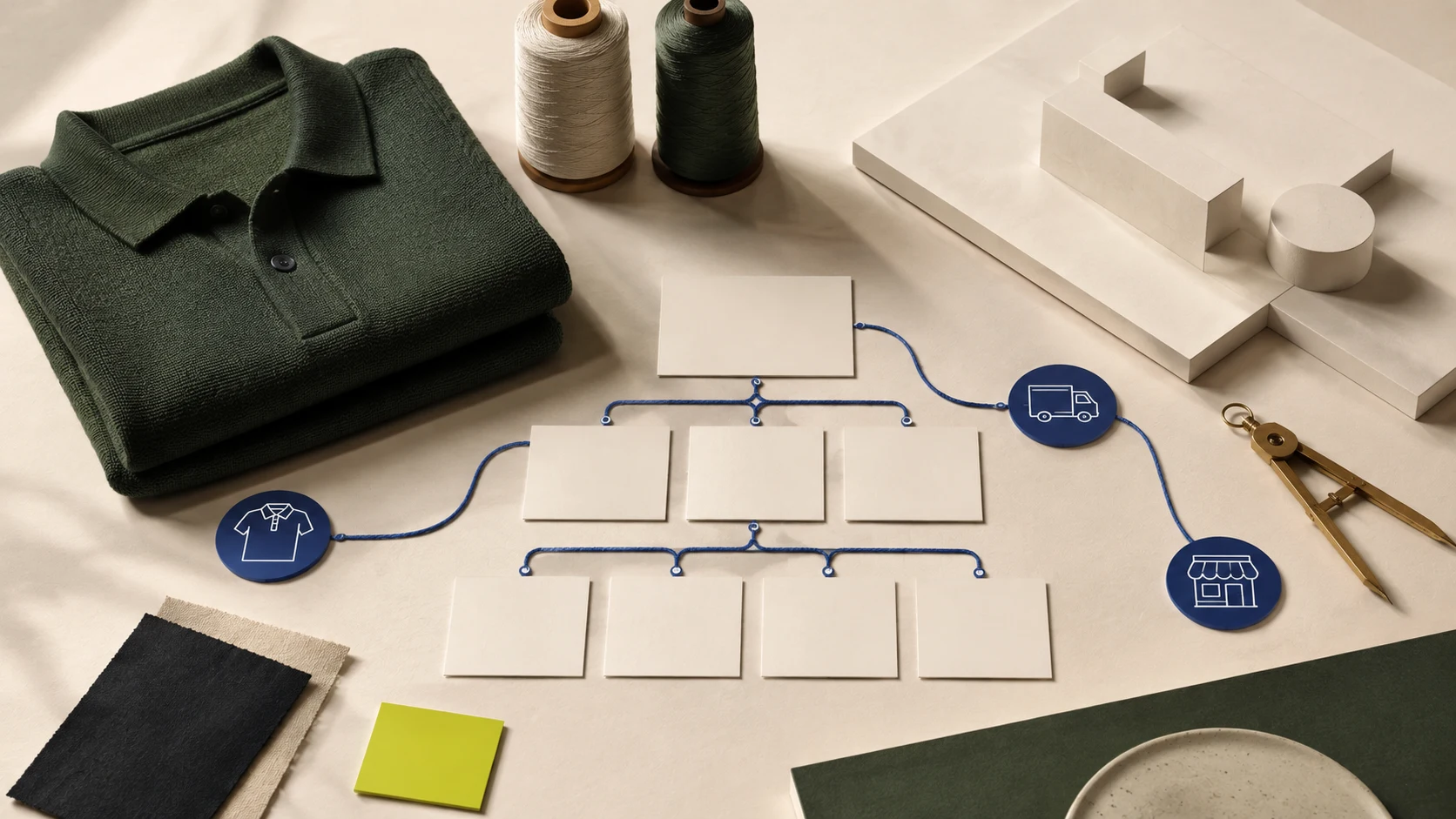
Ralph Lauren's September 3 leadership announcement is easy to read as a list of promotions. It is more revealing as a map of where the company wants decisions to meet. Halide Alagöz, already the chief product and merchandising officer, will become chief operating and product officer on November 29, after chief operating officer Bob Ranftl retires. Her expanded remit includes the company's AI strategy and its architecture and design organization, while keeping global sourcing, integrated business planning, product, and merchandising.
That combination puts an abstract technology agenda next to the records and teams that decide what gets made. The same announcement gives Chief Financial Officer Justin Picicci global responsibility for real estate and logistics, and adds the licensing business to Chief Marketing Officer Iris Langlois-Meurinne's role. Katie Ioanilli, the company's chief corporate affairs and communications officer, will also take on Design with Intent. Ralph Lauren says the changes support its Next Great Chapter: Drive strategy. They do not, by themselves, show that a new AI system is live or that the structure has improved results.
The useful signal is narrower and more practical: AI is being placed in the operating conversation, not left as a side project owned only by a technology team. For a global lifestyle company, that means the quality of an AI decision will be tied to product data, sourcing constraints, inventory plans, store environments, and the logistics that connect them. For an independent label, the lesson is not to copy a title. It is to make one person accountable for the handoff from an AI-assisted recommendation to a product or customer decision.
A title change is a decision-rights map
The official release describes Alagöz's new role in unusually operational language. She will lead AI strategy and architecture and design while retaining global sourcing, integrated business planning, product, and merchandising. Those are separate disciplines in many organizations. Joining them creates a line between an idea in a model and the physical conditions that determine whether the idea can be executed.
Consider a seemingly simple assortment suggestion. A model may identify a color or silhouette with potential, but a product team still needs a specification, a sourcing team needs a viable material and supplier, and an integrated plan needs a delivery window and inventory commitment. Architecture and design affect how a store or digital environment presents the result. If those decisions live in disconnected systems, a confident recommendation can become an expensive exception.
Picicci's added responsibility for real estate and logistics completes another side of the map. Finance already sees capital, leases, and performance. Logistics sees movement, capacity, and delivery risk. Placing both under the CFO does not prove that the functions will collaborate well, but it gives the organization a named executive who can arbitrate when a store plan, a freight constraint, and a financial target disagree.
Langlois-Meurinne's licensing addition and Ioanilli's Design with Intent remit extend the map into brand permissions and corporate commitments. The announcement does not explain new processes, reporting lines below these executives, or decision thresholds. Those gaps matter. A broad remit can reduce handoffs when responsibilities are explicit; it can also make accountability harder to see when every problem has several owners.
The timing is part of the story
The changes take effect on November 29, leaving a transition period rather than an overnight reorganization. That date gives teams time to define who approves a model-assisted decision, which source data is authoritative, and what happens when an AI recommendation conflicts with a buyer's or planner's judgment. It also creates a period in which two operating models can coexist.
Ralph Lauren's first-quarter fiscal 2027 release supplies business context, but not proof of a cause-and-effect relationship. The company reported revenue of $2.0 billion, up 14 percent as reported, and said it added 1.5 million direct-to-consumer customers. It reported 22 new owned or partnered stores, including The Grove in Los Angeles, and described growth in retail, digital, and wholesale channels. These are company-reported results for the quarter; they cannot be attributed to the September leadership changes, which had not yet taken effect.
The release also identifies digital technology and analytics and operational capabilities as strategic enablers. In its risk disclosures, Ralph Lauren flags implementation and operational risks from artificial intelligence and evolving regulatory requirements. Read together, those documents suggest a company preparing for governance work around technology while it scales the physical business. They do not disclose a specific model, vendor, deployment rate, or AI-generated sales contribution.
The structure also sits inside the longer Next Great Chapter: Drive plan announced in 2025. That plan links brand elevation, core products and under-penetrated categories, and a consumer ecosystem in key cities with technology, AI, analytics, operations, partners, and materials. The September change therefore looks like an attempt to put named executives around capabilities already described in the strategy, not a standalone AI launch.
Why sourcing belongs in the AI conversation
Fashion AI discussions often begin with the visible interface: a generated image, a search assistant, or a forecast chart. Sourcing is less photogenic but more decisive. Product master data, fiber and trim specifications, supplier capacity, lead times, minimums, testing records, and country-of-origin fields determine what a recommendation can responsibly mean.
If a model reads an outdated material record, it may recommend an option that cannot meet a delivery date or compliance requirement. If a planner cannot see the assumptions behind a demand signal, the organization cannot decide whether to adjust the buy or reject the signal. If logistics data arrives after a product promise has been made, the store and the customer absorb the contradiction. Connecting AI strategy to sourcing and integrated planning makes these dependencies visible, but it does not make the underlying data clean.
FashionMember's reading of the announcement is that governance is becoming part of product work. A useful governance record for any AI-assisted decision would name the source data, the accountable approver, the permitted action, the exception path, and the stop condition. That is a recommendation, not a description of Ralph Lauren's internal controls; the company has not published those details in the materials reviewed here.
A smaller-label version of the charter
An independent Los Angeles label does not need a chief operating and product officer to borrow the logic. It can create a one-page decision-rights charter for a narrow pilot:
* A product or merchandising owner decides what question the tool may answer. * A sourcing or production partner verifies material, capacity, and timing inputs before a recommendation becomes a commitment. * A finance or operations owner records the inventory, cash, logistics, and return-risk assumptions. * A named editor or brand lead checks that the output fits the label's design language and public claims.
The charter should live beside the work, not in a generic policy folder. For a small capsule, that might mean a versioned assortment sheet, a supplier confirmation, and a short decision log showing which recommendation was accepted, changed, or rejected. The objective is traceability: a later teammate should be able to tell whether an error came from the data, the prompt, the supplier constraint, or the human decision.
The pilot also needs a stopping rule. If a recommendation cannot show its source fields, if a material substitution changes a tested claim, or if a delivery assumption falls outside the approved window, the label should pause the workflow rather than quietly promote the output to a product promise. That discipline is valuable even when no AI is involved.
What to watch over the next 12–24 months
FashionMember's base scenario is that Ralph Lauren uses the expanded roles to make AI an enablement layer across product and operations. The assumption is that leaders publish enough process detail for teams to know who approves data, models, and exceptions. Confirming signals would include documented use cases tied to assortment, sourcing, planning, or store operations; consistent definitions across digital and physical channels; and reporting that explains a correction when a model-assisted decision is changed.
In an upside scenario, the new alignment reduces handoff friction. Product, sourcing, planning, logistics, and store teams could work from a shared decision record, allowing a recommendation to be tested against capacity and customer experience before a large commitment. The falsifiers would be repeated public contradictions between product promises and operational availability, or a succession of tools that never acquire an accountable business owner.
In a downside scenario, the remit becomes too broad. AI, architecture, sourcing, and merchandising may all sit under one executive while local teams still lack clear approval rights. The warning signs would be recurring reorganizations without published operating changes, unexplained delays in data or product decisions, and risk disclosures that grow while practical use cases remain vague. These are scenarios, not forecasts of Ralph Lauren's revenue or share price.
For smaller labels, the measurable signals are closer to the workbench: time from recommendation to approved sample, the number of manual corrections to a product record, whether a supplier can reproduce the approved specification, and whether a customer-facing promise matches the shipment. A label can track those internally without claiming that AI caused the outcome.
The physical store is the accountability test
The most interesting part of the announcement may be the quiet connection between a model and a room. A store is where assortment, architecture, visual language, staffing, inventory, and logistics become one customer experience. When architecture and design sit beside AI strategy, and real estate and logistics sit with finance, the organization is at least acknowledging that digital recommendations end in physical constraints.
The Los Angeles reference in Ralph Lauren's quarterly release makes that concrete without turning The Grove opening into evidence of AI performance. A store opening is a company-reported event. It does not tell us which tools influenced the assortment, how inventory was allocated, or whether the new structure will change future openings. Those questions require later disclosures or direct reporting.
The September announcement is therefore best treated as an operating hypothesis. It says where Ralph Lauren wants responsibility to sit; the next 12 to 24 months will show whether teams receive the data, records, and authority to make that structure useful. For any brand, the durable work is less glamorous than a new title: put a name beside the decision, document the evidence, and make it easy to stop when the evidence breaks.
Sources and verification
* Ralph Lauren, “Ralph Lauren Announces Enterprise Leadership Changes” (September 3, 2026) — primary source for the expanded roles, responsibilities, and November 29 effective date. * U.S. Securities and Exchange Commission, Ralph Lauren Corporation Form 8-K (filed September 3, 2026) — filing record and Exhibit 99.1 for the leadership announcement. * Ralph Lauren, “Reports Better Than Expected First Quarter Fiscal 2027 Results” (August 6, 2026) — company-reported quarterly revenue, customer, store, channel, and risk-disclosure context. * Ralph Lauren, “Next Great Chapter: Drive” strategic growth plan (September 16, 2025) — strategic drivers and listed technology, AI, analytics, operations, partner, and materials enablers. * Ralph Lauren, 2025 Global Citizenship & Sustainability Report (PDF) — company description of upstream sourcing, manufacturing, and inbound-logistics scope; used as context, not as evidence of AI deployment. * Ralph Lauren Reports & Policies — provenance for the company's published reporting archive.
Last verified: September 4, 2026. This article distinguishes documented corporate announcements and results from FashionMember analysis and clearly labeled scenarios. It does not claim that Ralph Lauren's AI systems are deployed, effective, or responsible for reported financial performance.
How this story was checked
- Sources
- 6 linked records · View list
- Last verified
- Reporting desk
- FashionMember AI & Retail Desk
- Format
- Analysis
- AI assistance
- Used with editorial review; disclosed above.