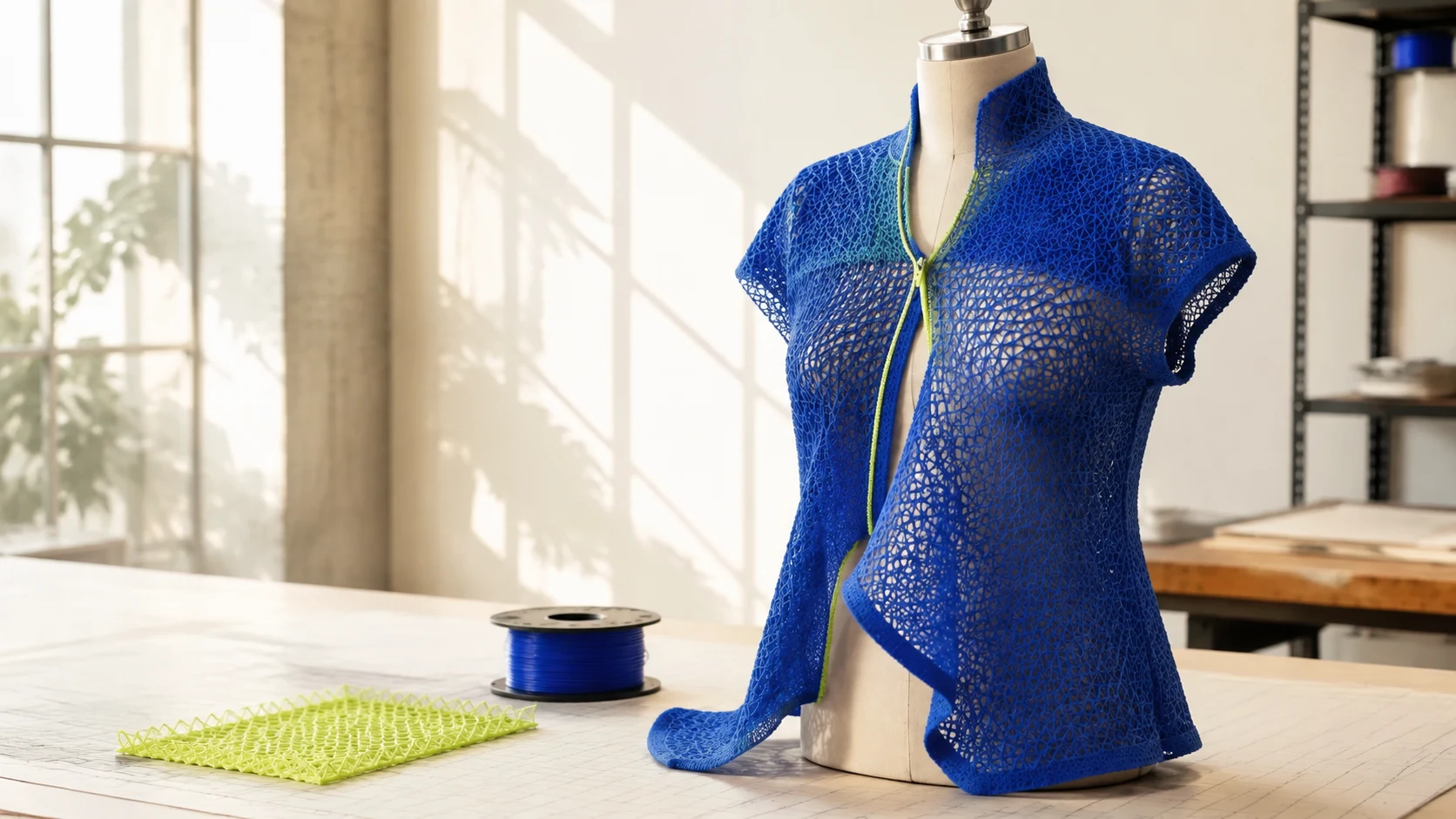
A printer can already add a raised, multicolor structure to fabric. It can make a lattice midsole, a custom brace, a chain-mail-like panel, or a runway piece that would be difficult to mold or sew. That is enough to say 3D printing has entered fashion production. It is not enough to say that a printer is ready to replace the machines, materials, and skills that make an everyday shirt.
FashionMember's base case is that additive manufacturing becomes a durable specialty process for apparel during the 2030s, not the dominant way the world makes clothes. Under a strict definition of a 3D-printed garment, we estimate less than 1% of global apparel retail value by 2030, roughly 1–3% by 2035, and 2–5% by 2040. An upside case reaches 5–10% by 2040 if soft recyclable materials, automated finishing, print speed, and product economics improve together. Those are scenario ranges, not reported market shares.
The larger opportunity is hybrid: conventional fabric carrying printed structure only where it adds value. That may be a ventilation zone, protective area, closure, embellishment, shape-changing element, or made-to-measure support. In selected premium, performance, adaptive, costume, and protective categories, additive elements could take a much larger share than they do in apparel overall.
First, define what “printed clothing” means
Additive manufacturing builds an object from digital model data by joining material, usually layer by layer. That definition excludes two technologies often placed in the same headline.
Direct-to-garment graphic printing deposits ink on a finished textile; it does not build a three-dimensional product. Computerized whole-garment knitting shapes loops of yarn into a finished form. It is a powerful digital manufacturing system, but it is knitting rather than additive manufacturing. SHIMA SEIKI introduced its seam-free WHOLEGARMENT machine in 1995. MIT's 4D Knit Dress combines computerized tubular knitting, heat-active yarn, and robotic activation; even the project description calls 3D knitting “akin to” 3D printing rather than the same process.
For this outlook, strict additive apparel means a garment whose body or functionally significant panel is built layer by layer from polymer, resin, powder, gel, or another printable feedstock. Hybrid additive apparel means a conventional textile with a three-dimensional printed element bonded to or integrated with it. Footwear is discussed as evidence of manufacturing maturity but excluded from the apparel-share estimate.
That boundary matters. A forecast that mixes printers, software, prototypes, midsoles, jewelry, knitted sweaters, and finished apparel can produce a large growth rate without telling a clothing company how many sellable garments will actually reach customers.
What is commercially real in 2026
Three levels of evidence are visible now.
Printed footwear components are the clearest scale proof. Adidas announced Futurecraft 4D in 2017 with a Carbon-produced lattice midsole and a target of more than 100,000 pairs by the end of 2018. That announcement is evidence of industrial intent and a consumer product architecture—not proof that all garments can follow the same cost curve. A midsole is one engineered component with a defined mechanical job. A shirt must manage drape, touch, heat, moisture, stretch, color, seams, laundering, repair, and multiple body movements across a much larger surface.
Direct-to-textile 3D printing is a commercial machine category. Stratasys currently markets its J850 TechStyle for printing full-color, multi-material structures directly on fabric, garments, footwear, and accessories. Its stated effective print area is 460 by 360 millimeters, while its fabric-handling system accepts material up to two meters wide. That is highly relevant to luxury surfaces and localized functions. It also reveals the present production logic: move fabric through a bounded print zone rather than print a complete soft garment in one uninterrupted build.
Fully printed wearable structures remain a development category. A 2025 laboratory study produced flexible, breathable lattice samples and measured tensile, bending, compression, thermal, and permeability behavior. The work advances material design, but a tested lattice sample is not yet a complete commercial garment with verified fit, skin contact, wash life, color life, manufacturing yield, repair, and end-of-life handling.
The technology is therefore commercial today, but the commercially mature product is usually a component, surface, accessory, or high-value special piece—not a low-cost everyday garment.
Why the shirt is harder than the shoe
Traditional textiles obtain softness and drape from thousands of fibers and loops that move relative to one another. Many additive systems instead produce a continuous polymer part. Designers can add hinges, rings, holes, meshes, and lattice cells to restore movement, but structure must then do the work that fiber and yarn already perform efficiently.
Five gates separate an impressive sample from repeatable apparel production.
- Body comfort. A garment must bend, shear, breathe, stretch, recover, and feel acceptable against skin. A structure can be technically flexible and still feel heavy, noisy, warm, tacky, or abrasive over a day of wear.
- Care durability. Adhesion between a printed polymer and fabric depends on polymer, yarn, weave, porosity, surface treatment, temperature, nozzle distance, speed, and post-treatment. A 2024 systematic review found encouraging washing results in some combinations, including one study in which the weakest tested material endured 25 cycles, but the results were not universal across fabrics and processes.
- Throughput and finishing. Print time, support removal, cleaning, curing, inspection, assembly, and rejected builds all enter the cost. Tool-free production helps customization and small runs; it does not automatically beat a mature knitting or cut-and-sew line at volume.
- Material and color system. Everyday apparel needs a broad palette, predictable touch, safe skin contact, stable color, stretch recovery, UV and chemical resistance, and reliable sourcing. Multi-material printing exists, but a sellable wardrobe requires more than a demonstration palette.
- Circularity and repair. Combining a polymer structure with cotton, polyester, elastane, coatings, or adhesives can make separation harder. Research on circular design treats detachability and material recovery as design requirements, not automatic benefits of printing.
Additive manufacturing can reduce cutting scrap for a suitable geometry. It can also consume support material, energy, cleaning inputs, and a feedstock that is difficult to recover. The environmental case has to be measured product by product against the process it replaces.
A realistic commercialization timeline
2026–2030: specialists prove repeatability. Expect more commercial use in footwear components, accessories, couture, costumes, adaptive products, protective zones, molds, tooling, samples, and direct-to-textile decoration. The important progress will be less theatrical: published care limits, faster setup, repeat orders, stable color, fewer rejected builds, and clearer repair or take-back paths. Strict additive clothing remains below 1% of global apparel retail value in our base case.
2030–2035: hybrid garments become a recognizable premium category. If material suppliers can offer softer, safer, more washable and more recoverable systems, printed functions can move from a runway statement into premium sportswear, outerwear, adaptive clothing, and made-to-measure products. Local service bureaus may let smaller brands buy capacity without owning a machine. Strict additive apparel reaches roughly 1–3% in the base case; hybrid additive details spread more widely.
2035–2040: economics decide whether the category stays niche. The decisive comparison will be cost per accepted, cared-for garment—not print speed in isolation. Automated scanning, generative engineering, robotic handling, inspection, and finishing could make personalized production practical. If those systems improve while feedstocks become circular and comfortable, strict additive apparel could reach 5–10% of apparel retail value in an upside case. Our base case remains 2–5%.
After 2040: dominance is possible only under a different material system. A global share above 20% would require additive clothing to approach traditional textiles on comfort and care while winning on total cost, response time, customization, or performance. It would also require distributed standards for files, body data, product safety, recycling, and quality control. There is no current evidence strong enough to make that the central forecast.
How much market power could it gain?
Market share by retail value will probably rise faster than unit share because early products carry premium prices. Even so, “dominance” is the wrong base-case expectation. The likely structure is a portfolio of manufacturing methods.
- Low case for 2040: below 1%. Materials remain uncomfortable or difficult to recover, and printing stays concentrated in samples, art, and isolated components.
- Base case for 2040: 2–5%. Hybrid products grow, a small strict-additive apparel category persists, and conventional knitting and cut-and-sew keep their cost and comfort advantage for most units.
- Upside case for 2040: 5–10%. Soft multi-material systems, automation, reliable laundering, local production, and circular recovery improve together. Premium and functional categories adopt first.
- Dominance case: above 20%. This is low probability before 2040. It needs a step-change in feedstock, speed, energy, finishing, and consumer experience—not only better design software.
A niche can still matter economically. A process does not need to make every T-shirt to control a profitable layer of custom fit, protection, ventilation, personalization, or rapid local production. Footwear also shows that an additively manufactured component can become the product's visual and technical signature while most of the item remains conventionally made.
The four signals that would change this forecast
FashionMember would move the timeline forward only after seeing evidence in four places.
First, a brand publishes standardized wear and care results across multiple production lots, not only a hero sample. Second, a factory reports accepted units per machine-hour including finishing and scrap. Third, a material system demonstrates safe use and a credible recovery route at commercial volume. Fourth, customers reorder the product after living with it, rather than buying once for novelty.
The forecast moves backward if printed structures crack, separate, discolor, trap heat, resist repair, or require hand care that conflicts with the product's intended use. It also moves backward if customization creates expensive file preparation or body-data risk without lowering returns.
For an independent brand, the sensible entry point is a bounded function: one closure, flexible panel, texture, reinforcement, accessory, or made-to-measure element with a measurable job. Compare it with embroidery, molding, laser cutting, heat transfer, knitting, and sewing on total accepted cost and care life. A printer is a production option, not a business model.
The commercial question has already changed from “Can a printer make something wearable?” to “Which part of a garment is valuable enough to print?” Through 2040, that is where 3D printing is most likely to build real market power.
Method and limits
The ranges above are FashionMember editorial scenarios for the share of global finished-apparel retail value associated with strict additive apparel. They exclude footwear, jewelry, printer and material sales, software, tooling, prototypes, conventional graphic printing, and computerized 3D knitting. They are not measured market data, a CAGR calculation, financial advice, or a prediction about any company.
We scored four production routes against five commercialization gates: sellable products, industrial equipment, repeatable wear/care evidence, production economics, and repeat customer demand. Footwear components scored highest but sit outside the denominator. Direct-to-textile structures ranked next. Fully printed everyday garments ranked lowest because current evidence is concentrated in design pieces and laboratory structures. The scenario should be updated when comparable production, durability, and sales data become available.
Sources and verification
- NIST: What is Additive Manufacturing? — official layer-by-layer definition and manufacturing context.
- Stratasys: J850 TechStyle — current first-party machine capabilities, applications, and print-area specifications; commercial claims are treated as vendor statements.
- Adidas: Futurecraft 4D announcement — first-party description of the Carbon-manufactured midsole and the company's 2017 scale target; the target is not treated as independently verified output.
- MIT Self-Assembly Lab: 4D Knit Dress — primary project description separating computerized knitting and robotic activation from additive garment printing.
- SHIMA SEIKI annual report — first-party history of WHOLEGARMENT computerized seamless knitting.
- Popescu and Amza: systematic analysis of adhesion studies — peer-reviewed review of polymer-to-textile adhesion, washing, abrasion, materials, and process variables.
- Liu et al.: breathable flexible lattice structures — 2025 laboratory study of mechanical and wearable properties; not a finished-garment market test.
- Sitotaw et al.: Additive Manufacturing and Textiles—State-of-the-Art — open technical review of printing on textiles, flexible printed structures, materials, applications, and limitations.
- Lekeckas et al.: textile printing within circular design — testing and design discussion emphasizing wear performance, separation, and recycling at end of life.
How this story was checked
- Sources
- 9 linked records · View list
- Last verified
- Reporting desk
- FashionMember AI & Retail Desk
- Format
- Explainer
- AI assistance
- Used with editorial review; disclosed above.