An AI policy that says “use tools responsibly” gives a fashion team almost no help when a buyer pastes a vendor spreadsheet into a chatbot, a marketer generates a synthetic model, or a manager wants software to score job applicants. The risks, evidence, affected people, and reversibility are different in each case.
A usable policy connects principles to decisions. It says who owns the use, which inputs are allowed, how outputs are checked, what must be disclosed, what evidence the vendor supplies, who can stop the system, and what happens when something goes wrong.
The policy should be short enough to use and backed by records detailed enough to audit.
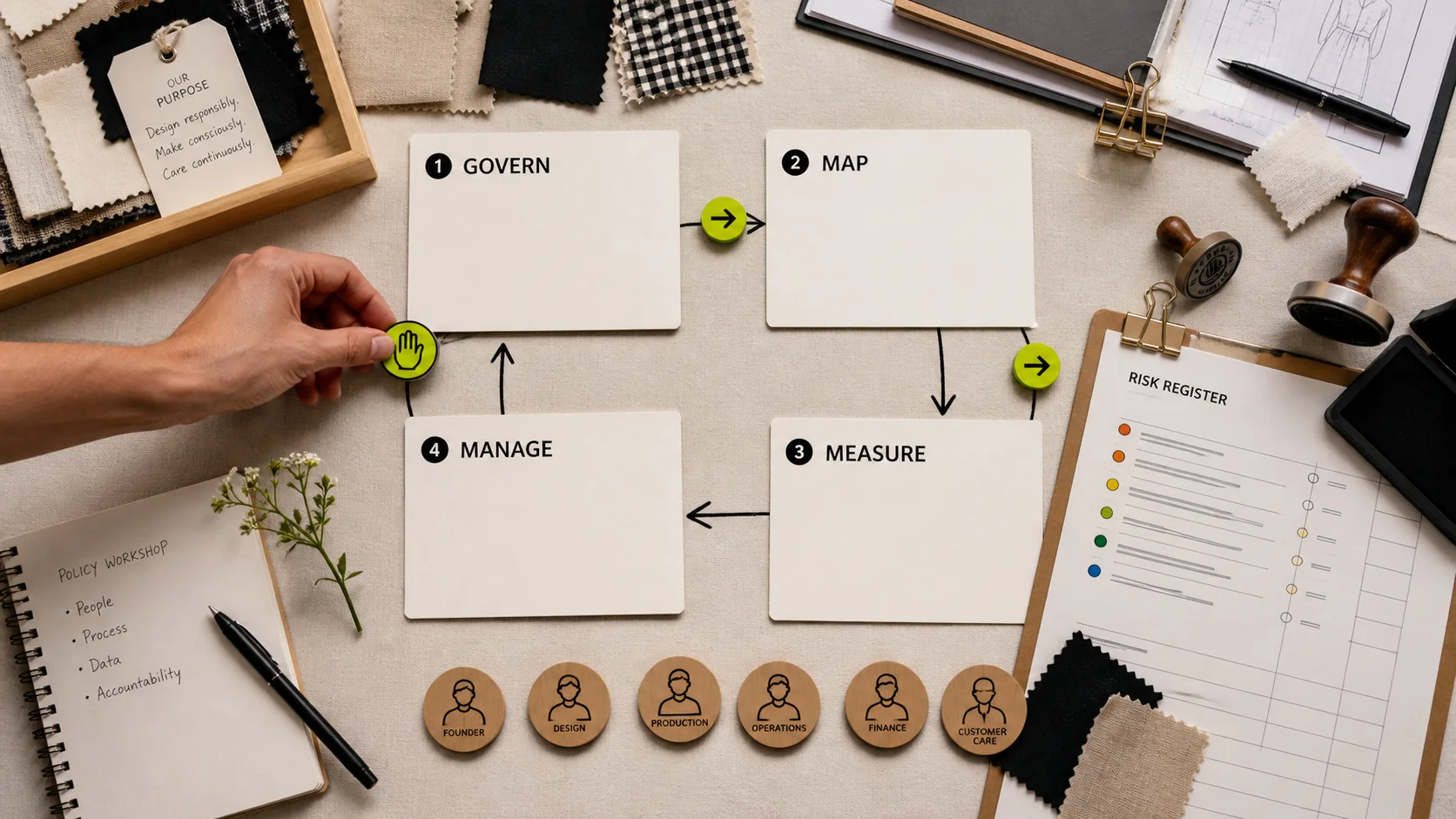
Organize the policy around four functions
The NIST AI Risk Management Framework Core organizes work into Govern, Map, Measure, and Manage. NIST describes the framework as voluntary and adaptable, not a universal checklist. That distinction matters for a small fashion business: copy the discipline, not the size of a federal program.
Govern: assign authority before buying tools
Name an accountable business owner for each approved use case and someone who understands the operational or technical workflow. Maintain an inventory of tools, models, vendors, integrations, data classes, contract dates, and approvals.
Set a few non-negotiable rules. Examples may include:
- no customer, employee, applicant, supplier, or unreleased product data in unapproved tools;
- no product-performance, sustainability, origin, legal, or safety claim without authoritative evidence and human approval;
- no synthetic person presented as a real customer, worker, model, founder, or interview subject;
- no automated consequential decision without defined human review, notice where required, and an appeal or alternative route;
- no launch without a named incident and shutdown process.
The policy also needs a protected way for employees and contractors to raise concerns. Governance fails if the only person who can question the system is the person whose performance depends on launching it.
Map: document the real workflow
“We use AI for marketing” is too broad. Define the task: drafting product-description variants from an approved fact sheet; clustering anonymous search terms; producing non-documentary mood-board concepts; or recommending reorder quantities for human review.
Then map inputs, outputs, integrations, affected people, human decisions, third-party components, and plausible misuse. Record what happens when the tool is wrong.
A mood-board experiment using cleared internal images may be reversible. A system that rejects a worker, changes a customer’s price, publishes a false material claim, or exposes a supplier’s confidential line sheet is not. The policy should require stronger review as impact and irreversibility increase.
NIST’s Core specifically includes third-party software and data in risk mapping. A fashion brand does not outsource accountability simply because a model arrives through a familiar software subscription.
Measure: test the use, not the demo
Vendor demonstrations show selected conditions. Brand evaluation should use representative work.
For product copy, build a test set containing complete fact sheets, missing values, conflicting fields, unusual care instructions, regulated claims, and near-identical variants. Measure unsupported claims, omitted material facts, wrong variant details, tone deviations, accessibility problems, and editing time.
For image generation, test anatomy, product fidelity, protected marks, culturally sensitive styling, disclosure placement, and whether a reviewer can distinguish the concept image from product evidence.
For forecasting, compare against a simple baseline and include uncertainty, bias, stockout costs, and the consequence of over-ordering. A more complex model is not automatically a better business decision.
Document what was not tested. NIST’s Generative AI Profile notes that suggested actions depend on actor and use context. A test that supports one workflow should not become a blanket approval for every department.
Manage: make a real decision
After mapping and measurement, decide to proceed, limit, redesign, pause, or stop. Attach controls to the remaining risk: smaller pilot scope, data minimization, additional review, restricted access, a slower publication path, or a contractual change.
Set monitoring and renewal dates. Model behavior, vendor terms, integrations, laws, organizational needs, and employee practices change. A tool approved for internal brainstorming should not quietly expand into customer-facing decisions.
Build a tiered use-case register
A simple register can group uses by impact.
Tier 1 — reversible assistance: transcription of a consented internal meeting, formatting approved copy, or generating internal ideation that will not be represented as fact. These still need data and rights rules, but approvals can be lightweight.
Tier 2 — public or commercial content: product copy, campaign imagery, customer service, translation, personalization, or pricing support. Require documented evidence, disclosure decisions, representative tests, named human approval, monitoring, and correction routes.
Tier 3 — consequential or sensitive use: employment, worker monitoring, credit, eligibility, access, safety, biometric inference, individual pricing, or decisions using sensitive personal data. Do not treat a general policy as approval. Require specific legal and domain review, executive accountability, affected-party protections, and a defensible alternative to automation.
The tiers are an internal design tool, not a statement about legal classification. Applicable law depends on jurisdiction, data, role, and use.
Put truth and disclosure into the workflow
The FTC’s AI claims guidance tells businesses to avoid exaggerating what an AI product can do, claiming it is better without adequate proof, or ignoring foreseeable risks. That applies to a brand describing its own system and to a vendor selling one.
For fashion, the policy should identify claims that always require evidence: material composition, environmental benefit, labor condition, country of origin, performance, health or safety effect, comparative price, availability, and model or customer identity.
Disclosure should be specific. “AI-assisted” may be enough for an internal workflow log but too vague for a synthetic campaign image. Tell the audience what is synthetic or materially altered when that information affects interpretation.
Write contracts and exits into governance
The use-case owner needs to know whether the vendor retains inputs, trains on them, changes models without notice, uses subprocessors, offers audit logs, supports deletion, provides incident notice, and lets the brand export its data. Sales-page statements are not a substitute for contract language.
Governance also needs an exit. Identify dependencies, exports, deletion evidence, replacement workflows, and communications before the tool becomes essential. A brand that cannot stop using a system does not fully control the risk.
A starter policy, with an explicit boundary
FashionMember’s working template is stored in content/resources/FM-046-fashion-ai-governance-starter.md. It contains the four functions, minimum records, human-review requirements, monitoring, incident, appeal, and shutdown routes.
It is educational material, not legal advice or a ready-to-sign corporate policy. Before adoption, a business must tailor it to actual uses and obtain the qualified legal, HR, privacy, security, labor, and accessibility review those uses require.
Where policy still needs judgment
This article translates voluntary risk frameworks into a small-company operating model. It does not determine legal obligations, approve a vendor, or evaluate a specific fashion brand. NIST’s AI RMF is being revised, and laws and regulator guidance can change. The template must be reviewed against current requirements in every relevant jurisdiction.
Sources and verification
- NIST AI RMF Core — Govern, Map, Measure, and Manage functions; lifecycle, third-party, oversight, and monitoring outcomes.
- NIST AI RMF Generative AI Profile — generative-AI risks and context-dependent suggested actions.
- NIST AI RMF Playbook — voluntary implementation suggestions aligned to the Core.
- FTC: Keep your AI claims in check — substantiation, comparative claims, foreseeable risks, and shared responsibility.
- FTC: Advertising and marketing basics — truthfulness, non-deception, and evidence for claims.
How this story was checked
- Sources
- 5 linked records · View list
- Last verified
- Reporting desk
- FashionMember AI & Retail Desk
- Format
- Analysis
- AI assistance
- Used with editorial review; disclosed above.