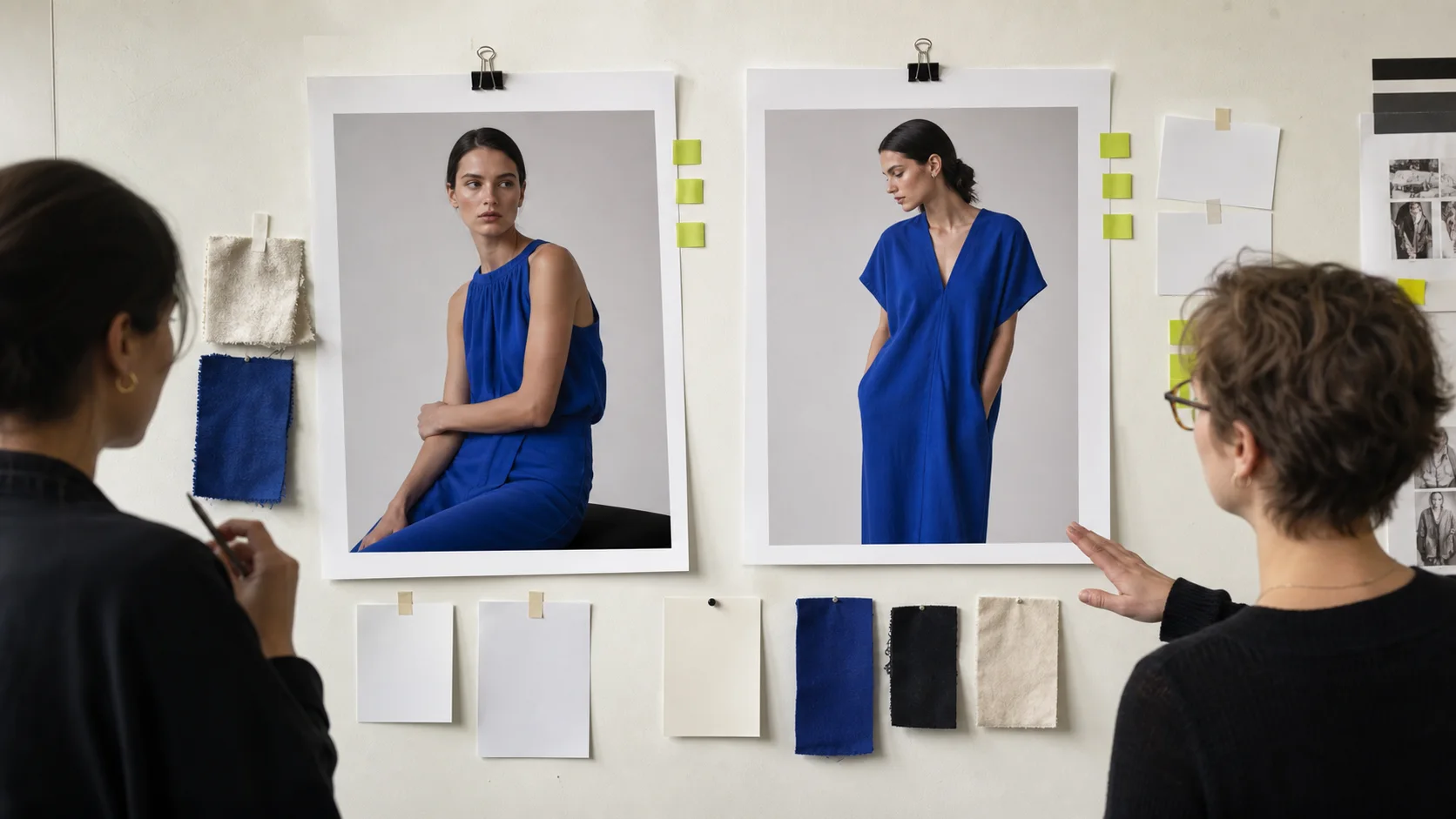
An AI-generated person can wear a fictional garment in seconds. That technical convenience creates a new editorial responsibility: a customer may reasonably interpret the image as evidence of how a real product, on a real body, in a real setting, actually looks.
The central trust question is not “Was AI used?” It is “What conclusion could a reasonable viewer draw from this image, and is that conclusion supported?”
Separate four kinds of image
Documentary product photography
The image records the actual sellable item. Color, construction, proportion, hardware, pattern placement, and included components should match what the customer receives. Ordinary retouching may clean dust or balance exposure, but it should not materially rewrite the product.
AI-assisted product photography
An actual product image is extended, relit, or placed into a new background. The underlying product remains real, but the environment or presentation is synthetic. The production record should state what changed.
Synthetic campaign imagery
The model, garment, setting, or all three are generated. This can function as concept art or campaign expression, but it is not reliable fit or product evidence unless every relevant product detail has been checked against the sellable item.
Virtual try-on or personalized visualization
The image estimates how an item may appear on a person. It should be presented as a visualization, not a fitting result or guarantee. Fabric behavior, scale, body geometry, and garment ease may be approximated.
Customers need different disclosures for these different uses. “Made with AI” is too blunt when only the background changed and too vague when the person and garment are entirely fictional.
Product truth is the first gate
Before approving a synthetic fashion image, compare it with the product specification and physical sample:
- silhouette and length;
- neckline, collar, lapel, and closure;
- seam, dart, pocket, and panel placement;
- material texture, weight, sheen, and transparency;
- print scale and placement;
- hardware count, color, and shape;
- color under a defined reference condition;
- included accessories and styling pieces.
If the visual invents a pocket, removes a zipper, lengthens a hem, changes the fiber appearance, or implies water resistance that the item does not have, a caption cannot repair the product claim. The image needs correction or should not be used to sell the item.
FTC advertising guidance states that advertising claims must be truthful, not deceptive or unfair, and evidence-based. The same principle applies to visual claims. A picture can communicate a claim even when no sentence does.
Do not fabricate social proof
A synthetic person should not be presented as a customer, influencer, designer, craftsperson, employee, or expert who used or endorsed the product. The FTC’s revised Endorsement Guides explicitly address virtual influencers and emphasize truthful endorsements and clear disclosure of material connections.
If a fictional avatar is part of a brand world, identify it as fictional. Do not attach invented biography, testimony, before-and-after results, or quotes that a viewer could mistake for lived experience.
Build a three-layer disclosure
Visible context. Place plain-language information where the image is encountered: “AI-generated campaign image; fictional model and setting.”
Detailed caption or disclosure. Explain which elements are synthetic and whether the actual product was used as a reference: “The model and studio are AI-generated. Garment details were checked against style ABC-123; this image is not fit evidence.”
Machine-readable provenance. Preserve embedded metadata and Content Credentials when available. Google’s Merchant Center documentation requires specific metadata for generative-AI product images and offers platform label settings for created or edited assets.
These layers serve different audiences and survive different parts of the distribution chain. Metadata alone may disappear in a screenshot or export. A visible label alone may be cropped. Keep both when the risk warrants it.
What Content Credentials can and cannot prove
The C2PA specification supports tamper-evident provenance records describing an asset’s origin, edits, and use of AI. Its own explainer is careful about the limit: a valid credential does not establish that the depicted scene is true or that every assertion is accurate. It shows that the provenance information is structurally valid, associated with the asset, and signed within a trust framework.
Use provenance as evidence of process, not as a substitute for product inspection, fact-checking, consent, or legal review.
Consent and identity
Do not generate a recognizable person without appropriate authority. A contract for ordinary photography may not authorize model training, identity simulation, future synthetic variations, or reuse outside the original campaign.
Keep a rights record for every input:
- who owns the photograph or design;
- what the license permits;
- whether the person consented to synthetic edits or identity use;
- whether the garment design and artwork can be reproduced;
- which tool processed the asset;
- where the output may be used and for how long.
When the answer is uncertain, use a fully fictional person and unbranded product concept—or do not generate the asset.
A pre-publication trust review
- Purpose: Is the image inspiration, campaign expression, product evidence, or fit visualization?
- Product check: Which physical sample or approved specification was used?
- Identity check: Is every depicted person fictional or properly authorized?
- Claim check: What performance, origin, scarcity, sustainability, or endorsement might the image imply?
- Disclosure check: Can viewers understand what is synthetic without opening a policy page?
- Accessibility check: Does the alt text disclose synthetic status when that context matters?
- Metadata check: Were provenance and source-type tags preserved?
- Archive check: Are prompts, inputs, versions, approvals, and final uses recorded?
- Channel check: Does the destination platform require an additional label?
- Removal check: Can the brand find and correct every live use if a product detail is wrong?
Trust comes from correction, not perfection
NIST’s Generative AI Profile treats risk management as a lifecycle practice of governing, mapping, measuring, and managing—not a one-time label. Fashion teams should monitor complaints, returns, product-detail corrections, and cases where viewers mistake synthetic images for real evidence.
AI can expand the visual vocabulary of a small brand. It should not expand the distance between what a customer sees and what the customer receives.
Sources and verification
- FTC: Advertising and Marketing Basics, accessed August 31, 2026.
- FTC: Updated Endorsement Guides, June 29, 2023.
- Google Merchant Center: Use AI content label settings and disclosures, accessed August 31, 2026.
- C2PA: Content Credentials Explainer, accessed August 31, 2026.
- NIST: AI RMF Generative AI Profile, published July 26, 2024; updated April 8, 2026.
How this story was checked
- Sources
- 5 linked records · View list
- Last verified
- Reporting desk
- FashionMember AI & Retail Desk
- Format
- Analysis
- AI assistance
- Used with editorial review; disclosed above.