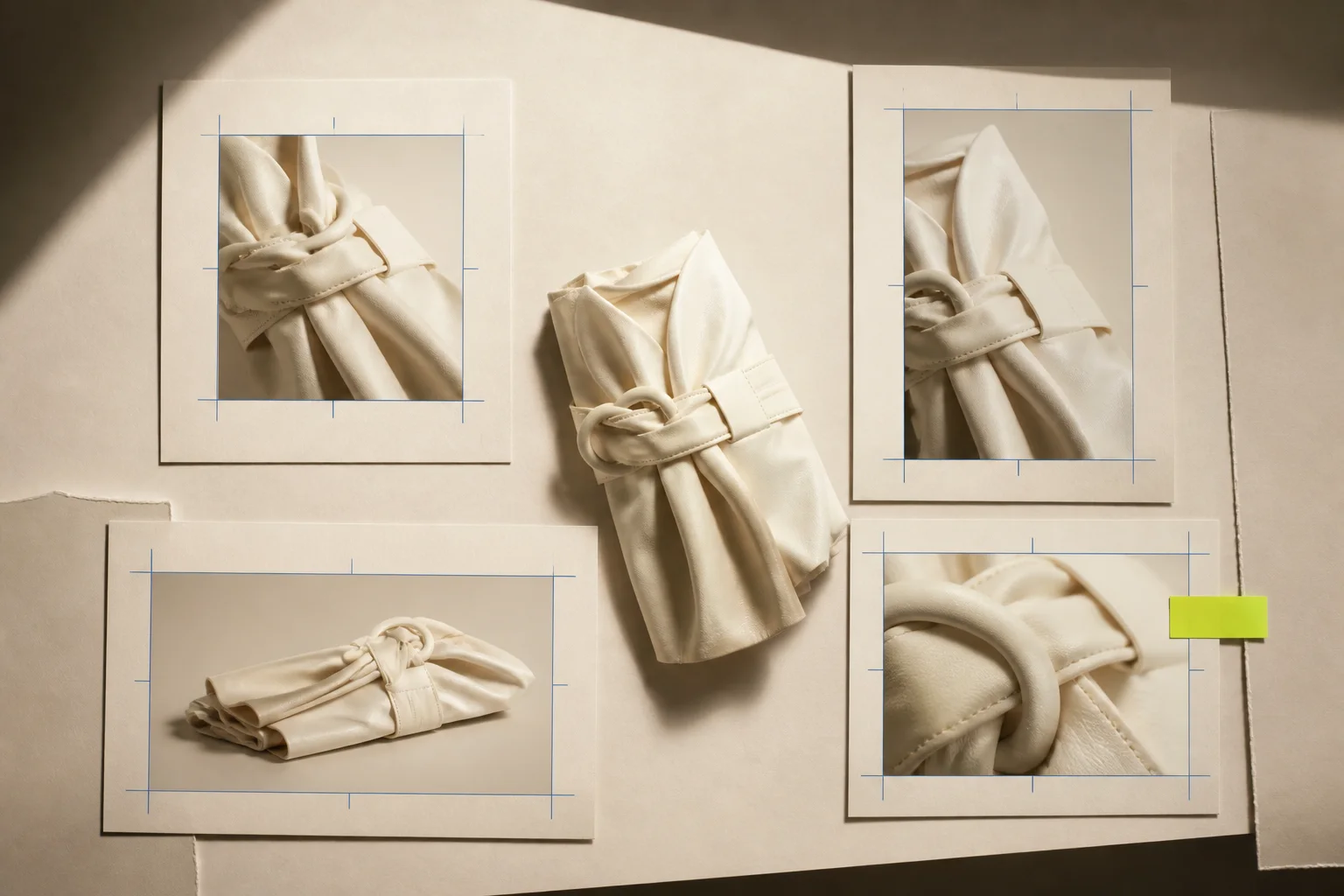
One clean product photograph can become a square shop tile, a portrait social crop, a landscape newsletter image, a detail view, a line-sheet thumbnail, and an editorial composition. Generative tools make those variations faster. They also make it easier to lose the boundary between a photographed fact and a synthetic invention.
The safe workflow does not begin by uploading the image and asking for a campaign. It begins with a source record: what the file depicts, who created it, who owns it, what permissions apply, which product facts are verified, and which transformations are allowed.
Establish the source asset
Assign an asset ID and preserve the original file. Record a cryptographic hash, creator, owner, license or assignment, usage scope, territory, term, product and variant, model or property releases if applicable, and any restrictions imposed by a photographer, agency, platform, or contract.
Do not assume that owning a physical product grants image rights, that receiving a file grants permission to alter it, or that a tool’s terms resolve third-party rights. A product photo may include a person, artwork, packaging, logo, location, or styling element with separate permissions.
Create a factual visual inventory. Note only what is verified: silhouette, construction, visible color, material if documented, hardware, print, and proportions. Mark claims that the image cannot establish, including sustainability, performance, comfort, origin, durability, fit across bodies, and exact color on every display.
Write a transformation matrix
Every derivative needs a purpose, ratio, allowed edits, prohibited edits, reviewer, and disclosure. A useful matrix distinguishes four operations.
Crop and resize preserve the photographed content while changing composition. Even here, the crop must not remove a warning, label, qualification, or feature necessary to understand the product.
Cleanup may remove dust, extend a neutral background, or correct exposure within an approved range. It should not repair a construction defect, change texture, improve fit, or make a material appear more luxurious.
Visualization can test a proposed color, background, or styling direction. It is not evidence that the variation exists. Keep it out of a purchasable listing unless the exact relationship between visualization and product is clear and platform rules permit the use.
Composite or generative context invents new pixels and may create lighting, shadows, objects, bodies, environments, labels, or product details. Treat it as synthetic editorial artwork. Prohibit the addition of logos, endorsements, readable claims, real places, real people, or unverified product features.
Preserve identity across the set
The source product is the invariant. Compare every derivative against a checklist for silhouette, seam placement, closures, pockets, hardware count, print repeat, color family, proportions, and visible defects. A beautiful image that changes the collar, adds a pocket, or removes a seam is a different product representation.
Use side-by-side review at high resolution. Record the model and tool version, prompt, negative constraints, seed or generation identifier when available, source asset ID, operator, date, transformation, crop, and approval. Store rejected variants as evidence of the decision, not as reusable assets.
Do not use visual similarity alone as approval. A reviewer needs the product specification or physical sample for commerce-critical images.
Put rights and provenance in the file’s journey
C2PA’s Content Credentials specification describes a system for cryptographically bound provenance information that can record an asset’s history and changes. Its explainer also makes an essential distinction: provenance can show whether recorded history is well formed and resistant to tampering; it does not decide whether a claim is true.
That makes provenance one layer of the workflow. A complete project record should preserve the source master, approved derivatives, source hash, tool record, prompt, actions, reviewers, rights basis, and public disclosure. When the production chain supports Content Credentials, test whether the credential survives optimization, content delivery, download, and reupload.
Also keep rights metadata that readers and search systems can use. Google’s official image metadata guidance supports structured data or embedded IPTC fields for creator, credit, copyright, and licensing information. It warns that conflicting structured and embedded records can be resolved in favor of structured data. The team must therefore keep them synchronized.
Treat alt text as editorial work
Alt text is not a generated keyword list. WCAG 2.2 requires text alternatives for non-text content when an equivalent purpose is needed, with context-dependent exceptions. Assign a person to write and review the text after the image is final.
For a product image, describe the relevant visible product and view. For an editorial composite, include the content needed to understand the article and identify it as an illustration when that distinction matters. Do not hide an advertising claim in alt text, and do not use the same description for every crop when the informational content changes.
The HTML, caption, page copy, structured data, feed, and embedded metadata must agree. A synthetic image labeled only in a buried policy is not a useful reader-facing disclosure.
A reproducible six-asset preflight
FashionMember created six fictional derivative records in content/data/FM-017-editorial-asset-set.csv. The script scripts/fm017-asset-set-preflight.php checks whether each record is marked fictional and has a source ID, source hash, rights basis, transformation, aspect ratio, claim-safe state, alt-text owner, provenance record, and human approval.
Four assets route to ready for editorial review. Two route to hold. One proposed lifestyle composite has unknown rights, no assigned alt owner, no complete provenance, and an open claim review. A proposed colorway visualization has not passed claim review or human approval.
The script does not inspect pixels, verify rights, validate a C2PA signature, judge accessibility, compare a real product, or approve publication. It proves only that a conservative preflight can stop incomplete records before export.
Design the production path
A compact workflow can run as follows:
- Ingest the source master without modification and create the rights record.
- Photograph or verify the physical product against the source record.
- Approve the transformation matrix and prohibited edits.
- Generate one derivative at a time; do not request an uncontrolled pile of variants.
- Compare the derivative with the source and product facts.
- Complete claim, rights, accessibility, disclosure, and metadata review.
- Export a named master and web rendition while preserving the original generation.
- Test the actual CMS, CDN, structured data, feed, and download behavior.
- Publish only approved uses; archive or delete rejected public renditions according to policy.
- Revoke or replace assets when a right, claim, product, or platform condition changes.
Measure accepted assets per hour, correction categories, altered product details, missing disclosures, metadata survival, accessibility defects, and rejected exports. Do not measure success by the number of images generated.
What remains to verify
This article does not use a real product photo or report a completed editorial set. An operational case study would require a project-owned or appropriately licensed source, written permissions, comparison with the physical product, a test of Content Credentials and IPTC preservation through the actual web pipeline, accessibility review, and confirmation of current platform policies.
One photo can support many useful assets. The scalable part is not unlimited generation; it is a consistent record of what stayed true, what changed, who approved it, and what the reader is told.
Sources and verification
- C2PA Content Credentials specification — official technical specification for cryptographically bound asset provenance.
- C2PA and Content Credentials explainer — official explanation of provenance value and limits.
- Google Search Central: Image metadata — official structured-data and IPTC guidance for creator, credit, copyright, and licensing information.
- Google Search Central: Image SEO best practices — official guidance on image elements, page context, filenames, alt text, formats, and image quality.
- W3C Web Content Accessibility Guidelines 2.2 — official Recommendation used for text-alternative and accessible-interface requirements.
- IPTC Digital Source Type vocabulary — official controlled vocabulary for digital-media source types.
How this story was checked
- Sources
- 6 linked records · View list
- Last verified
- Reporting desk
- FashionMember AI & Retail Desk
- Format
- Analysis
- AI assistance
- Used with editorial review; disclosed above.