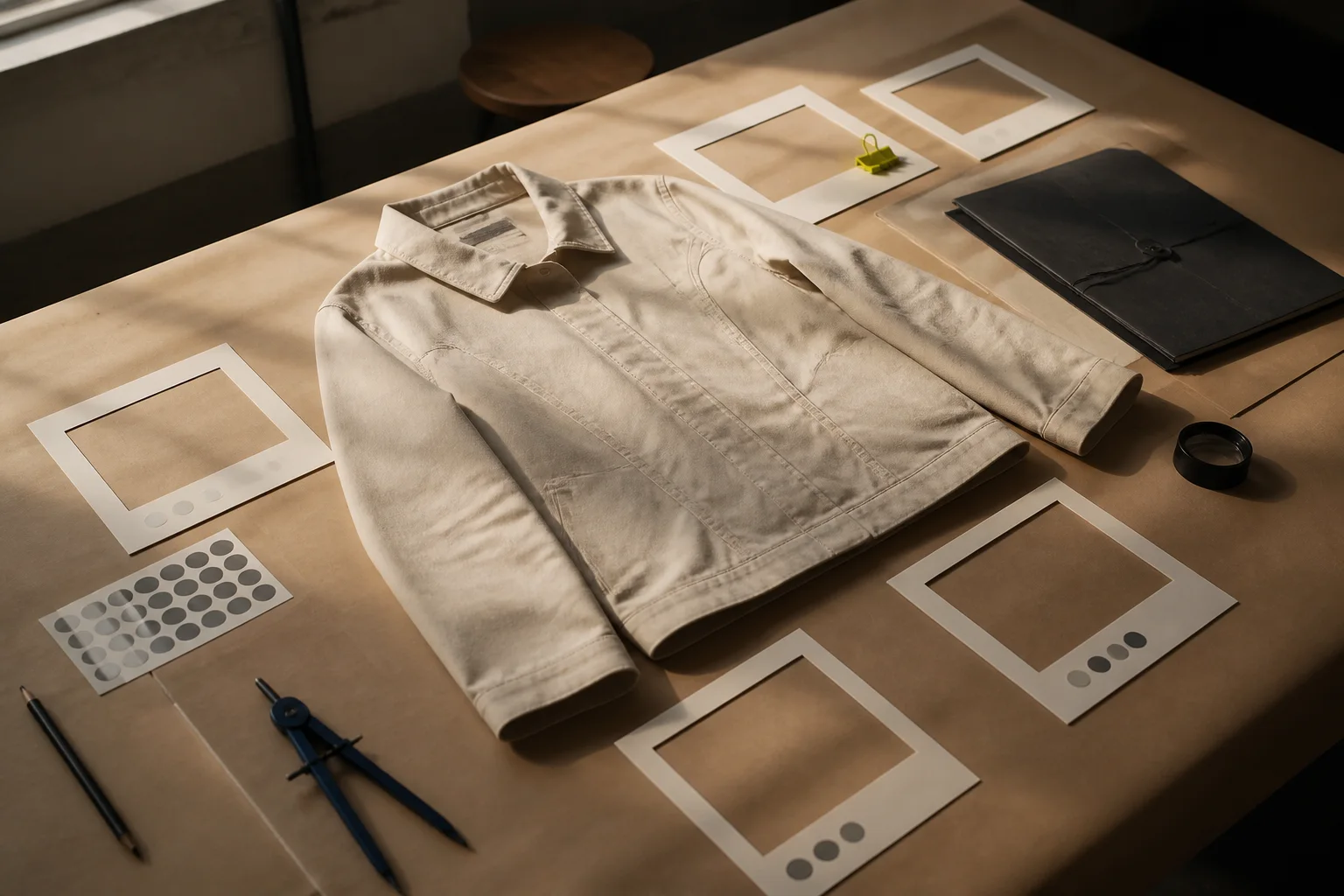
A camera can find a visual pattern. It cannot decide, by itself, what a brand is willing to ship.
That distinction should shape every computer-vision quality project. The useful question is not whether a demonstration recognizes a skipped stitch. It is whether a documented capture-and-review system helps trained people find relevant defects under actual fabrics, colors, lighting, speeds, and production variation without weakening the existing quality plan.
For a small fashion business, the safest first role is triage. The system flags items or image regions for human review, while standard quality checks and release authority remain intact.
Define the inspection stage precisely
“Garment quality” combines different visual problems. Fabric inspection may look for holes, bars, slubs, stains, shade variation, print defects, or surface damage across a roll. Sewing-line inspection may look for skipped stitches, broken stitches, puckering, open seams, missing operations, or alignment. Finished-product inspection adds measurements, components, labels, symmetry, cleanliness, packaging, and workmanship.
A model developed for plain fabric on a controlled web is not automatically valid for a finished patterned garment. Write the use case as one bounded sentence:
> At the end of one sewing operation, under a fixed capture station, flag possible skipped or broken stitches on approved style-color combinations for trained human review.
The sentence names the stage, conditions, defects, product scope, and decision. It also excludes autonomous acceptance.
Build the visual standard before the model
Create a defect taxonomy with quality and production owners. Each code needs:
- a plain definition and excluded look-alikes;
- minimum observable size or severity where appropriate;
- accepted and rejected examples from authorized production;
- location and construction context;
- inspector action and escalation path;
- whether correction is possible;
- the measurement or workmanship standard that governs disposition.
ASTM D5430 describes procedures for visually inspecting and grading fabrics and notes that different point-assignment options can produce different reported values. The current standard must be acquired and applied by qualified parties if relevant; citing its title is not implementation.
Do not use a model label such as “bad seam” when inspectors cannot apply the same definition consistently. Measure agreement between trained reviewers, adjudicate disagreements, and preserve the source images and taxonomy version behind the reference decision.
Control image capture as part of the system
Performance depends on more than model weights. Record camera and lens, working distance, angle, resolution, exposure, focus, lighting geometry, line speed, background, fixture, garment tension, orientation, and trigger timing. Establish checks for blur, glare, shadow, occlusion, and missing views.
Create groups that represent deployment:
- dark, light, reflective, sheer, textured, and patterned materials;
- contrast and low-contrast thread;
- different seam types and stitch densities;
- trims, folds, prints, and construction details;
- clean items and realistic defect severities;
- expected equipment, operator, shift, and environmental variation.
A 2026 garment-inspection preprint reported limitations when moving from darker training fabrics to visually different colors, including light blue, silver, and fluorescent yellow. That study does not establish general performance, but it illustrates why a single aggregate score is weak evidence for a varied fashion line.
Evaluate errors by their operational cost
Use a frozen test set that was not used to choose the threshold. Report the number of cases, defect prevalence, group composition, labeling method, exclusions, and uncertainty.
At minimum, calculate:
- true positive: model flags a human-confirmed defect;
- false positive: model flags a human-confirmed clear case;
- false negative: model does not flag a human-confirmed defect;
- true negative: model does not flag a human-confirmed clear case;
- recall by defect and deployment group;
- precision and review workload;
- audit findings among unflagged items;
- capture failures and unusable images;
- decision time, reinspection, and rework.
Overall accuracy can look high when defects are rare. A small number of misses in a safety, durability, labeling, or high-cost category may matter more than many harmless false alerts. Set severity-specific thresholds and stop rules before the test.
A reproducible synthetic triage example
FashionMember created twenty fictional cases in content/data/FM-031-vision-qc-cases.csv. The script scripts/fm031-vision-qc.php treats a fictional human decision as the reference, calculates recall and precision by fabric group, and applies one routing rule: model flags go to human review; a declared sample of unflagged cases goes to audit; every item remains inside standard quality control.
The synthetic results vary sharply. Dark plain cases show 66.7 percent recall and 100 percent precision. Light plain cases show 100 percent recall and 66.7 percent precision. Patterned cases show 100 percent recall but only 33.3 percent precision. Reflective cases show 50 percent recall and 50 percent precision.
Those percentages come from five fictional cases per group and should not support any purchase or deployment. Their purpose is to demonstrate why group counts, false positives, and false negatives must remain visible. The script runs no model and includes no camera, line-speed, labor, or product-release test.
Keep people in the control design
Human review is not a phrase placed after the model. Define who receives the alert, what evidence they see, how much time they have, which standard they apply, how they record disagreement, and who can stop production or release.
Monitor whether the interface creates automation bias, alert fatigue, or pressure to clear items quickly. Inspectors should be able to identify an unflagged defect, override a false alert, report a new defect type, and flag poor capture without being penalized for disagreeing with the system.
Include workers and quality specialists in mapping the process. Evaluate changes in workload, pace, training, surveillance, privacy, ergonomics, and escalation. A camera positioned for defect detection should not quietly become a worker-scoring system.
Run a shadow pilot before operational use
In shadow mode, the system produces flags but does not change disposition. Compare its output with the existing process over representative production. Investigate every severe miss and sample unflagged cases.
NIST’s AI Risk Management Framework calls for documented test, evaluation, verification, and validation processes, representative conditions, uncertainty, monitoring, and independent or multidisciplinary review. Apply those principles to the complete system, including capture hardware, labels, model, threshold, interface, humans, and fallback.
Precommit decisions:
- continue: evidence meets group and severity limits with manageable review work;
- revise: capture or taxonomy problems can be corrected and retested;
- pause: a relevant group is underrepresented or reviewer agreement is weak;
- stop: severe defects escape, capture cannot be controlled, or the workflow harms quality or workers.
After a bounded deployment, monitor camera movement, lighting drift, style and material changes, defect mix, threshold changes, reviewer disagreement, alert volume, and audited misses. Reauthorize after relevant changes.
Computer vision is useful when it improves evidence and attention. It becomes dangerous when a confidence score replaces a quality decision that the system was never designed or validated to make.
Sources and verification
- NIST AI Resource Center — official AI RMF and testing, evaluation, verification, and validation resources.
- NIST AI RMF Core: Measure — official voluntary guidance on documented testing, representative conditions, uncertainty, monitoring, and review.
- ASTM D5430-26 — official current standard page for visual fabric inspection and grading; full implementation requires the standard and qualified review.
- AI Visual Inspection for Garment Production — 2026 preprint consulted for its reported generalization limitations across fabric colors; it is not treated as proof of production performance.
- RAW-FABRID dataset paper — primary dataset article consulted for controlled acquisition, annotation, metadata, and traceability concepts.
How this story was checked
- Sources
- 5 linked records · View list
- Last verified
- Reporting desk
- FashionMember AI & Retail Desk
- Format
- Analysis
- AI assistance
- Used with editorial review; disclosed above.