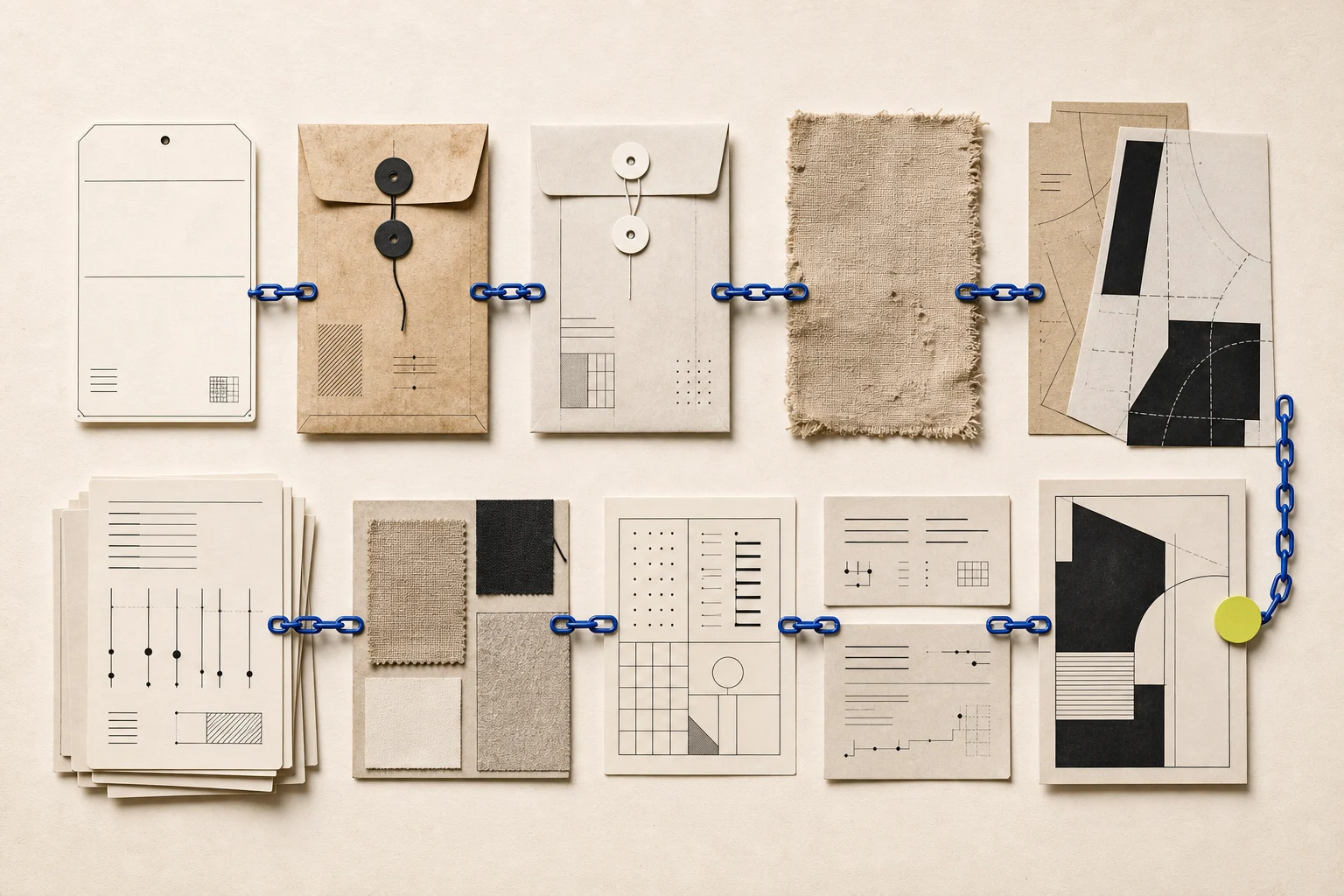
A reissue can preserve construction knowledge, reconnect a brand with its archive, make a scarce design available again, or show how material and fit have changed. It can also turn an uncertain object into a confident origin story, copy protected artwork or identifiers, repeat an exclusionary size system, or market a new product as environmentally responsible without evidence.
FashionMember reviewed a current first-party archival reproduction and official copyright, trademark, product-data, textile, environmental-claim, safety, and image guidance. It has not accessed an archive, verified provenance, cleared rights, interviewed designers, or physically compared an original with a reissue. This draft defines the ledger a responsible project needs.
Identify the archive object precisely
Start with accession or internal object ID, owner or custodian, object type, estimated and verified dates, maker, labels and marks, materials, construction, dimensions, condition, alterations, repair history, photographs, documentation, and source confidence. Distinguish an original production object from a sample, costume, later replacement, customer-altered piece, or reproduction.
“From the archive” is too broad when the product depends on one artifact. Record which element is referenced: silhouette, pattern, fit, fabric, weave, wash, pocket, hardware, graphic, color, label, packaging, or story. If the date or maker is uncertain, the public wording should remain uncertain.
Levi’s current 1955 501 product page is a useful first-party example. It calls the item an archival reproduction, identifies an exact product, describes source material from the company archive, and lists fit, details, material, care, and a Japanese mill relationship. Those statements still require attribution to Levi’s; FashionMember has not inspected the archive object or product.
Provenance and rights are different records
Physical custody does not automatically include copyright, trademark, publicity, privacy, photograph, or contractual rights. The product may contain artwork, a fabric print, label, patch, photograph, text, collaboration mark, or another identifiable contribution with a separate owner.
The U.S. Copyright Office explains that derivative works recast or adapt preexisting works and that registration for new material does not extend protection to the preexisting material. Its current Compendium also explains the useful-article framework and the limited treatment of clothing designs, while recognizing that separable pictorial, graphic, or sculptural features can raise different questions.
USPTO trademark guidance explains that marks identify the source of goods or services. An old label, logo, name, or product configuration may require current search and legal analysis. A brand should not use the federal registration symbol unless the relevant mark and goods support it.
Create a rights table for every copied, photographed, quoted, displayed, or marketed element: owner, basis, territory, channel, term, credit, modification permission, approval requirement, and expiration. “Vintage” and “publicly visible” are not rights statuses.
Publish a change ledger
A reissue is not less legitimate because it changes. It becomes more accountable when the changes are named. Compare original and new pattern, measurements, grade, fiber, yarn, weave or knit, weight, finish, color, hardware, thread, interlining, labels, closures, construction sequence, care, production country, packaging, and safety requirements.
Classify each change: unavailable original input, legal or safety requirement, durability improvement, size and accessibility revision, production capability, cost, care, environmental target, or creative reinterpretation. Attribute the decision to the appropriate designer, technician, archive, sourcing, legal, or production source.
Physical comparison should use a declared protocol and qualified specialists. An aged object has changed through wear, storage, cleaning, repair, light, and material degradation. It should not be treated as a perfect measurement of the original day-one product.
Responsibility includes contemporary users
Reproducing an old size range or access barrier without review is not neutral. Measure closure force and reach, pocket access, garment weight, seam pressure, movement, seated fit, sensory response, care burden, and alteration options. Develop and test an explicit grade rather than scaling from one vintage sample.
Material substitution also needs evidence. FTC textile guidance addresses fiber, origin, and responsible-business labeling for covered products, while the Care Labeling Rule addresses appropriate care instructions. Preserve supplier and production records for the sold version.
If “responsible,” “sustainable,” “lower impact,” “organic,” “recycled,” “local,” or “made in USA” appears in the reissue story, create a separate claim file. The FTC’s Green Guides explain that broad unqualified environmental benefit claims can be difficult to substantiate. An archive reference does not create an environmental benefit by itself.
Product and archive images need separate permission
Archive photography may be owned by the institution, photographer, donor, brand, or another party under specific access terms. A product image made today has its own authorship and releases. Record capture date, object ID, photographer, owner, license, permitted edits, credit, channel, term, and alt text.
Do not use ImageGen to recreate or “restore” a real archive object as documentary evidence. A generated diagram can explain the reporting process only when it contains no recognizable protected design and is clearly labeled non-documentary.
W3C image guidance helps decide whether an image is informative, functional, or decorative. Rights determine whether it can be published; alternative text does not cure missing permission.
Retail evidence tests the new object
Google Merchant Center’s product specification supports exact IDs, variants, condition, price, availability, and landing-page consistency. A reissue must be separated from vintage, used, repaired, and inspired-by products in the data.
An authorized retail study should record ordered and received units, sizes, time available, price, promotion, completed returns, repair issues, kept sales, and reorders. Interview buyers about the documented archive information they received. Customer questions can reveal whether “reissue,” “reproduction,” “replica,” “remake,” and “archive-inspired” are being understood differently.
The CPSC recall database should be checked for applicable product and component risks, but a search is not a safety certification. Exact materials, category, intended users, construction, and current requirements need qualified review.
A reproducible fictional reissue audit
FashionMember created four invented evidence packets in content/data/FM-114-responsible-reissue-audit.csv. The script scripts/fm114-responsible-reissue-audit.php checks whether a fictional packet documents archive-source identity, rights status, original-object provenance, reference scope, designer interviews, product identity, a change log, trademark and copyright review, material origin, construction specifications, physical comparison, size and accessibility, care and durability, environmental claims, an authorized retail sample, completed returns, image rights, a human editor, ownership, and complete object arithmetic.
Two complete fictional packets reach reissue-review; two remain on hold. Every object, maker, archive, product, material, right, designer, retailer, return, owner, and result is fictional. The audit does not establish provenance, permission, accuracy, quality, or environmental benefit.
A reissue is an argument with evidence
The strongest reissue does more than look old. It explains which object was studied, who owns what, what was retained, what changed, why it changed, how the current product was verified, and which claims remain limited.
Until archive access, provenance, rights, interviews, physical comparison, current product testing, returns, and human review are complete, FashionMember can publish the method and attributed public example. It cannot certify a responsible reissue.
Sources and verification
- Levi’s: 1955 501 Original Men’s Jeans — current first-party archival-reproduction, fit, material, construction, and care statements; not independent verification.
- Levi’s: Vintage 501 Collection — current first-party reissue assortment; dynamic and not a balanced market sample.
- U.S. Copyright Office: Copyright in Derivative Works and Compilations — authoritative derivative-work, preexisting-material, authorship, and claim context.
- U.S. Copyright Office: Compendium — authoritative registration-practice guidance for visual art, useful articles, and separable features.
- USPTO: Trademark Basics — current official mark, search, goods, specimen, registration, and maintenance context.
- Google Merchant Center: Product Data Specification — official current product, variant, condition, price, and availability guidance.
- FTC: Threading Your Way Through Textile and Wool Labeling — authoritative U.S. fiber, origin, and responsible-business labeling guidance.
- FTC: Green Guides — official environmental marketing guidance; not certification of any reissue.
- U.S. Consumer Product Safety Commission: Recalls — official recall search context; not a complete product-safety assessment.
- W3C WAI: Images Tutorial — authoritative image-purpose and alternative-text guidance.
How this story was checked
- Sources
- 10 linked records · View list
- Last verified
- Reporting desk
- FashionMember Editorial Desk
- Format
- Analysis
- AI assistance
- Used with editorial review; disclosed above.