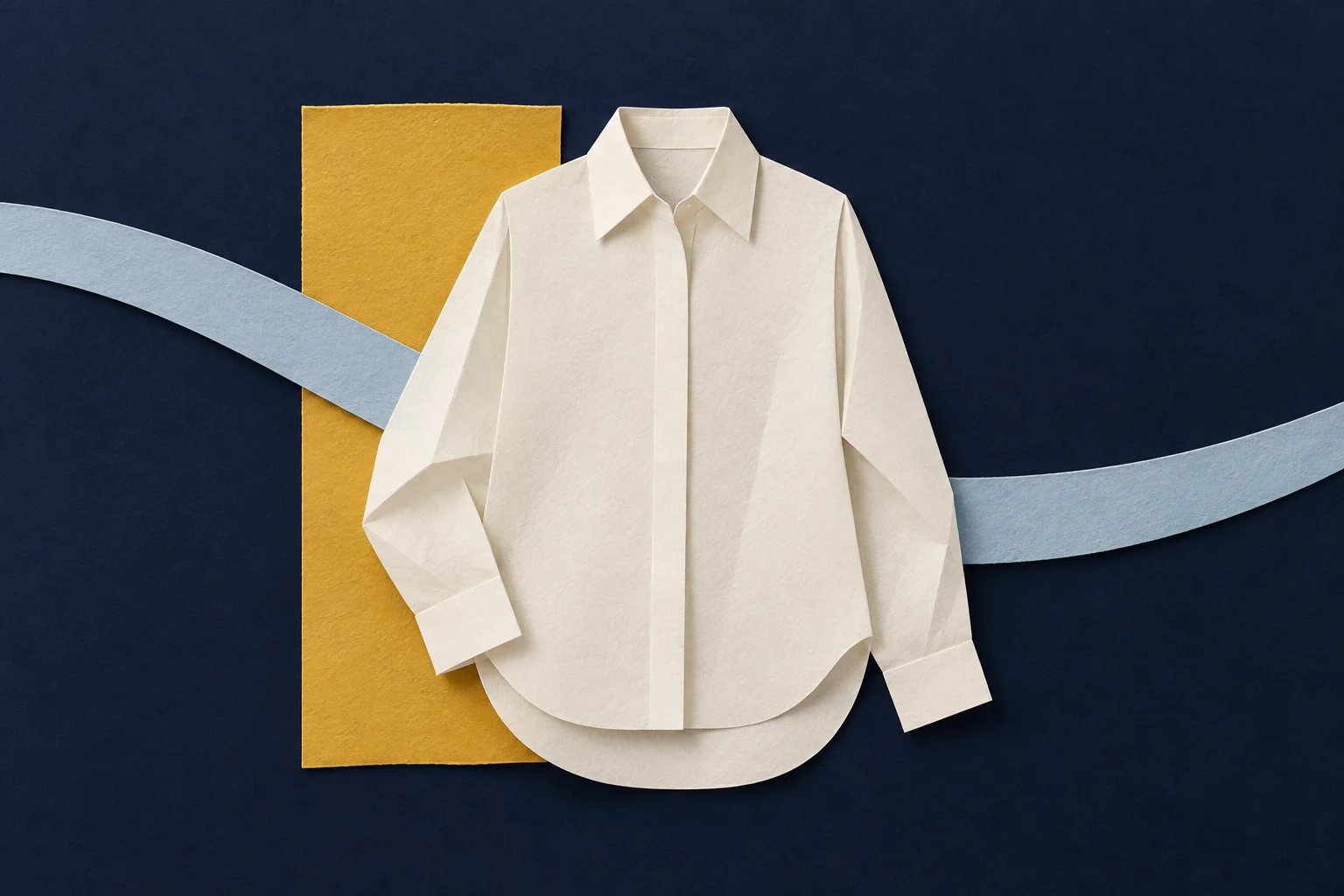
A shirt is easy to recognize and surprisingly difficult to reinvent. Change too little and the result needs a label to explain its relevance. Change everything and the qualities that made someone reach for a shirt in the first place can disappear. Between those extremes is a useful fashion problem: how much difference can a familiar garment carry?
J.Crew and Eckhaus Latta’s forthcoming collaboration makes that question timely. As checked September 12, J.Crew’s official page offers early shopping access on September 15 at 9 a.m. Eastern Time. It identifies Mike Eckhaus and Zoe Latta as the designers reinterpreting its established pieces through color and silhouette. The collection is still an upcoming launch at the time of writing, not a sales result.
FashionMember’s interest is in the design proposition rather than the countdown. A collaboration can invite people to reconsider clothes they already understand. Whether that reconsideration leads to a useful purchase requires a closer look than the announcement alone provides.
A recognizable garment gives the experiment somewhere to begin
In its September 11 coverage, Harper’s Bazaar describes a 27-piece collection and identifies shirting, barn jackets and knitwear among its components. Vogue’s same-day report traces the designers’ references to earlier J.Crew catalogs and describes the challenge of keeping the work connected to the retailer’s customer. Neither account constitutes our own inspection of the clothes.
There is an earlier chapter. The CFDA’s March 11 article documents Eckhaus Latta’s participation in J.Crew’s spring rollneck reinterpretation project alongside other designers. That provides context for the relationship. It does not establish how the expanded collection will perform, and we are not using reported sellouts as a measure of future demand.
The general design opportunity is clear enough without a forecast. Recognition supplies a starting point. A shopper understands approximately what a shirt, sweater or casual jacket is supposed to do. The designer can work against that expectation, but the expectation has to remain legible for the contrast to matter.
Think of the difference between recognizing an object and knowing exactly how it will look on you. Those are not the same experience. A garment can be familiar enough to approach while leaving something to discover in its proportions, its styling possibilities or the way it sits alongside clothes already owned. That is the territory this collaboration invites us to consider.
Look for the change that affects the whole outfit
For a reader assessing any reworked basic, FashionMember would start with a simple question: what does the change make possible? A detail can be visually noticeable without making the garment more interesting to wear. The distinction becomes easier to see when the piece is considered as part of an outfit rather than as an isolated image.
Imagine a hypothetical shirt with a shorter body and otherwise restrained proportions. It could alter the balance with a high-waisted trouser. A longer version could create a different relationship with a narrow skirt. These are styling exercises, not descriptions of products in the announced collaboration or claims about their fit.
The useful comparison is not which version looks newer on its own. It is whether the changed proportion creates an outfit the wearer actually wants. A small shift can be enough if it changes where the eye pauses. Several conspicuous alterations can feel redundant if they all demand attention at once.
This is also why an unconventional detail should be judged with the rest of the garment visible. A close-up might make an opening or seam look exciting, while hiding how it affects the overall shape. Conversely, a quiet change can be lost in a thumbnail and become persuasive only in a full-length view.
For an independent designer, the editing task is to decide which alteration deserves to lead. It may be the collar, the length, the distribution of volume or the color relationship. That decision does not require every other part to be neutral, but it does require the parts to make sense together. An accumulation of ideas is not automatically a point of view.
Try removing the campaign from the decision
Campaign styling gives a collection a world. It is part of fashion’s pleasure, and there is no reason to pretend otherwise. But a shopper takes home an item, not the room, the cast or the complete visual atmosphere surrounding it.
Our suggested test is to picture the garment in three ordinary combinations using pieces already in the wardrobe. For a shirt, those might be a familiar trouser, an existing skirt and a jacket worn frequently. The combinations are personal, not a universal capsule wardrobe or a requirement to buy additional items.
If the piece works only when the entire campaign look is recreated, that may still be a deliberate choice. It is simply a different purchase from an adaptable everyday garment. Being clear about that difference makes the decision more honest. There is no need to describe a statement piece as a basic just because its original category is familiar.
Fit information matters at this point. Before purchasing, consult the actual item’s dimensions, composition, care information and available views. An expressive image does not answer how much room there is through the shoulder or whether the preferred way of wearing it requires a layer underneath. We have not checked those details for individual collaboration items, so this article does not recommend a size or claim a particular fit.
The same logic helps a store decide what to show beside a new piece. A display can demonstrate a useful relationship with existing inventory instead of suggesting that the shopper needs a complete replacement wardrobe. Whether that approach improves sales would need the store’s own evidence; here it is a proposed way to explain the clothes.
Familiarity should belong to the customer too
For a small Los Angeles label developing its own collection, the lesson is not to reproduce another brand’s recognizable design. It is to identify the familiar garment language its own customers already use and make a deliberate contribution to it.
That might begin with a piece the label has made before. What do customers recognize in it? What is essential to its purpose? Which proposed change would give an existing wearer a genuinely different option? Those questions can guide development without pretending that a large collaboration offers a ready-made formula for a smaller business.
A useful sample review would place the new version beside the earlier one and explain the difference without mentioning a campaign theme. If the explanation depends entirely on adjectives, the idea may need to become more specific. If it is clear but the sample does not yet express it, the next task is construction, not more persuasive copy.
Ask for feedback about the intended use rather than simply asking whether someone likes the new version. Someone may admire a shape without wanting to wear it. Another person may find a detail useful even if it produces a less dramatic picture. Both responses can inform an edit, provided they are recorded as individual feedback rather than inflated into a market trend.
The collaboration is an invitation, not a verdict
The upcoming release gives this discussion a concrete occasion. It does not prove that familiar clothes need designer intervention, that novelty is always worth paying for, or that one collection defines the direction of American fashion.
What it offers is a chance to look carefully. Separate the attraction of the partnership from the attraction of the item. Ask what remains recognizable, what has changed and whether that change matters in use. The answers may differ from piece to piece, which is precisely why a collection deserves more than a single enthusiastic label.
A successful reinterpretation, in FashionMember’s judgment, leaves the wearer with more than a story about who designed it. It gives them a reason to reach for the garment. The shirt remains a shirt, but the outfit becomes a little less predictable.
Sources and verification
- J.Crew, official Eckhaus Latta collaboration page — Accessed September 12, 2026. Primary source for the collaboration and advertised September 15, 9 a.m. ET early access. Product availability remains prospective.
- Harper’s Bazaar, September collaboration coverage — September 11, 2026, Julie Tong. Corroborates the launch date and provides collection scope and garment categories. No prices or product-performance claims adopted here.
- Vogue, Eckhaus Latta and J.Crew’s collaboration — September 11, 2026, Max Berlinger. Used for catalog references and the customer-facing design context; interviews were conducted by Vogue, not FashionMember.
- CFDA, designers reinterpret the J.Crew rollneck — March 11, 2026, Molly Healy. Historical context for Eckhaus Latta’s participation in the earlier spring project, not evidence of future sales.
All sources were accessed September 12, 2026. Outfit examples and sample-review questions are original FashionMember analysis. We have not attended the launch, tried the garments or independently measured demand. Check the official page for access changes before shopping.
How this story was checked
- Sources
- 4 linked records · View list
- Last verified
- Reporting desk
- FashionMember Editorial Desk
- Format
- Analysis
- AI assistance
- Used with editorial review; disclosed above.