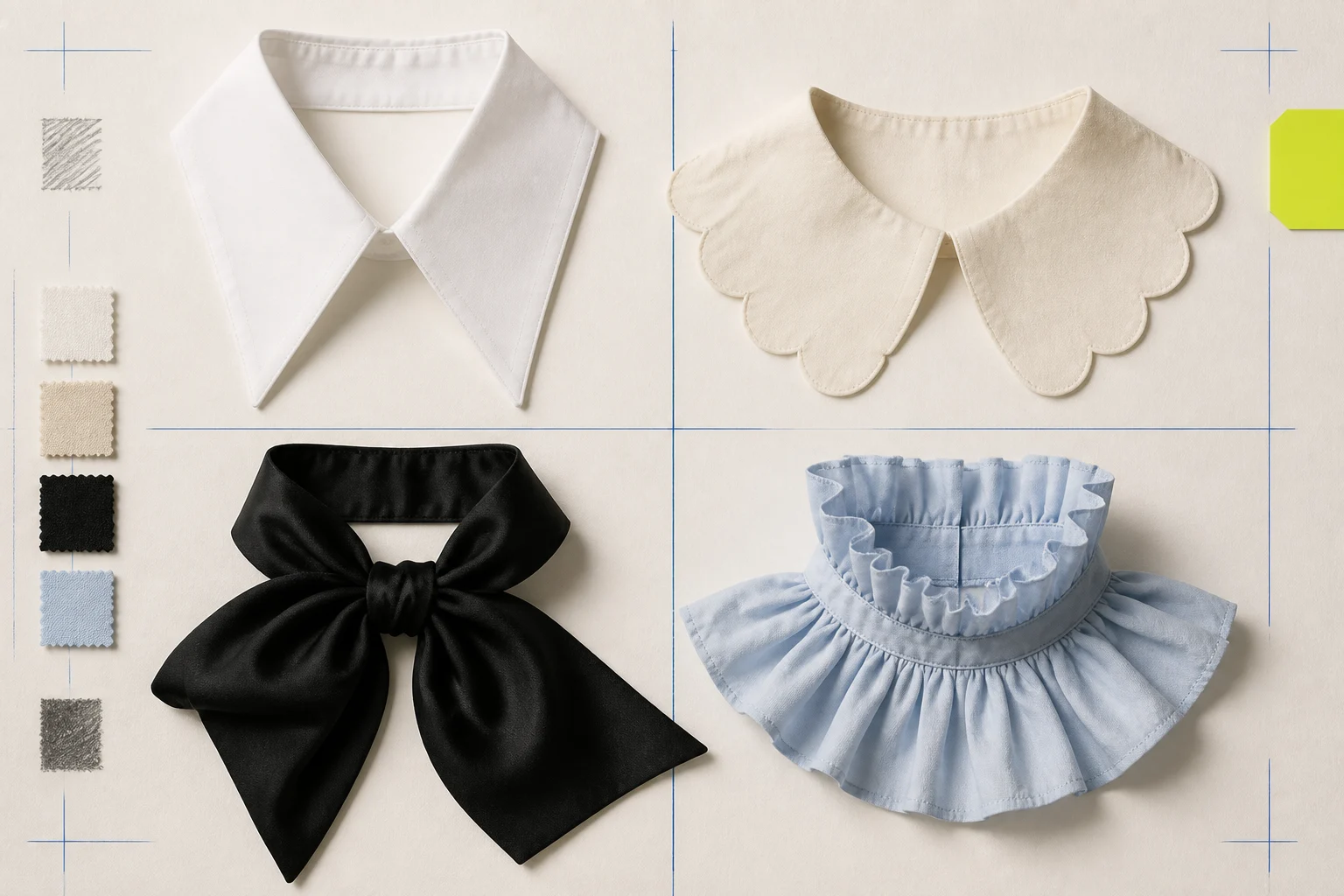
A collar can do an unusual amount of visual work. It can widen the shoulder line, sharpen a plain shirt, frame jewelry, change the apparent scale of a jacket, or turn a practical closure into the focal point of a look. Large points, scalloped edges, lavallière bows, ruffles, and stand-up constructions are easy to notice in a fast image stream.
Current first-party product pages provide several live examples. They do not, by themselves, prove that the statement collar has returned across fashion. FashionMember has not yet frozen and coded complete runway and retail samples, measured physical garments, or interviewed buyers. This draft defines what the claim would require.
Statement needs a measurable codebook
“Statement collar” is an editorial phrase, not a standardized product class. Before counting, define observable fields: collar type, point length, spread, depth, circumference, stand height, edge shape, contrast, stiffness, layers, trim, closure, removability, and proportion relative to the bodice and wearer.
The codebook can include point, spread, button-down, Peter Pan, sailor, wing, band, funnel, shawl, cape, bib, scalloped, ruffled, bow, and lavallière forms. Decorative plastrons, attached scarves, hood-collar hybrids, lapels, and necklaces need explicit inclusion rules. A normal point collar on an oversized shirt is not automatically an oversized collar.
Scale should be evaluated against a declared reference such as shoulder width, neck opening, garment width, or a physical pattern measurement. Photograph perspective can exaggerate a near-camera collar, while hair, jewelry, and layering can hide it.
Current product pages show several forms
Thom Browne currently describes a cotton-poplin supersized shirt with an “exaggerated point collar,” an unusually direct first-party label. Chloé lists a silk blouse with a large scalloped collar and current styles with ruffled, stand-up, and lavallière treatments. Valentino describes a silk georgette blouse with ruffle details at the collar and cuffs.
Chanel’s Spring/Summer 2026 blouse pages and current ready-to-wear category establish a broader blouse and shirt context, including silk satin and mixed-fiber styles. Nordstrom’s current collared-blouse category contains thousands of results and an active Thom Browne listing described with an exaggerated button-down collar.
These pages support an existence claim: emphatic collar treatments are commercially visible in more than one design vocabulary. The item count on a dynamic category page is not a clean trend denominator. It may include watches, duplicate colors, sponsored placements, marketplace sellers, carryover stock, sale items, and products that do not meet the project’s definition.
Return requires a historical comparison
To call something a return, the study must specify what it returned from and when. A feature that never disappeared from vintage-inspired brands, formal shirting, childrenswear references, or specific communities may only be newly prominent in one market segment.
Freeze comparable seasons, regions, categories, and price tiers. Code complete eligible collections rather than screenshots selected after the hypothesis is known. Keep womenswear, menswear, unisex merchandising, couture, ready-to-wear, resort, pre-collection, and retail delivery periods separate unless the study justifies combining them.
Two trained coders should classify each eligible look independently. Report agreement and resolve disagreements against the written codebook. Preserve the official look URL, collection, look number, access date, and rights status. A runway frequency can establish design visibility, not retail adoption.
Retail verification starts with exact product identity
The retail sample should capture seller, brand, product name, style or reference number, category, color, material, price, promotion, variant range, availability, date first observed, and date last observed. Parent styles and color-size variants belong in separate fields so one broad size run does not look like many designs.
Google Merchant Center’s current size and material guidance illustrates why structured variants matter. Size, size system, color, material, item group, and variant identity affect how products appear and filter. The landing page must remain aligned with the submitted product data.
The audit also needs a stable denominator: all eligible shirts and blouses, all eligible tops, or all ready-to-wear looks. Counting only collared results can show variety within the category but cannot show whether collars gained share.
Price and availability are snapshots. “Few left” is not a sale. An out-of-stock product may have sold through, been withheld, been delayed, or never been broadly available. Capture received inventory and replenishment directly from consenting retailers before discussing demand.
The physical collar changes the experience
A visually strong collar can create fit and care questions that an image cannot answer. Measure neck circumference, stand pressure, point movement, bow weight, edge curl, stiffness after wear, interference with outerwear, seatbelts, headphones, hair, glasses, earrings, necklaces, mobility aids, and skin contact.
Material and construction determine whether a collar stays graphic. Interfacing, canvas, boning, embroidery, lace, gathers, piping, topstitching, button placement, grain direction, and seam allowance matter. A soft silk lavallière and a starched cotton point may share visual scale while behaving very differently.
The FTC Care Labeling Rule requires applicable textile garments to provide regular-care instructions. That rule is not a durability certification. A product sample should be evaluated under its actual labeled care route, with before-and-after measurements and photographs. Claims about ease, comfort, wrinkle recovery, or longevity require their own methods.
Buyers can explain adoption, not just appearance
Direct buyer interviews should ask whether the collar affected the buy, how it fit into an existing assortment, what comparable style informed the decision, and whether the customer use case was work, day, occasion, layering, gifting, or editorial novelty.
The interview should distinguish liking a sample from placing an order, receiving units, selling without promotion, completing the return window, and reordering. A buyer may love a collar but reduce depth because of cleaning, styling difficulty, jacket compatibility, price, or a narrow size response.
Interviewed buyers should consent to attribution and review exact commercial facts. FashionMember should not publish confidential terms, supplier information, order quantities, or customer records without permission.
Images need rights and accurate framing
Runway and product photography carry usage terms. Store screenshots should not become a substitute for licensed editorial images. If FashionMember commissions a detail photograph, the caption must identify the real garment, source, date, stylist, photographer, and any commercial relationship.
AI-generated collar art can illustrate the codebook only when labeled as non-documentary. It cannot be placed beside a named designer in a way that implies authorship, a real runway look, or a product feature. Alternative text should describe the visible form and avoid declaring a trend result.
A reproducible fictional collar audit
FashionMember created four invented packets in content/data/FM-119-statement-collar-audit.json. The script scripts/fm119-statement-collar-audit.php checks for a collar codebook, locked runway and retail samples, two coders, exact product identity, physical measurements, material and construction, size and fit, care and durability, price and inventory, buyer interviews, received inventory, completed returns, sales quality, rights, claims, and accountable editorial review.
Two complete fictional packets reach trend-review; two remain on hold. Every designer, collection, look, product, seller, buyer, order, receipt, return, sale, reorder, owner, and outcome in the fixture is fictional. The audit does not establish a real statement-collar trend.
The visible signal is worth tracking
The most supportable current conclusion is modest. Several current first-party product pages make the collar an explicit design feature through scale, edge treatment, bowing, or ruffle. That is enough to open a reporting file.
It is not yet enough to publish “the return” as a verified market shift. FashionMember still needs the locked historical runway comparison, balanced retail denominator, physical samples, buyer interviews, receipts, completed returns, kept sales, and human fashion review.
Sources and verification
- Thom Browne: Supersized Shirt With Exaggerated Point Collar — current first-party product description, material, construction, and fit context.
- Chloé: Puff-Sleeve Blouse With Large Scalloped Collar — current first-party collar, material, fit, traceability, price, and availability context.
- Chloé: Ruffled Lavallière Blouse — current first-party ruffled collar and lavallière product example.
- Valentino: Georgette Blouse — current first-party ruffle-at-collar product example.
- Chanel: Spring/Summer 2026 Silk Satin Blouse — current first-party collection, material, color, reference, and look context.
- Nordstrom: Women’s Collared Blouses — dynamic first-party retail category snapshot; not a locked trend denominator.
- Nordstrom: Thom Browne Exaggerated Point-Collar Shirt — current first-party retailer description, price, color, and seller context.
- Google Merchant Center: Size Attribute — current official size, size-system, variant, and item-group guidance.
- FTC: Care Labeling Rule — authoritative regular-care instruction framework; not a durability result.
- W3C WAI: Images Tutorial — authoritative image-purpose and alternative-text guidance.
How this story was checked
- Sources
- 10 linked records · View list
- Last verified
- Reporting desk
- FashionMember Editorial Desk
- Format
- Analysis
- AI assistance
- Used with editorial review; disclosed above.