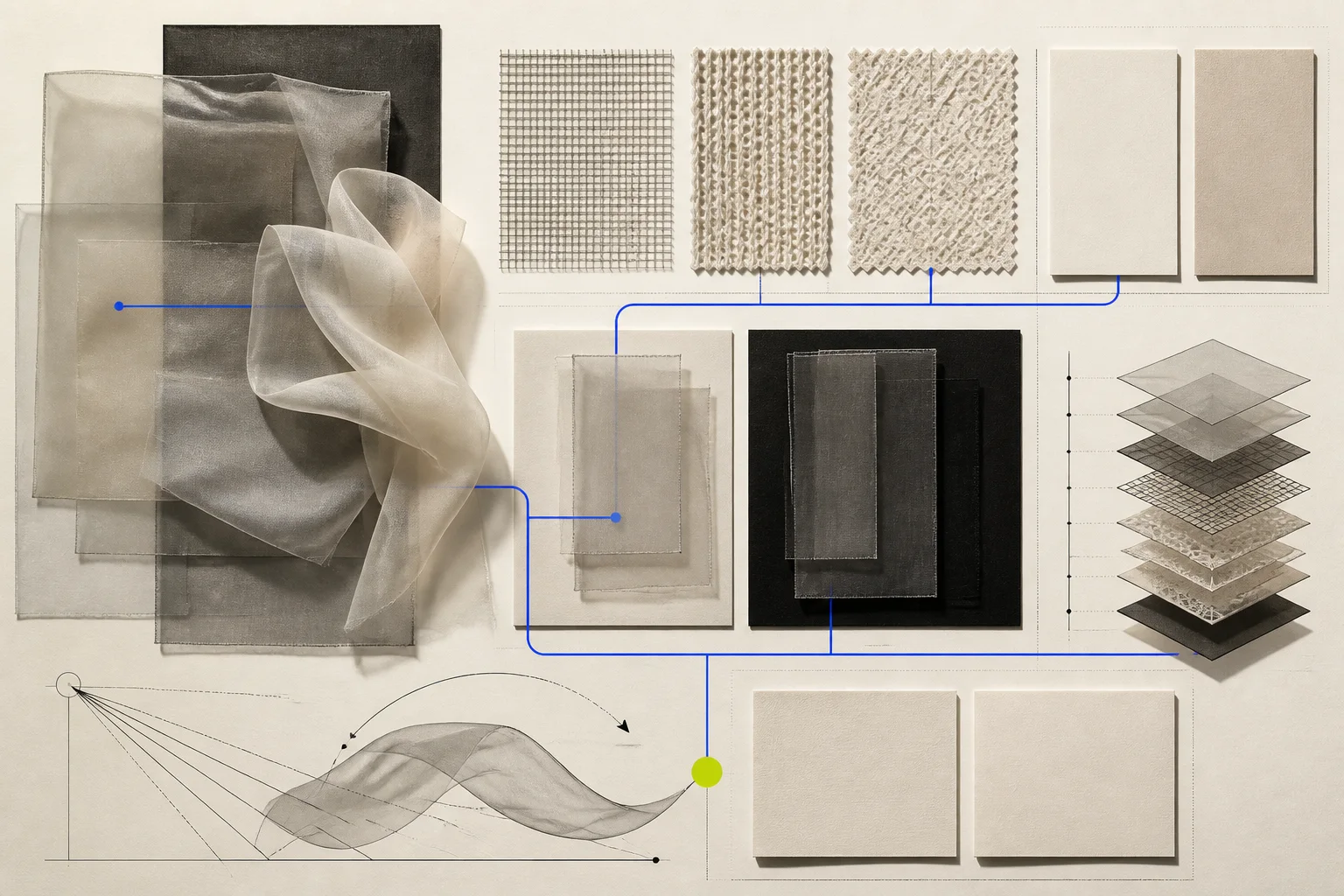
“Sheer” can describe silk organza, chiffon, mesh, lace, open knit, transparent film, burnout, a cutout panel, or a fabric that becomes translucent only under strong light. “Layered” can mean a lining, overlay, underdress, separate base, doubled panel, wrap, or styling choice. Treating all of those as one trend hides the product information a customer needs.
FashionMember reviewed current first-party collection and product pages plus official commerce, textile, care, advertising, and accessibility guidance. It did not code a locked runway sample, obtain licensed images, inspect authorized retail products, test opacity, interview wearers or buyers, or reconcile completed returns. This draft defines a reporting language rather than claiming verified runway frequency or demand.
Build the material and construction codebook
The first code should describe light transmission without guessing fiber: transparent, translucent, opaque, open structure, patterned openness, or unknown. A second code identifies the specified construction: organza, chiffon, mesh, lace, open knit, gauze, film, burnout, cutwork, or another verified term. Record fiber content separately.
Then map the garment system. Is the sheer area the full shell, a sleeve, yoke, inset, skirt panel, hem, or trim? Is there an attached lining, partial lining, separate underlayer, optional component, or no included coverage? Does the product page show styling pieces that are not sold with the garment?
Chanel’s current embroidered silk-organza top is a useful first-party example because the page names the material and product reference. Chanel’s Spring/Summer 2026 product and look pages, and Dior’s current ready-to-wear pages, provide additional public examples of transparency and layering. They are dynamic, brand-authored pages—not a locked census or independent physical test.
Two coders should classify a frozen set of eligible looks and retain disagreements. The sample must include non-sheer looks so the denominator is visible. Count look, garment, and sheer component separately.
An image cannot prove opacity
Studio lighting, exposure, background, retouching, movement, skin tone, underlayers, and compression can change how transparent a fabric appears. A runway photograph can document styling in one captured moment; it cannot establish what an exact retail variant does under daylight, backlight, flash, office light, or motion.
Physical review should use the sold product and predeclared conditions. Record illuminance or another practical light description, light direction, background values, distance, camera settings if images are evidence, number of layers, fabric orientation, stretch, and movement. Test after applicable care when the article discusses durability of opacity or structure.
Do not rate a participant’s body or “modesty.” Ask concrete questions about coverage expectations, visibility of seams or underlayers, temperature, movement, snagging, sensory comfort, and whether the product description prepared them. Different customers may choose the same transparency for different reasons.
The underlayer is part of the offer
If the published look depends on a bra, slip, bodysuit, camisole, trouser, skirt, or second top, state whether that component is included, separately sold, borrowed for styling, or unidentified. Record its exact product, fiber, color, size range, care, current availability, and price where verified.
The total-look cost is not the shell price alone. A customer may need several pieces, different laundering, or alterations. A retailer study should report both the hero item and the practical configuration that was displayed and sold.
Google Merchant Center’s product specification supports exact joins among product IDs, variant attributes, price, availability, and landing-page information. It does not guarantee that photographs convey transparency accurately. Retail descriptions should add plain-language coverage information while avoiding universal conclusions from one lighting condition.
Fit and access change the layer system
Layering adds bulk and friction. Armholes, necklines, closures, sleeve widths, waistbands, and hems may work differently over the intended base. Stretching a mesh or knit can increase openness; gathering or doubling can reduce it. Size grade and garment tension therefore belong in the review.
Include consented wearers across the sold size range and relevant mobility, seated, sensory, dressing-assistance, climate, and gender-expression contexts. Test closure reach, underlayer slippage, seam pressure, snag points, static, ventilation, tactile irritation, restroom use, and care burden. Report the participant and context without treating one response as universal.
Product photography should avoid forcing people to disclose more of their body than necessary. Use forms, flat lays, detail rigs, or consented models according to the research question. Secure image and quote rights, minimize personal data, and follow a documented retention policy.
Care and material claims need exact evidence
FTC textile guidance explains U.S. labeling obligations for fiber content, origin, and responsible business identity for covered products. The Care Labeling Rule addresses appropriate care instructions. Preserve the label, exact variant, and date. Do not infer silk, handcrafted lace, recycled content, durability, or performance from a photograph.
Delicate, breathable, cooling, supportive, snag-resistant, or seasonless can be objective or implied claims depending on context. Attribute brand language and request substantiation. If the article performs a wash, snag, seam, or dimensional-stability test, publish the method and limitations rather than converting an editorial observation into certification.
Retail evidence separates visibility from demand
A later market report should freeze runway and authorized retail samples for the same time and geography. Track buyer consideration, ordered and received units, display configuration, exact components, customer questions, eligible sales, completed returns, kept units, and reorders. A viral photograph or a product page does not show purchase or retention.
Return reasons should distinguish unexpected transparency, missing or unsuitable underlayer, fit tension, snagging, care, color, and styling difficulty. The denominator and return-window maturity must be stated. Customer comments require consent and should be aggregated safely.
A reproducible fictional layering audit
FashionMember created four invented evidence packets in content/data/FM-109-sheer-layering-audit.csv. The script scripts/fm109-sheer-layering-audit.php checks whether a fictional packet documents current runway sources, sheer and layer definitions, a locked visual sample, two coders, an authorized retail sample, product identity, fiber and material specifications, underlayer components, total-look cost, a physical opacity test, lighting context, movement and fit, size and accessibility, care and durability, buyer and wearer interviews, completed returns, image rights, claims review, a human editor, ownership, and complete look arithmetic.
Two complete fictional packets reach layering-review; two remain on hold. Every look, product, material, participant, buyer, retailer, test, return, owner, and result is fictional. The audit does not establish real opacity, fit, frequency, demand, or sales.
Describe the system, not just the surface
The strongest sheer story will show how material, construction, light, underlayers, movement, size, care, and cost create different forms of dress. That vocabulary is more useful than declaring that exposure has increased.
Until FashionMember secures the locked sample, licensed images, physical tests, interviews, returns, and human review, it can document current public examples and the evidence pathway. It cannot yet claim a verified new language at market scale.
Sources and verification
- Chanel: Embroidered Silk Organza Top — current first-party material and product-reference example; dynamic and not an opacity test.
- Chanel: Spring/Summer 2026 Collection Products — current first-party product index used to define a possible dated sample.
- Chanel: Spring/Summer 2026 Looks — current first-party look presentation; image rights and coding remain open.
- Dior: Current Women’s Ready-to-Wear — dynamic first-party product context including sheer materials; not a locked retail sample.
- Dior: Cruise 2027 Show — current first-party collection and savoir-faire framing.
- Google Merchant Center: Product Data Specification — official product, variant, price, availability, and landing-page consistency guidance.
- FTC: Threading Your Way Through Textile and Wool Labeling — authoritative U.S. fiber, origin, and identity labeling context.
- FTC: Care Labeling Rule — authoritative care-instruction framework; not a material-performance test.
- W3C WAI: Images Tutorial — authoritative image-purpose and alternative-text guidance.
How this story was checked
- Sources
- 9 linked records · View list
- Last verified
- Reporting desk
- FashionMember Editorial Desk
- Format
- Analysis
- AI assistance
- Used with editorial review; disclosed above.