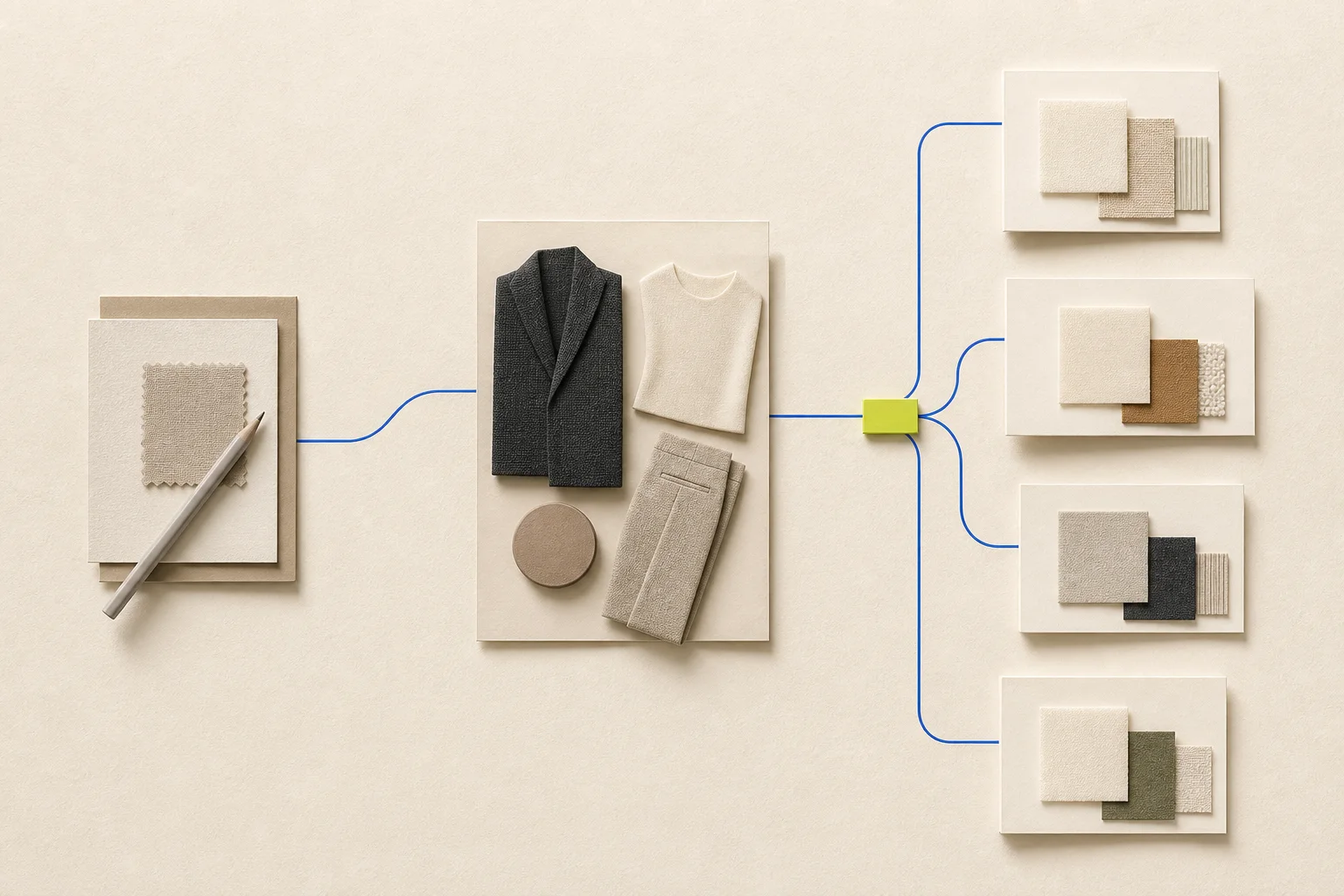
The most interesting alternative to a dominant look may not be another look. It may be a service that helps one person assemble a wardrobe around climate, fit, work, mobility, taste, budget, maintenance, and the clothes already owned.
Personal styling never disappeared, and “return” should not be read as a proven market reversal. Current services show that human appointments, profile-led boxes, generative style inspiration, visual search, and virtual visualization can coexist. Their availability does not establish how many people use them, who benefits, or whether they improve fit, satisfaction, retention, or returns.
FashionMember did not create an account, submit personal data, test live inventory, recruit users, interview independent stylists, or wait for a return window for this draft. The public evidence supports a service-design question: what would make individualized styling meaningfully different from trend-led product promotion?
Personal does not mean secret prediction
A legitimate styling service begins with permission and a defined job. A customer may want a travel capsule, interview outfit, closet edit, occasion look, fit alternative, or a way to use an existing garment. That request is not authorization to infer every sensitive trait or to retain an unlimited behavioral profile.
The service should explain what it collects, what is optional, how it will be used, how long it is retained, who can access it, and how the customer can correct or delete it. It should avoid turning body, identity, health, religion, or financial assumptions into hidden targeting variables. When a stylist needs contextual information, a direct question is often better than an opaque inference.
NIST’s AI Risk Management Framework emphasizes governance, context, measurement, and ongoing management rather than a single accuracy score. Applied to styling, that means documenting the recommendation’s purpose, possible harms, affected people, evidence, feedback route, and accountable owner.
The human role is more than approval theater
Nordstrom publicly presents styling services, including store appointments and a Nordstrom To You offer in eligible areas. Stitch Fix describes a profile-led service in which a human stylist selects items, while its recent product materials describe AI-supported inspiration and more flexible Fix options.
These are first-party descriptions of current services, not independent comparisons. Still, they make an important distinction visible. A human stylist can ask why a suggestion failed, notice conflict among goals, interpret ambiguity, work with an existing wardrobe, and explain a tradeoff. A system can help retrieve inventory, surface combinations, preserve preferences, and generate alternatives at scale.
The human should have real authority to reject, change, or contextualize an automated suggestion. If inventory is wrong, sizing is uncertain, the generated image invents a detail, or the profile contains a stale assumption, the service needs an abstention or correction route. Calling a final click “human in the loop” is not enough.
Trend awareness can be an input, not the identity
Stylists naturally work with the visual language of the moment. The difference is whether that language becomes a menu or a mandate. A useful session can translate a current proportion or texture into a customer’s own wardrobe rather than declaring that everyone needs the same item.
This changes the merchandising question. Instead of asking only, “What trend should we push?” a retailer can ask, “Which customer jobs can this product actually serve?” The product record then needs more than aesthetic keywords. It needs verified measurements, fit notes, material, opacity, stretch, closure, care, climate relevance, accessibility considerations, current variants, price, and return terms.
Personalization cannot repair weak data. If a recommended size is unavailable, the color is wrong, the garment is dry-clean-only when the customer requested easy care, or the system confuses an inspirational image with the sellable product, the personalized interface merely delivers a more confident error.
AI visualization is not a fit result
Google has introduced shopping tools that can create style visualizations, support visual matching, and let users experiment with outfits. Stitch Fix describes AI-generated personalized style inspiration. Such tools can help a customer articulate a direction or discover a combination they would not have searched by name.
The output must remain labeled for what it is. A generated look is not a product photograph, size recommendation, stock promise, compatibility test, or proof that the garment will drape the same way. If the image blends products, changes construction, or invents accessories, the interface should not hide that uncertainty.
Evaluation should separate inspiration quality from commerce accuracy. A user can like an image while every linked item is unavailable or materially different. Conversely, a less dramatic recommendation can be more useful because it respects budget, size, care, and existing clothes.
Measure a completed service, not a pleasing session
A responsible comparison should begin with consented users and matched tasks. It should document service scope, channel, stylist time, AI role, current inventory, product-data version, profile fields, accessibility, and the baseline being compared. Outcomes should extend beyond immediate clicks.
Useful measures include whether the user understood the recommendation, found available options in the requested size and budget, could correct assumptions, used an owned garment, kept or returned purchased items after the return window, and would use the service again. Report time, service cost, unwanted contact, and reasons for rejection. Segment results carefully enough to detect whether the service fails particular size ranges, disabilities, skin tones, genders, ages, or price needs.
A return reduction is not automatically good. The service could discourage returns, make terms harder to find, or select only easy cases. Measure satisfaction, product fit, customer effort, accessibility, gross margin, and harm alongside returns. Do not publish personal examples without clear consent and de-identification review.
Give the customer control
Personal styling becomes more trustworthy when the customer can see and change the inputs. Useful controls might include:
- “Do not use this preference again.”
- “Show why this item was selected.”
- “Only show items available now in my size and budget.”
- “Use this piece I already own.”
- “Avoid this material, closure, care method, or silhouette.”
- “Let me switch from AI inspiration to a human stylist.”
- “Delete my profile and styling history.”
The service also needs an accessible nonvisual path. Styling should not depend entirely on generated imagery, drag gestures, or color-only distinctions. Text descriptions, keyboard support, screen-reader labels, and a clear contact route belong in the product.
Testing the service evidence
FashionMember created four invented service packets in content/data/FM-093-personal-styling-evaluation.json. The script scripts/fm093-personal-styling-audit.php checks whether a fictional packet documents current service materials, scope, consented users, human and AI roles, profile minimization, inventory truth, fit/size/budget, feedback controls, a completed return window, accessibility, subgroup bias, privacy and security, claims review, user and independent-stylist interviews, a human editor, ownership, and complete session arithmetic.
Two complete fictional packets reach service-review; two remain on hold. Every service, session, user, stylist, inventory check, owner, and outcome is fictional. The result is not a real customer test, ranking, fit finding, return result, business outcome, or publication approval.
Individuality is an operating commitment
The case for personal styling is not that trends no longer matter. It is that a wardrobe is a longer and more specific relationship than a trend feed. Delivering that relationship requires accurate product data, present inventory, customer control, a meaningful human role, careful use of AI, and evaluation that lasts past the first attractive image.
Until independent, consented outcome evidence is available, it is too early to declare personal styling the winner over trend uniformity. It is reasonable to call it a valuable direction to test—especially when the service helps customers make fewer, clearer, more usable choices rather than simply personalizing the same pressure to buy.
Sources and verification
- Nordstrom: Styling Services — current first-party overview of service offerings; not independent effectiveness evidence.
- Nordstrom To You — first-party service page accessed for this article; eligibility, availability, and terms can change and should be confirmed directly.
- Stitch Fix: How the Fix Experience Works — current first-party support description of the Fix workflow.
- Stitch Fix: How It Works — current first-party description of profiles and human stylists; not independent outcome evidence.
- Stitch Fix Vision — first-party description of AI-generated style inspiration.
- Stitch Fix: Generative AI and Styling Enhancements — dated company announcement; claims require independent testing.
- Google: Vision Match and Fashion Try-On — first-party product announcement; not fit or customer-outcome proof.
- Google: Spring Fashion Shopping Tips — dated first-party description of shopping and visualization features.
- NIST: AI RMF Core — official risk-management framework used to structure governance questions.
How this story was checked
- Sources
- 9 linked records · View list
- Last verified
- Reporting desk
- FashionMember Editorial Desk
- Format
- Analysis
- AI assistance
- Used with editorial review; disclosed above.