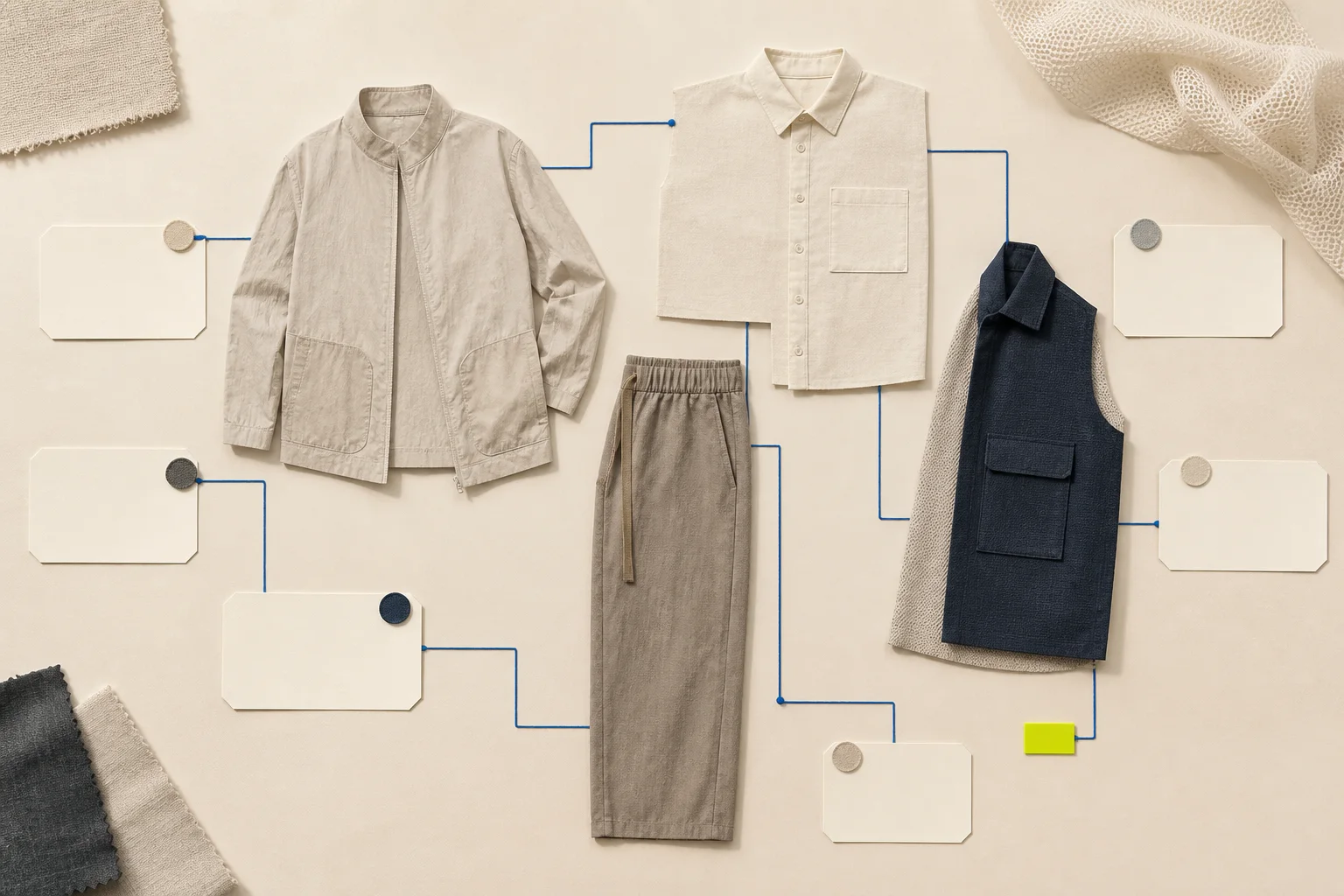
The sharp suit is not disappearing, and no single office wardrobe has replaced it. Yet current collection language offers a useful hypothesis: fashion workwear is becoming less dependent on rigid formality and more interested in light structure, comfortable materials, and pieces that can be recombined across changing settings.
“Workwear” here means clothing marketed or styled for ordinary professional life. It does not mean personal protective equipment, regulated uniforms, or garments whose performance affects health or safety. Those categories require standards and job-specific assessment beyond the scope of a fashion article.
As of September 1, 2026, FashionMember has reviewed public brand-authored collection materials and official product-data and care guidance. We have not locked an independent retail sample, examined garments, interviewed wearers, reconciled inventory or prices, or waited for returns. The direction remains an editorial signal, not a verified market shift.
Softer is not the same as shapeless
Softness can describe hand feel, visible drape, internal construction, or the social impression of a garment. Those are different observations. An unstructured jacket may still use a firm cloth. A soft knit can restrict movement through cut. A flowing image does not establish comfort.
Chanel’s Cruise 2026/27 presentation places washed cotton canvas suiting beside moving silk-foulard ensembles and raffia skirts. Dior’s Cruise 2027 page juxtaposes bouclé jackets, lace evening dresses, shearling, sequined suits, and pajama shirts with leather trousers. These are brand-authored creative descriptions, not a workwear census. They do show familiar formal categories being expressed through more varied material behavior.
A retail study should therefore code the garment rather than repeat the adjective. Record lining, interfacing, shoulder construction, closure, waistband, stretch, weight, opacity, wrinkle behavior, pocket use, and care. Only a physical sample and wearer can establish whether “soft” produces useful comfort.
Lighter must have a defined basis
Lightness can refer to physical mass, visual density, thermal burden, layering count, or ease of packing. Prada’s Spring/Summer 2027 menswear note describes jeans, jean jackets, and T-shirts as pragmatic garments reconsidered within an exact, controlled silhouette. Loewe’s Fall/Winter 2026 campaign describes a sportswear sensibility meeting artisanal construction. Neither source supplies a comparative garment-weight dataset.
If an article says workwear is lighter, it should state how. Weigh comparable garments in the same size and category, record fabric weight where verified, and note lining and components. Then test the intended climate and task. A light jacket that requires three extra layers may not reduce the total system. A thin fabric may create opacity or durability tradeoffs.
Climate matters especially in Los Angeles, where outdoor heat, air-conditioned interiors, commuting, and varied workplace expectations can occur in one day. A useful wardrobe handles transitions rather than optimizing for one photograph.
Modularity is a product function, not a styling slogan
A modular wardrobe can mean interchangeable separates, reversible pieces, removable components, adjustable closures, or a small color and proportion system that produces several combinations. The definition should be written before items are counted.
Prada’s current collection note presents familiar garment types as a framework for reinterpretation and integrates accessories into the whole. Chanel places salon codes in a beach context. These creative ideas suggest recombination, but they do not prove component compatibility in a commercial assortment.
For a retailer, modularity requires exact checks:
- compatible rise, length, volume, and hem relationships;
- color and material coordination under real light;
- closures that remain usable across relevant dexterity needs;
- layers that fit without pulling or excessive bulk;
- components available in coordinated size and color ranges;
- care methods that can coexist; and
- replacement or reorder options when one part sells out.
If a jacket and trouser are sold as flexible separates but their color lots visibly differ, the promise fails. If detachable parts are easy to lose or cannot be replaced, modularity creates maintenance rather than value.
Start with the wearer’s work
The strongest research unit is not “the modern worker.” It is a defined person, task, environment, and dress expectation. Interview people across different jobs, schedules, bodies, disabilities, climates, and transportation patterns with consent.
Ask what the clothing must enable: sitting, presenting, lifting ordinary objects, walking, cycling, driving, transitioning to an event, managing temperature, carrying devices, or meeting a written dress policy. Record what wearers already own and what fails. Avoid turning one professional culture into a universal rule.
Mobility and accessibility should be evaluated directly. Consider reach, seated fit, pressure points, closure effort, sensory preferences, pocket access, dressing time, and compatibility with mobility devices or medical equipment where participants choose to discuss them. Do not infer needs from appearance.
Product data must carry the flexibility claim
Google Merchant Center’s product-data specification treats apparel variants, size, color, material, and pattern as structured product facts. Its local product guidance says descriptions can include shape, texture, and design. These requirements do not prove a workwear trend, but they show how an adaptable product must be represented accurately.
A listing should identify the exact variant, measurements, materials, construction, closure, pockets, lining, stretch, opacity, care, and current availability. If a component is removable, say what is included and show the configuration. Do not use one image to imply that every color or size has identical details.
The FTC Care Labeling Rule requires covered manufacturers and importers to provide regular care instructions and possess a reasonable basis for them. Care affects whether a modular system is practical: pieces intended to work together may be inconvenient if one requires specialist cleaning after each use while another is washable.
Measure beyond the first fitting
A credible test would recruit consented wearers for defined tasks, document the baseline wardrobe, and use exact products from an authorized retail sample. It would record fit at the start, movement, climate, styling combinations, care, repeated use, damage, customer effort, and whether purchases are kept after the return window.
Retail measures should preserve availability, price, promotion, size coverage, full-price selling, exchanges, completed returns, and reasons. A sellout from a small buy is not proof of widespread preference. A low return rate is not automatically positive if the return policy is restrictive.
The study should compare within category and price tier. A technical overshirt, soft blazer, knit jacket, and protective work jacket do not belong in one undifferentiated denominator.
What the workwear packets revealed
FashionMember created four invented evidence packets in content/data/FM-097-modular-workwear-audit.json. The script scripts/fm097-modular-workwear-audit.php checks whether a fictional packet documents current collection sources, exclusion of PPE, an authorized retail sample, wearer interviews, task and climate, size and fit, mobility and accessibility, a modularity definition, component compatibility, material weight, care and durability, inventory and price, a completed return window, claims review, a human editor, ownership, and complete item arithmetic.
Two complete fictional packets reach workwear-review; two remain on hold. Every collection sample, item, wearer, task, component, owner, and result is fictional. The result is not a uniform or PPE assessment, product test, demand finding, ranking, or publication approval.
The useful version of the hypothesis
The new workwear is not one soft suit. It is a possible shift in how professional clothing is evaluated: less by a single formal image and more by movement, climate, combination, care, and repeated use.
Public collection notes make that question timely, but they do not answer it. A stronger FashionMember follow-up needs real products, a transparent retail sample, wearers with different work conditions, and completed returns; the accountable desk should publish the uncertainty alongside the visual direction.
Sources and verification
- Prada: Spring/Summer 2027 Menswear — first-party collection framing around pragmatic garments and reinterpretation; not workwear demand evidence.
- Chanel: Cruise 2026/27 Collection — first-party material and movement language; not a commercial workwear sample.
- Dior: Cruise 2027 Show — first-party examples mixing formal, evening, and relaxed categories.
- Loewe: Fall/Winter 2026 Campaign — first-party sportswear and craft framing; not wearer evidence.
- Loewe: Fall/Winter 2026 Precollection — first-party material and sportswear context; not an independent comparison.
- Google Merchant Center: Product Data Specification — current official apparel-attribute and variant requirements.
- Google Merchant Center: Local Product Data Specification — current official description and visual-attribute guidance.
- FTC: Care Labeling Rule — authoritative federal care-labeling requirements for covered products.
- W3C WAI: Images Tutorial — authoritative guidance for conveying relevant image information accessibly.
How this story was checked
- Sources
- 9 linked records · View list
- Last verified
- Reporting desk
- FashionMember Editorial Desk
- Format
- Analysis
- AI assistance
- Used with editorial review; disclosed above.