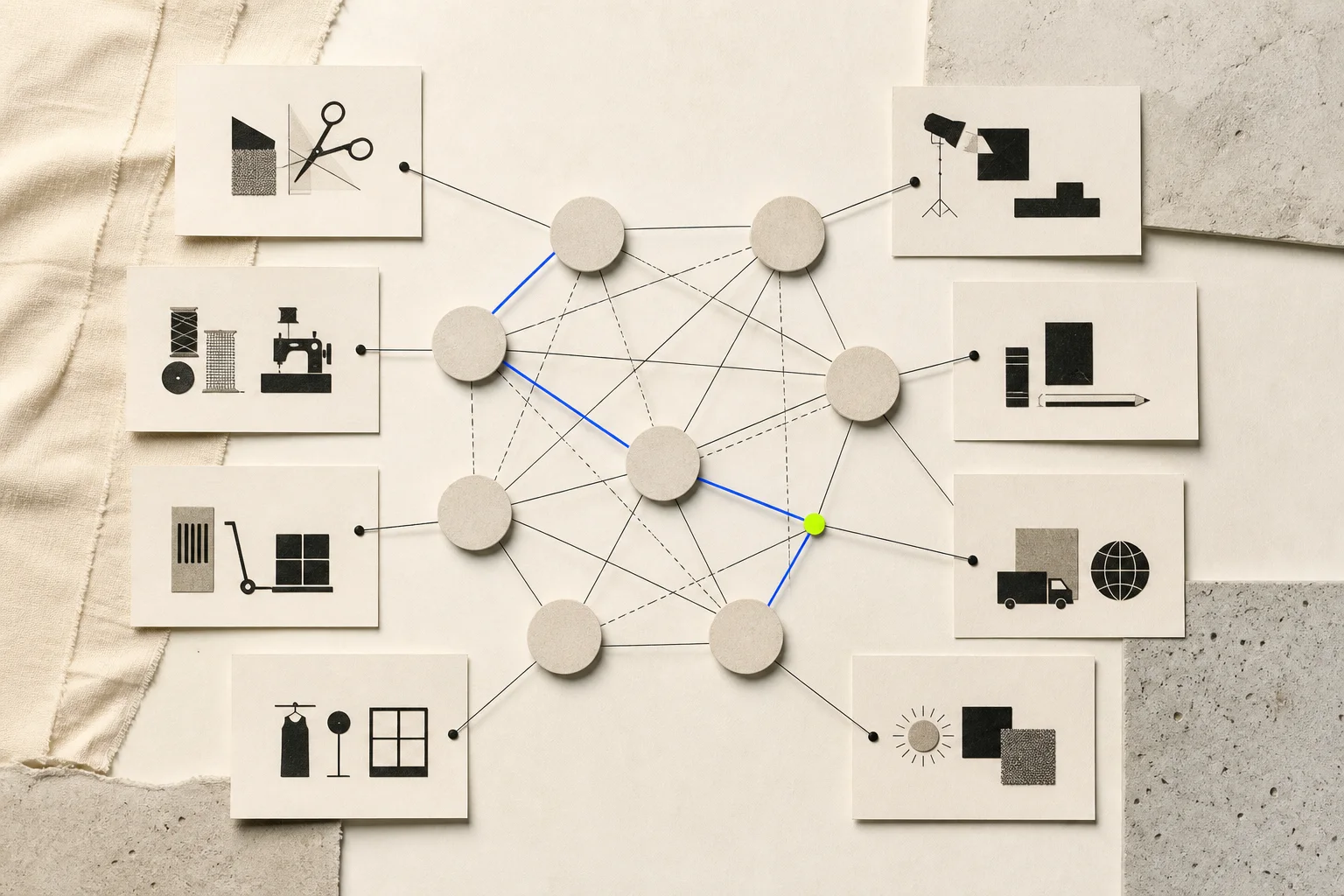
American fashion has more than one center because influence has more than one job. A designer may work in New York, develop a sample in Los Angeles, meet a buyer in Atlanta or Dallas, show a category in Las Vegas, produce through another state or country, ship through a national logistics network, and find the clearest customer use in a region shaped by different weather and social habits.
FashionMember has not completed the matched government data, regional interviews, market attendance, or retailer sample needed to rank American fashion regions. This article therefore rejects the ranking format and defines a reproducible geography of functions.
Influence is a vector, not a trophy
At least seven dimensions matter: design and creative labor; manufacturing and sourcing; wholesale-market activity; retail and customer adoption; media and cultural visibility; education and talent development; and logistics, capital, and business infrastructure. Climate and regional use should be an eighth context rather than an afterthought.
A region can be strong in one dimension and dependent in another. A dense design workforce does not prove local production. A market calendar does not prove orders. A busy port does not show which apparel firms benefit. A runway schedule does not measure what independent retailers keep selling.
The study should publish a profile for each dimension, not average unlike measures into one “most influential” score.
Start with comparable geography
City names are not consistent statistical units. New York City is a five-county municipality; Los Angeles can mean a city, county, metropolitan area, or cultural region. Dallas and Atlanta are similarly used as shorthand for wider commercial networks. The research plan must select one comparable geography—counties or a declared county group—and preserve the definition across sources.
The Bureau of Economic Analysis has changed how it publishes some aggregate local geographies. Its current data pages provide county-level GDP, income, and employment detail, while an official FAQ explains the discontinuation of certain metro aggregates. A study should not mix a current county total for one place with an older metropolitan total for another.
Every table needs reference year, release date, geography, industry or occupation code, units, suppression flags, and revision status. Apparent precision without those fields is cosmetic.
Business establishments reveal functions, with limits
The Census Bureau’s County Business Patterns program provides annual statistics for establishments with paid employees at detailed geographies and two- through six-digit NAICS levels. Variables include establishment counts, employment for a reference week, and payroll. The program applies disclosure protections and does not cover every type of work.
Fashion research should define a code set before extracting data. Possible functions may include apparel manufacturing, apparel and notions wholesaling, clothing retail, specialized design, and related logistics. Codes should not be added after seeing which combination makes a preferred city look strongest.
County Business Patterns excludes nonemployers from its establishment universe. That matters in a field with freelancers, sole proprietors, independent stylists, designers, photographers, resellers, and very small firms. An establishment count is not a complete creative-community count, and one establishment can range from a small studio to a large operation.
The responsible approach is to pair CBP with clearly compatible sources, flag the coverage gap, and avoid estimating missing workers without a documented model.
Occupation and industry answer different questions
The Bureau of Labor Statistics defines fashion designers as an occupation and notes that designers work across wholesalers, manufacturers, apparel companies, retailers, performance organizations, and design firms. Occupational data asks what people do; industry data asks what the employer does. The two should not be treated as interchangeable.
BLS also states that most fashion designers work in New York and California. That broad statement is useful national context but does not settle the distribution among counties, remote arrangements, freelancers, or emerging networks. Any current regional comparison should use the same release and geography for every location and retain measures of statistical reliability.
Creative labor also extends beyond the Fashion Designer occupation. Technical designers, patternmakers, sample makers, merchandisers, buyers, sewers, photographers, stylists, marketers, ecommerce operators, and logistics workers participate in fashion systems. Expanding the occupational basket can be valid, but the inclusion rule must be declared in advance.
Market infrastructure should be observed, not merely listed
Official event and market pages demonstrate that commercial institutions operate beyond a single coast. Atlanta Apparel identifies itself as a wholesale apparel marketplace and publishes market dates and an exhibitor directory. Dallas Market Center materials describe apparel and accessories markets. MAGIC publishes fashion-market programming in Las Vegas. The CFDA owns and organizes the official New York Fashion Week schedule. The LA Fashion District BID describes a 107-block district supporting retail, wholesale, and other business activity.
These first-party pages establish existence and stated purpose. They do not provide comparable attendance, qualified buyer counts, orders written, order quality, cancellations, delivery, returns, or long-term business outcomes.
A field reporter should attend under disclosed credentials and log event dates, category coverage, number of eligible exhibitors, appointment structure, buyer qualification, accessibility, and data availability. Interviews should include organizers, exhibiting brands, attending retailers, local service firms, and participants who did not achieve their goals. Promotional attendance claims require source and denominator review.
Retail adoption is local and portable
A style can become influential because retailers interpret it for local customers, because a regional scene exports an image, or because an online seller reaches customers nationally from a low-visibility operating base. Store addresses alone will not reveal those flows.
With authorization, the study should compare assortment breadth, product origins, received inventory, full-price kept sales, completed returns, reorders, and customer destination at an aggregated level. A buyer interview should distinguish discovery location from purchase decision and fulfillment location. “Found at a show” and “ordered after the show” are different fields.
Regional use also matters. Climate, transportation, dress codes, nightlife, industry mix, and community practice can change how garments are layered, sized, carried, and maintained. The study must avoid turning those contexts into stereotypes. Named local sources and observed product behavior should lead.
Media, education, logistics, and capital are separate maps
Fashion media can amplify a designer from anywhere, but editorial employment, production facilities, creator networks, public relations, and event access remain uneven. Education can supply skills without retaining graduates. Logistics can support commerce without creating design authority. Investment can scale firms while weakening local production ties.
Each map needs its own evidence. Education could use accredited program data, graduate outcomes collected with consent, and local-employment retention. Logistics could use official freight data and verified apparel business interviews. Media could use a dated, rights-compliant content sample rather than follower totals. Capital would require named deals or aggregated survey evidence, not rumors.
Remote and hybrid work complicate every category. The employee’s residence, employer headquarters, design decision, production site, and sale may occur in five places. The study should document which location receives credit for which function instead of assigning all influence to a headquarters ZIP code.
A reproducible fictional regional audit
FashionMember created four invented evidence packets in content/data/FM-104-regional-influence-audit.json. The script scripts/fm104-regional-influence-audit.php checks whether a fictional packet documents geography, matched dates, industry codes, government employment and business data, creative labor, manufacturing, wholesale, retail, media and education, logistics and capital, climate and use, named interviews, event attendance, methodology revisions, accessibility and rights, claims, a human editor, ownership, and complete regional arithmetic.
Two complete fictional packets reach regional-review; two remain on hold. Every region, institution, event, employer, business, interview, owner, score, and result is fictional. The audit does not rank a real city or estimate real influence.
Publish a network of accountable claims
The final package should let a reader compare matched regional profiles and trace each claim to a dated source. It should include missing-data flags and revision notes. A region can lead one dimension without becoming “the next capital.”
The more accurate picture of American fashion will probably look like a network: specialized nodes connected by labor, goods, media, buyers, and customers. Until FashionMember completes matched data and named reporting across a defined sample, that network is a research hypothesis—not a new hierarchy disguised as a map.
Sources and verification
- U.S. Census Bureau: County Business Patterns Data — official annual establishment, employment, and payroll access; subject to coverage and disclosure limits.
- U.S. Census Bureau: County Business Patterns API — official geography, NAICS, variable, and API documentation.
- Bureau of Labor Statistics: Fashion Designers — current official occupation definition, work settings, and national context.
- Bureau of Economic Analysis: County, Metro, and Other Local Areas — current official local GDP, income, and employment data routes.
- BEA: Local-Area Aggregate Geography FAQ — official explanation of discontinued metro aggregate publication and comparability limits.
- Atlanta Apparel — current first-party wholesale-market dates and directory context; not independent outcome evidence.
- Dallas Market Center: June 2026 Exhibitor Prospectus — first-party apparel and accessories market context; not a verified order dataset.
- MAGIC Fashion Events — official fashion-market programming context; attendance and commercial outcomes require separate verification.
- CFDA: September 2026 Official NYFW Schedule Application — first-party official-schedule and dates context; not a complete influence measure.
- LA Fashion District BID: About — official district geography and organizational context; not a regional ranking.
How this story was checked
- Sources
- 10 linked records · View list
- Last verified
- Reporting desk
- FashionMember Editorial Desk
- Format
- Analysis
- AI assistance
- Used with editorial review; disclosed above.