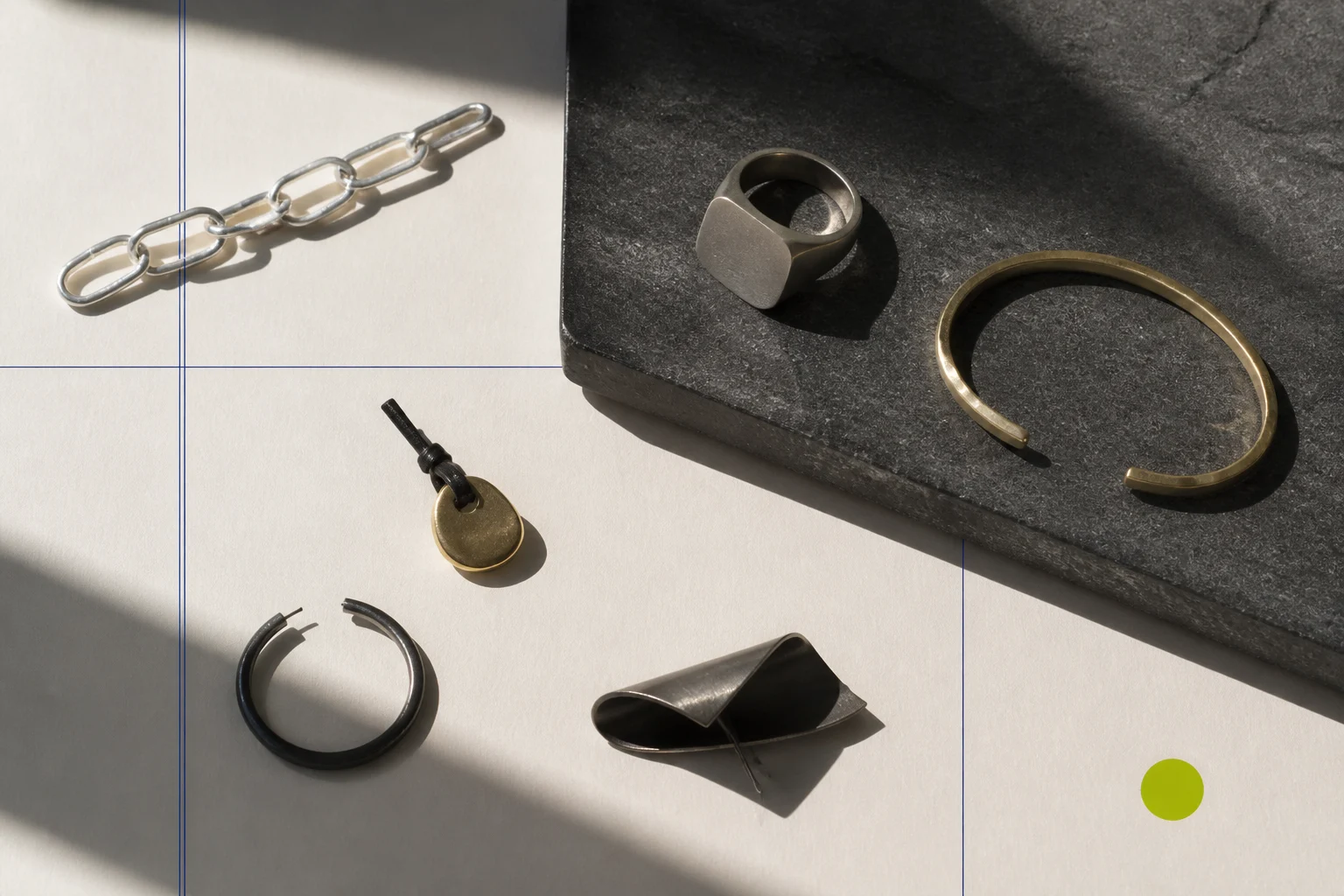
Men’s jewelry is no longer presented only as a watch, wedding band, or pair of cuff links. Current retail and brand pages organize chains, pendants, bracelets, rings, earrings, lapel pins, tie accessories, personalization, diamonds, precious metals, leather, rubber, and mixed materials under a men’s shopping path.
That visible breadth makes a strong reporting question. It does not yet prove market expansion. FashionMember has not obtained a gender-resolved market dataset, frozen a representative retail sample, interviewed retailers, or reconciled completed returns and kept sales. This draft separates what can be observed from what must still be measured.
Category language should not define the customer
“Men’s jewelry” is a merchandising label. It does not establish the gender of the person who buys or wears a product. A study should preserve the retailer’s navigation label while separately recording whether the brand describes an item as men’s, women’s, unisex, genderless, or without gender classification.
Customer research should use self-description, voluntary participation, minimum necessary data, and small-cell privacy. Avoid inferring gender from a name, photograph, size, payment record, or product choice. Gifting adds another distinction between purchaser, recipient, and wearer.
The category codebook can separate necklaces and pendants, bracelets and cuffs, rings, earrings, brooches and lapel pins, cuff links, tie bars, body jewelry, charms, and watches. Decide whether smart devices, belt hardware, eyewear chains, bag charms, and costume accessories belong before collection.
Current assortments show breadth
Nordstrom’s current Men’s Jewelry & Watches page lists thousands of results across bracelets, cuff links, earrings, fine jewelry, lapel pins, necklaces, rings, tie clips, and watches. Visible examples span sterling silver, gold, diamonds, leather, rubber, and stainless steel at widely different prices.
Tiffany’s men’s jewelry page organizes signet rings, chain jewelry, identification pieces, pendants, bracelets, diamond jewelry, and engraving. The company’s press material describes its first comprehensive men’s collection as having launched in 2019.
These are useful first-party examples of category architecture. A dynamic retailer count can include watches, duplicate variants, sale items, sponsored placements, marketplace sellers, unavailable products, and multiple pages for one style. A luxury brand page demonstrates strategic presentation but cannot represent the whole market.
Aggregate market data does not isolate men’s jewelry
The U.S. Census Bureau’s Monthly Retail Trade program reports sales by kind of business and provides historical releases and methods. Jewelry-store data can help place the sector in context, but it does not by itself separate men’s, women’s, unisex, gift, watch, or repair revenue.
The Bureau of Labor Statistics Consumer Expenditure Survey instruments collect household spending information, including jewelry questions and purchaser context. Published aggregates and survey design still require close review before making a men’s-market estimate. Household reporting is not the same as retailer sell-through, and gender labels in a questionnaire should not be repurposed beyond their documented meaning.
BLS price indexes for jewelry and watches measure price change, not unit demand or category expansion. Rising prices can increase nominal sales without more pieces being bought. Any market model should separate price, units, mix, channel, and inflation.
Expansion needs a stable denominator
A defensible study can compare a locked panel of consenting retailers over several equivalent periods. For each period, record eligible active SKUs, new styles, units received, units sold, net revenue, completed returns, kept units, full-price share, reorder units, and inventory age.
Define the denominator before inspecting results. Possible measures include men’s-labeled jewelry as a share of total jewelry SKUs, units, revenue, gross margin dollars, customers, or floor space. Each answers a different question. An expanded assortment with flat kept sales is not the same outcome as expanded customer demand.
Retailer interviews should ask why the category changed: self-purchase, gifting, styling, ceremony, personalization, celebrity or music influence, price architecture, material availability, online discovery, or a reclassification of products that were already being sold.
Report panel coverage, store size, channel, region, price tier, years observed, missing periods, openings, closures, acquisitions, and changes in classification. Do not extrapolate a small specialty panel to the entire U.S. market.
Product truth matters more as the assortment widens
The FTC Jewelry Guides address how marketers can avoid deceptive claims about precious metals, diamonds, gemstones, pearls, and related products. Material, fineness, plating, fill, treatment, laboratory-created status, and imitation status require accurate language where applicable.
Google Merchant Center’s current material guidance tells merchants to submit precious-metal information through material and color fields and to keep variant data understandable. Its size guidance shows how rings and other jewelry variants can use size, size system, item group, and unique IDs.
A retail record should capture exact metal and fineness claims, plating or coating, stone identity and treatment claims, dimensions, weight, chain length, ring size system, earring unit count, closure, included components, care, warranty, repair, engraving, price, seller, and country information where supplied.
Never describe a product as solid gold, sterling silver, hypoallergenic, waterproof, tarnish-proof, conflict-free, natural, or investment grade without appropriate documentation and claim review.
Fit and service determine whether breadth is usable
Jewelry fit is not trivial. Chain lengths sit differently across neck and torso proportions. Bracelet opening and circumference, ring width and size, earring post and weight, cuff flexibility, and clasp dexterity can affect use.
Product pages should provide dimensions in a clear unit, scale photographs, what is included, and accessible controls for variants. Retail research can include consented try-on sessions across a range of bodies and access needs without labeling one fit universal.
Service is part of the category: resizing, extension links, replacement components, engraving lead time, repair, cleaning, warranty, returns, packaging, and authentication for resale. Capture the promise and the completed service separately.
Retailer interviews should look beyond trend language
A direct interview can ask which subcategories gained space, what price bands work, which materials require more education, and whether sales came from new customers or existing accessory buyers. The buyer should distinguish initial enthusiasm from mature return and reorder evidence.
Questions about customer identity need restraint. A retailer can describe an observed use case or voluntary survey result; it should not disclose individual purchase histories or infer sensitive attributes. Quotations, store names, and commercial numbers need explicit publication permission.
The most valuable disagreement may be between retailers. One may see self-purchased chains as a repeat category while another sees seasonal gifting. The article should publish those limits rather than flattening them into a single market story.
A reproducible fictional market audit
FashionMember created four invented evidence packets in content/data/FM-123-mens-jewelry-market-audit.json. The script scripts/fm123-mens-jewelry-market-audit.php checks for a category definition, gender-inclusion protocol, market denominator, authorized retail sample, retailer interviews, product identity, material and fineness, dimensions and fit, price and inventory, delivery and returns, repair and warranty, completed returns, kept sales, reorders, claims, rights, privacy, and human review.
Two complete fictional packets reach market-review; two remain on hold. Every retailer, customer, product, material, market figure, interview, order, return, sale, reorder, owner, and outcome is fictional. The audit does not estimate a real market.
A broader shelf is the beginning of the story
The current evidence supports a descriptive conclusion: major retail and brand pages present a broad men’s-jewelry vocabulary beyond watches and wedding bands. It also shows why accurate material, size, variant, service, and claim data matter.
Market expansion remains unverified until FashionMember secures gender-appropriate denominators, a stable retailer panel, direct interviews, exact product data, completed returns, kept sales, reorders, and human review. Visibility is not yet volume.
Sources and verification
- Nordstrom: Men’s Jewelry & Watches — current dynamic first-party assortment and category taxonomy; not a locked market denominator.
- Nordstrom: Men’s Designer Jewelry — current first-party designer-retail context; price and availability change.
- Tiffany & Co.: Men’s Jewelry — first-party category, form, material, personalization, and positioning context.
- Tiffany & Co. Press: Tiffany Men’s — first-party history of the comprehensive men’s collection.
- U.S. Census Bureau: Monthly Retail Trade — authoritative U.S. retail sales, inventory, e-commerce, schedule, and methodology entry point.
- U.S. Census Bureau: Monthly Retail Trade Historical Releases — official historical release archive; aggregate categories do not isolate men’s jewelry.
- BLS: Consumer Expenditure Diary Survey Form — official survey instrument context for clothing, shoes, jewelry, accessories, purchaser, and store fields.
- FTC: Jewelry, Precious Metals, and Pewter Industries Guides — authoritative jewelry marketing and disclosure framework.
- Google Merchant Center: Material Attribute — current official jewelry material, precious-metal, color, and variant guidance.
- Google Merchant Center: Size Attribute — current official ring-size, size-system, item-group, and variant example.
- W3C WAI: Images Tutorial — authoritative image-purpose and alternative-text guidance.
How this story was checked
- Sources
- 11 linked records · View list
- Last verified
- Reporting desk
- FashionMember Editorial Desk
- Format
- Analysis
- AI assistance
- Used with editorial review; disclosed above.