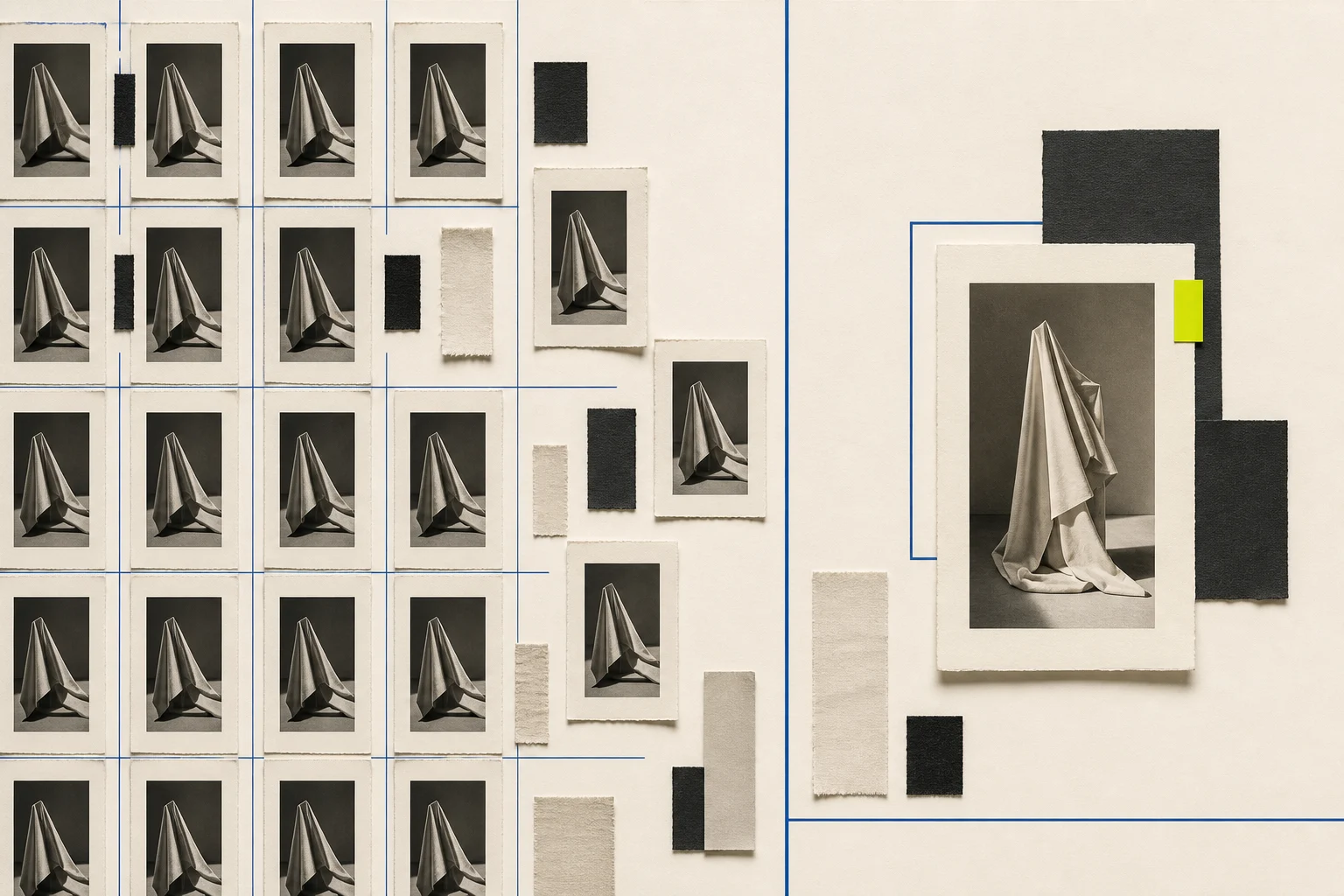
Fashion feeds can begin to look like a room full of mirrors. The same reveal, transition, surprised reaction, scarcity line, product angle, soundtrack, and comment prompt appear across creators within days. A launch may be widely visible while still feeling strangely unchosen.
That tension supports a useful hypothesis: some audiences may be tiring of fashion moments that appear engineered to resemble spontaneous discovery. FashionMember reviewed current platform explanations, U.S. advertising rules, consumer-research materials, and academic work on influencer authenticity. It has not run the required consumer study or interviewed creators. The title is therefore a question to test, not a verified population finding.
Define manufactured before measuring fatigue
Manufactured virality should not mean “popular content we dislike.” A defensible codebook can identify observable practices without guessing intent: coordinated posting windows, identical scripts, mandatory talking points, paid amplification, gifted product, affiliate links, repeated editing templates, engagement incentives, staged scarcity, synthetic accounts, or purchased indicators.
These practices are not equivalent. A disclosed creator campaign can be commercial and still useful. Several independent people can reach for the same visual form because a platform tool makes it easy. A sudden spike can come from legitimate news, strong creative work, community relevance, advertising, recommendation systems, or some combination.
“Fatigue” also requires a definition. It might mean self-reported boredom, irritation, distrust, avoidance, hiding, unfollowing, lower completion, lower recall, reduced consideration, or lower willingness to recommend. Those outcomes should be measured separately. A person can dislike a format and still remember it; another can watch repeatedly without wanting the product.
Recommendation systems complicate the feed
Platform documentation makes clear that a feed is not a neutral popularity chart. YouTube says recommendations use signals including watch behavior, likes, shares, comments, “not interested” feedback, and satisfaction surveys, with a stated objective of long-term viewer satisfaction. TikTok describes the For You feed as personalized and says it intersperses varied content; newer controls include keyword filters and tools for shaping recommendations.
Meta’s Instagram recommendations reset allows people to clear suggested content across Explore, Reels, and Feed and then personalize again through later interactions. “Interested,” “Not interested,” hidden words, Following, and Favorites provide additional control.
These controls are evidence that recommendation experiences require active management. They are not evidence that fashion audiences, as a whole, are fatigued. Nor does a platform’s distribution explain why a particular creative pattern spread. The study must preserve platform, placement, account, date, region, paid status, eligibility, and available user controls.
Commercial relationships belong in the evidence file
The FTC’s revised Endorsement Guides and influencer guidance say material relationships should be disclosed clearly and conspicuously with the endorsement. The FTC also warns that a platform’s built-in disclosure tool may not always be enough in context. Its Consumer Reviews and Testimonials Rule addresses fake testimonials and the buying or selling of fake indicators of social influence for commercial purposes.
An editorial audit should capture the actual disclosure as experienced: on-image, spoken, captioned, behind “more,” in a hashtag cluster, or absent. It should distinguish paid placement, gifted product, affiliate compensation, employment, ownership, invited travel, event access, and ordinary unpaid use.
Do not infer a hidden commercial relationship from visual similarity alone. Record only disclosed facts, creator or brand confirmation, and documented campaign evidence. Suspicion is a reporting lead, not a published accusation.
Authenticity is a relationship, not a visual filter
Current academic work on sponsored short-form content examines how creator and brand characteristics shape perceived authenticity and engagement. A recent meta-analytic review treats influencer effectiveness as a combination of post value, influencer characteristics, follower knowledge, platform context, and persuasion knowledge rather than one universal authenticity score.
That matters for fashion because “unpolished” has become a production style of its own. Handheld footage, bedroom mirrors, visible garment racks, and hesitant voiceovers can all be sincere; they can also be tightly art-directed. High production quality is not proof of manipulation, and low production quality is not proof of independence.
Research should test provenance, consistency, usefulness, expertise, disclosure, brand fit, and perceived autonomy separately. It should not ask participants whether something “looks fake” and convert that answer into a claim about the creator’s character.
A real audience study needs exposure, comparison, and time
A credible FashionMember study would recruit a declared sample of fashion-media users across relevant ages, regions, platforms, usage intensity, and shopping behavior. Recruitment source, incentives, exclusions, demographic coverage, completion quality, and weighting should be published. Participation must be voluntary and privacy-preserving.
The instrument should be frozen before collection. Participants can review consented or licensed examples across several conditions: independently initiated content, clearly disclosed sponsorship, repeated synchronized campaign content, paid brand creative, and a noncommercial control. Order should be randomized. The study should avoid deceptive hidden sponsorship unless an ethics-approved design and complete debrief justify it.
Measure immediate reaction and delayed response. Useful outcomes include recognition, perceived repetition, perceived autonomy, disclosure comprehension, usefulness, irritation, trust, hiding intent, purchase consideration, and recall after a declared interval. Report uncertainty and subgroup sample sizes. Do not present a narrow convenience sample as “fashion audiences.”
Exposure diaries can add context. Participants may encounter ten similar clips before the example tested in a survey. With consent, they can record approximate frequency and platform controls used without sharing private messages, contact lists, or unrelated browsing history.
Creator interviews should examine the production system
Direct interviews are essential because creators see constraints that public posts hide: briefs, revision rounds, whitelisting, exclusivity, approval delays, disclosure negotiations, posting windows, usage rights, performance bonuses, harassment risk, and the pressure to reproduce a winning format.
Creators should be paid for research time, allowed to decline sensitive questions, and quoted only with explicit scope approval. Small creators, staff creators, freelance producers, stylists, editors, and talent managers may experience the same campaign differently. Confidential participation should remain possible when naming a brand could threaten future work.
The goal is not to ask whether creators have “sold out.” It is to understand how commercial and platform systems narrow or expand creative choice, and which kinds of repetition audiences recognize.
Reach, response, and retail outcomes are separate
Views and likes can help describe distribution, but they do not establish attention quality or demand. The measurement chain should keep impressions, unique reach, completion, saves, shares, comments, profile visits, product-page visits, qualified sessions, add-to-cart activity, completed orders, cancellations, returns, kept sales, and repeat purchases separate.
Paid and organic delivery need distinct fields. Remove known bot or invalid traffic only with a documented rule. Normalize for audience size, placement, spend, time live, geography, and product availability. Comment sentiment is not a substitute for representative consumer research.
Fashion adds fit, quality, delivery, and return effects after the post. A campaign can produce clicks while an unavailable size run, late shipment, misleading material description, or poor fit drives disappointment. Attribution should not credit or blame creative work for downstream conditions it did not control.
A reproducible fictional virality audit
FashionMember created four invented evidence packets in content/data/FM-118-manufactured-virality-audit.csv. The script scripts/fm118-manufactured-virality-audit.php checks whether a fictional packet defines the term, locks a platform and exposure sample, separates paid and organic content, preregisters consumer research, includes consented and compensated creator interviews, verifies provenance and engagement integrity, follows downstream behavior and completed returns, and completes legal and human review.
Two complete fictional packets reach audience-review; two remain on hold. Every participant, creator, platform export, post, campaign, product, order, return, sale, owner, and outcome is fictional. The audit cannot prove that a real audience is tired or that any real campaign was manufactured.
The practical response is creative specificity
If the hypothesis is confirmed, the answer is not to disguise sponsorship more cleverly. Brands can reduce unnecessary repetition, give creators meaningful autonomy, disclose relationships clearly, publish useful product information, cap frequency, and evaluate long-term trust alongside short-term reach.
Editors can show how a garment is made, worn, fitted, cared for, priced, and delivered rather than treating social velocity as the story. Creators can explain what they chose, what the brand required, and what did not work. Platforms can keep making preference and transparency controls legible.
Until FashionMember completes direct consumer research and paid creator interviews, the honest conclusion is narrower: current systems can produce repeated, commercialized fashion visibility, and audiences have tools to reject or reset recommendations. Whether that has become broad fatigue remains open.
Sources and verification
- FTC: Endorsement Guides — What People Are Asking — current official disclosure and endorsement guidance, revised in 2023.
- FTC: Disclosures 101 for Social Media Influencers — plain-language material-connection and placement guidance.
- FTC: Final Rule Banning Fake Reviews and Testimonials — official summary including fake social-influence indicators.
- YouTube: Recommendation System — current first-party explanation of relevance, feedback, and satisfaction signals.
- TikTok: How TikTok Recommends Videos for You — first-party description of recommendation inputs and feed variety.
- TikTok: More Ways to Discover Content and Creators — current first-party keyword and recommendation controls.
- Meta: Reshape Instagram With a Recommendations Reset — first-party reset, interest, hidden-word, Following, and Favorites context.
- Sprout Social: Influencer Marketing Report 2024 — commercial consumer-research context; methodology and population limits require editorial review.
- Psychology & Marketing: Authenticity in TikTok — peer-reviewed multi-study work on sponsored user-generated content.
- Journal of the Academy of Marketing Science: Influencer Marketing Effectiveness — peer-reviewed meta-analytic review of influencer-marketing effects and moderators.
How this story was checked
- Sources
- 10 linked records · View list
- Last verified
- Reporting desk
- FashionMember Editorial Desk
- Format
- Analysis
- AI assistance
- Used with editorial review; disclosed above.