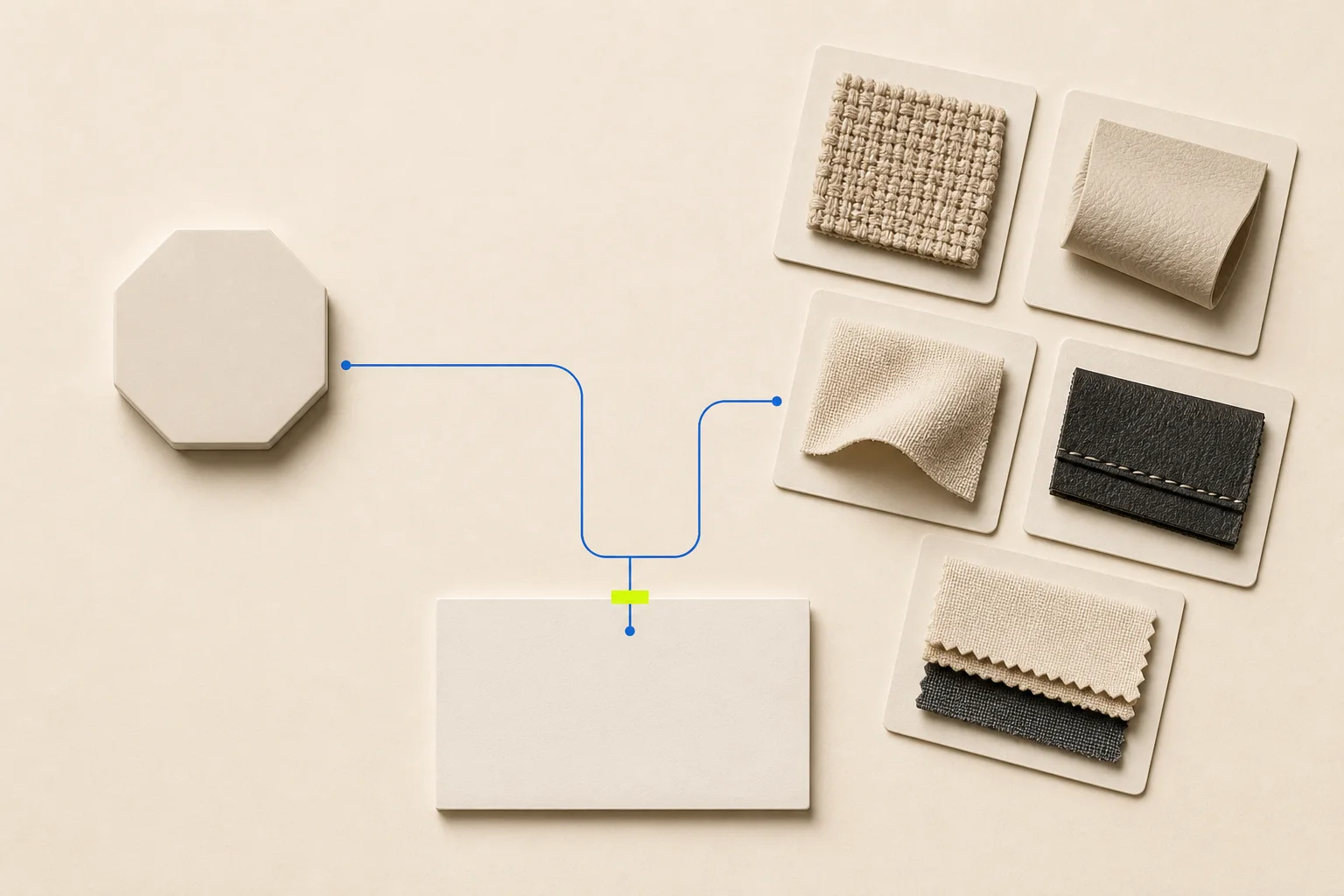
Fashion brands are talking more explicitly about leather, shearling, raffia, canvas, folding, intarsia, embroidery, and the work of construction. That language makes material value more visible. It does not prove that logo value is fading.
Logos can be graphic marks, monograms, hardware, repeated patterns, recognizable shapes, signature colors, or quieter brand codes. Materials can also function as codes. Treating the two as opposites would miss how a house uses material to make identity and how customers use identity to interpret material.
As of September 1, 2026, FashionMember has reviewed current first-party collection and product pages plus official product-data, care, advertising, and accessibility guidance. We have not inspected products, tested materials, sampled independent retailers, interviewed consumers, or analyzed transactions. The “shift” remains a research hypothesis about where explanatory attention is moving.
Brand language is foregrounding material
Prada’s Spring/Summer 2027 menswear note uses “rematerialization” to describe familiar garment types being reconsidered. Loewe’s Fall/Winter 2026 materials emphasize artisanal innovation, pioneering constructions, leather, intarsia, and vivid surface. Its Spring/Summer 2026 page names folded shoes, paneled leather dresses, and hand-blown glass clutches. Dior’s Cruise 2027 page identifies bouclé, frayed edges, embroidered lace, patchwork, shearling, and a savoir-faire proposition in which the everyday becomes couture.
Chanel’s current handbag catalog organizes products through material and color as well as recognizable forms, showing suede, shearling, canvas, raffia, calfskin, felt, and mixed fibers. The same page also retains strong house codes. This is precisely why a binary story fails: material detail and brand identity operate together.
First-party copy tells us how brands choose to present collections. It does not independently verify composition, construction quality, durability, labor, scarcity, or customer value.
Define what counts as logo visibility
A comparative study needs a codebook. One possible scale records:
- no visible brand code identifiable to coders;
- subtle hardware or small mark;
- recognizable signature construction or shape without a prominent mark;
- repeated monogram, large hardware, or central logo; and
- product whose primary visual field is the brand mark.
Two coders should work independently, and the study should report disagreement. Familiarity changes recognition: a specialist may identify a shape that a general shopper sees as unbranded. The code therefore measures visibility under defined conditions, not objective logo content.
Trademark and design-right questions require legal review. An editorial image should not erase, alter, or generate a confusing imitation of a real mark.
Define material value without “luxury” adjectives
Material value can refer to verified composition, construction complexity, performance for the intended use, sensory preference, care burden, repairability, traceability, or scarcity. These are not interchangeable, and a higher number is not always better.
A heavy leather is not automatically superior to a lightweight textile. Handwork can create beauty while increasing repair difficulty. A delicate finish may be appropriate for an occasional piece and unsuitable for daily transit. “Natural” does not guarantee durability or lower impact. “Technical” does not guarantee performance.
The product record should identify exact materials, components, construction, lining, finish, origin claims where made, care, version, and evidence source. Google Merchant Center’s data specification includes material as a product attribute, while its description guidance encourages relevant visual and technical facts. A data field is not proof; it is a place for a substantiated value.
Physical inspection is the missing bridge
Online images can show grain, weave, pile, gloss, and edge treatment. They can also hide coating, weight, hand feel, reinforcement, reverse surfaces, color transfer, odor, shedding, or weak stress points. AI imagery can invent every one of those details.
For an exact product, inspect fiber or material documentation, thickness or weight where relevant, panels, seams, edge finishing, reinforcement, lining, closures, hardware attachment, surface consistency, and expected variation. Test only what the claim requires and use an appropriate specialist. Preserve sample identity and conditions.
The FTC Care Labeling Rule requires a reasonable basis for regular care instructions on covered textile apparel. Care is part of material value because it shapes cost, time, damage risk, and usable life. It is not a durability certificate.
Consumer value must be asked, not inferred
A quiet exterior may signal discretion to one customer and insufficient identity to another. A visible logo may offer cultural meaning, resale recognition, affiliation, or design pleasure. A distinctive material may offer touch, function, craft, or a story. Researchers should not pre-label one motive as more sophisticated.
Consent-based interviews can use exact products with brand information both visible and masked in a controlled sequence. Ask what participants notice, what they believe, what evidence they require, how the item would be used, and whether their judgment changes after seeing the specification and price. Do not treat stated preference as a purchase outcome.
Behavioral research should preserve availability, price, promotion, product identity, channel, return window, and customer exposure. If a material-led product and logo-led product differ in every other attribute, their sales cannot isolate the value driver.
Price is not material quality
A high price may reflect design, brand, distribution, service, scarcity, marketing, material, construction, or margin. A low price does not establish poor material. The article should not reverse-engineer quality from price.
Compare total price and current terms separately from verified product evidence. Record repair and service options, but do not assume their existence proves durability or future resale value. A brand-authored craft story is a source about process claims, not an independent valuation.
The FTC’s advertising guidance requires objective claims to be truthful, non-deceptive, and substantiated. Editors should identify the exact claim and evidence before publishing “premium,” “responsibly sourced,” “handmade,” “durable,” or similar language.
Putting the material-value claim under pressure
FashionMember created four invented evidence packets in content/data/FM-100-material-value-audit.csv. The script scripts/fm100-material-value-audit.php checks whether a fictional packet documents current brand sources, definitions for logo and material, an authorized retail sample, product identity, material specifications, physical inspection, construction, care, durability, logo-visibility coding, consumer research, price and inventory, repair and service, claims review, a human editor, ownership, and complete item arithmetic.
Two complete fictional packets reach material-review; two remain on hold. Every brand sample, product, material, consumer, owner, and result is fictional. The result is not a logo-preference finding, material-quality test, value score, product ranking, or publication approval.
Make value inspectable
The useful shift is not from “bad logos” to “good materials.” It is from an image-led assumption to a product record that lets readers examine what identity and material each contribute.
Current collection pages make material language unusually visible. A defensible market conclusion still needs exact products, physical evidence, transparent coding, independent retail context, and consumer research that allows people to value brand, material, both, or neither. Until then, FashionMember should describe the language and keep the preference claim open.
Sources and verification
- Prada: Spring/Summer 2027 Menswear — first-party rematerialization and garment framing; not consumer-preference evidence.
- Loewe: Fall/Winter 2026 Campaign — first-party material, construction, and craft language.
- Loewe: Spring/Summer 2026 Women’s Runway — first-party construction examples; not independent quality verification.
- Dior: Cruise 2027 Show — first-party material and savoir-faire context.
- Chanel: Handbags — current first-party catalog organized by forms, materials, and colors; not an independent sample.
- Google Merchant Center: Product Data Specification — current official product-attribute requirements including material.
- Google Merchant Center: Local Product Data Specification — official description and product-image consistency guidance.
- FTC: Care Labeling Rule — authoritative requirements for covered textile apparel.
- FTC: Advertising FAQs for Small Business — official substantiation and truthfulness guidance.
- W3C WAI: Images Tutorial — authoritative accessibility guidance for informative images.
How this story was checked
- Sources
- 10 linked records · View list
- Last verified
- Reporting desk
- FashionMember Editorial Desk
- Format
- Analysis
- AI assistance
- Used with editorial review; disclosed above.