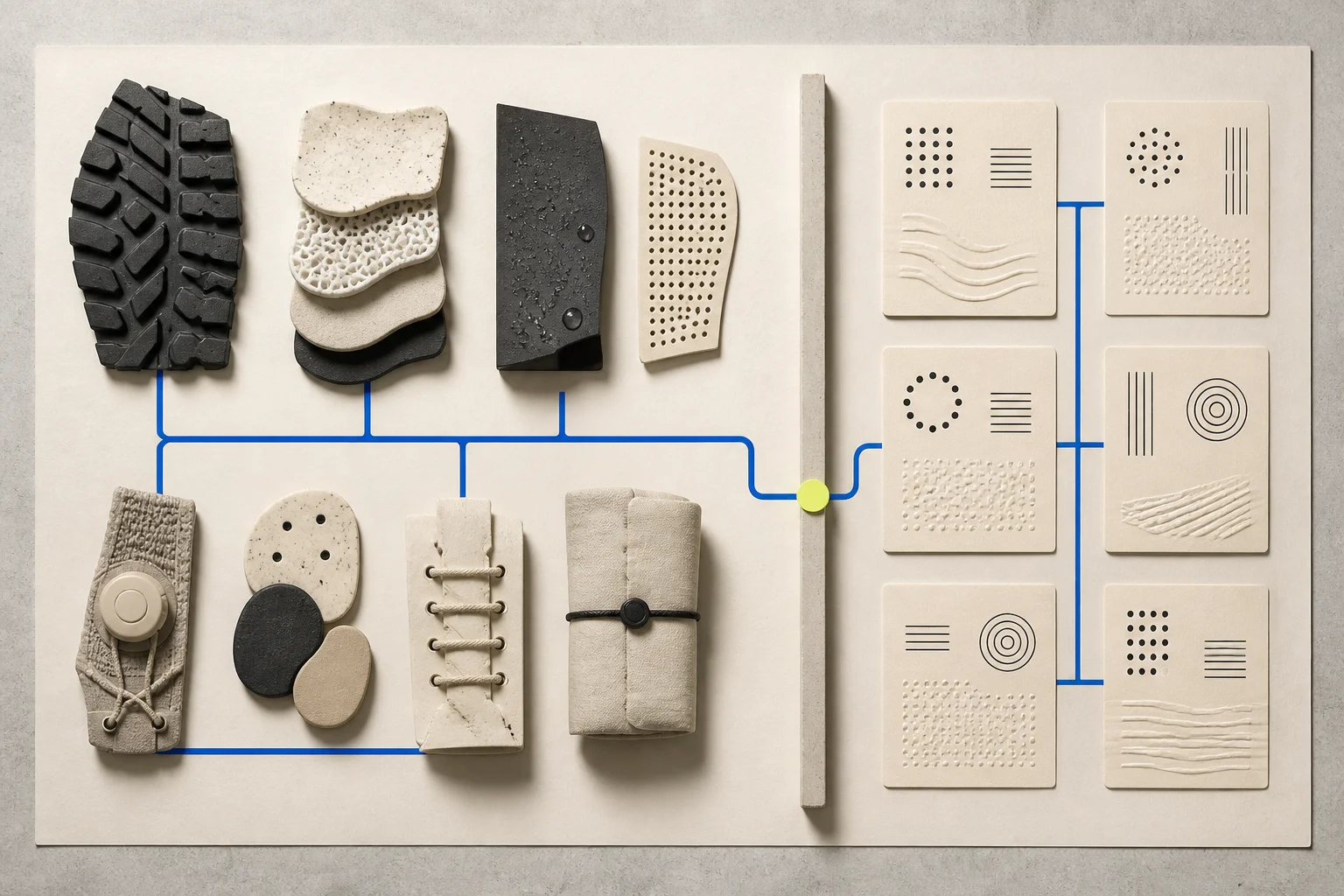
Footwear categories are increasingly described with borrowed languages: a trail shoe becomes sportstyle, a recovery-like slip-on enters daily dress, a clog moves between professional and casual assortments, and technical-looking soles appear under fashion uppers. The crossover is visible in current product architecture, but “utility” is not one measured property.
FashionMember reviewed current first-party footwear assortments and exact product pages plus official product-data, advertising, workplace-safety, recall, and image guidance. It has not locked an authorized retail sample, inspected footwear, conducted wear or surface tests, interviewed buyers or wearers, or reconciled completed returns and reorders. This draft defines a hybrid product study rather than claiming a market shift.
Define hybrid by source and destination
A codebook should record the design source being referenced and the context in which the product is sold. Possible sources include trail running, hiking, recovery, occupational clogs, water footwear, approach shoes, sandals, court shoes, motorcycle boots, or formal footwear. Possible retail contexts include performance, sportstyle, contemporary fashion, work, comfort, travel, and general casual.
Then record observable components: outsole lug geometry, contact area, rubber placement, midsole form, chassis or shank, footbed, toe protection, heel retention, upper material, lining, membrane, ventilation, closure, lace storage, pull tabs, weight, drop where specified, and replaceable parts.
The same component can serve different purposes. Deep lugs can be a performance choice, a visual reference, or both. A back strap can improve retention without making a clog safe for every workplace. “Hybrid” should be a transparent classification, not a benefit claim.
First-party products show category crossing
Salomon currently places the XT-6 in its Sportstyle assortment. The exact product page says the design was adapted for the city from a trail-running legacy and lists weight, drop, materials, lacing, chassis, footbed, toe cap, and outsole language. This is strong first-party evidence for a declared crossover. It is not independent proof of comfort, durability, grip, fit, or demand.
Birkenstock’s current U.S. professional assortment includes Tokio Super Grip and other clog forms, while the broader Tokio collection contains professional and nonprofessional variants. The adjacent placement shows how a recognizable form can span use categories. Exact product references and claims must remain separate; a fashion-facing Tokio is not automatically a professional or slip-rated product.
Hoka’s current Restore TC page provides another first-party slip-on example. A later study can include it only if the exact region, version, intended use, material, price, availability, and claims are frozen when the sample is built.
Product identity comes before testing
For every unit, preserve brand, model, article or SKU, color, size, width, generation, production code where available, region, seller, price, stock date, materials, manufacturer language, and included care. Photograph labels and construction with authorization.
Google Merchant Center’s specification helps join product IDs, variants, sizes, colors, price, availability, and landing pages. A product family name is not enough. Different membranes, outsoles, widths, or seasonal updates can change the result.
Weigh and measure the physical sample under a declared protocol. Record outsole dimensions and wear state, closure range, insole removability, internal seams, flex points, toe volume, heel retention, and construction. Do not infer materials or waterproofing from appearance.
Test utility in declared conditions
Start with ordinary-use tasks that match the public product: donning and doffing, closure operation, walking, stairs, sitting, standing, carrying, public transit, light rain only where appropriate, and cleaning according to instructions. Record surface, temperature, duration, participant, sample count, wear state, and incidents.
Fit research should include length, width, volume, heel hold, toe space, pressure, sock or orthotic compatibility, swelling, and relevant mobility or dexterity contexts. Recruit consented participants across available sizes and widths. A wearer report is contextual evidence, not a medical claim or universal recommendation.
Accessibility review should include closure force and reach, one-handed use, tactile distinction, pull tabs, stability during entry, removable footbeds, weight, and compatibility with prescribed devices. Do not call a hands-free-looking design accessible without testing the exact use.
Durability can include outsole wear, separation, upper abrasion, seam and bond condition, odor, cleanability, dimensional change, and component replacement. State units and cycles; one editorial wear is not a durability certification.
Separate everyday grip from occupational protection
OSHA’s PPE materials explain that employers must assess hazards and that protective equipment can include safety shoes and other protective clothing. Workplace requirements depend on hazards and applicable standards.
A product page’s “grip,” “protective toe,” or professional category does not establish compliance for every surface or job. Separate casual traction observations, standardized slip-resistance tests, safety-toe protection, electrical characteristics, chemical resistance, puncture resistance, and other claims. Use qualified laboratories and current standards where objective performance is in scope.
FTC advertising guidance requires a reasonable basis for objective claims before dissemination. Attribute manufacturer statements, request substantiation, and do not convert technical-looking construction into medical, safety, or performance language.
Retail evidence begins after the product arrives
Define retailers, categories, regions, price tiers, and dates. Track buyer consideration, order placement, received units, size and width availability, time in stock, promotions, eligible sales, completed returns, kept units, and reorders.
Buyer interviews should ask what role the product was intended to fill and where it was merchandised. A trail-derived shoe sold in fashion may succeed for color and silhouette rather than terrain use. A work-coded clog may be chosen for ease and styling without a workplace promise.
Completed return reasons should distinguish length, width, volume, closure, weight, noise, grip expectation, material, care, damage, and use mismatch. Report return-window maturity and eligible-sales denominators. CPSC recall searches belong in the product file but do not replace a current safety review.
A reproducible fictional footwear audit
FashionMember created four invented evidence packets in content/data/FM-115-hybrid-footwear-audit.json. The script scripts/fm115-hybrid-footwear-audit.php checks whether a fictional packet documents current product sources, a hybrid definition, a locked retail sample, product identity, intended use, material and construction, weight and dimensions, closure access, fit, size and accessibility, physical wear tests, surface conditions, separation of slip and performance claims, care and durability, price and inventory, buyer and wearer interviews, completed returns, sales quality, reorders, claims review, a human editor, ownership, and complete variant arithmetic.
Two complete fictional packets reach footwear-review; two remain on hold. Every product, wearer, retailer, buyer, surface, test, return, sale, reorder, owner, and result is fictional. The audit does not establish fit, utility, performance, safety, demand, or recommendation.
Hybrid is a question about boundaries
The interesting change is not that every shoe does everything. It is that components and retail meanings are moving across older boundaries. Responsible reporting names the borrowed system, the intended context, the exact product, and the test that supports each claim.
Until FashionMember completes the locked sample, physical tests, wearer and buyer interviews, completed returns, reorders, and human review, it can document public crossover examples and the evidence pathway. It cannot confirm a broad shift or rank the best hybrid footwear.
Sources and verification
- Salomon: Men’s Sportstyle Shoes — current first-party category placement for trail-derived and urban-positioned footwear.
- Salomon: XT-6 — current first-party exact-product materials, weight, drop, construction, outsole, and city-adaptation language.
- Birkenstock USA: Professional Footwear — current first-party professional assortment and exact product variants; dynamic and not independent performance evidence.
- Birkenstock USA: Tokio Collection — current first-party professional and lifestyle variant context for one form family.
- Hoka: Restore TC — current regional first-party slip-on product example; exact U.S. availability and claims remain open.
- OSHA: Personal Protective Equipment Fact Sheet — authoritative hazard-assessment and protective-footwear context; not certification of sampled products.
- FTC: Advertising FAQs for Small Business — authoritative substantiation guidance for objective performance and safety claims.
- Google Merchant Center: Product Data Specification — official current product, variant, size, material, price, and availability guidance.
- U.S. Consumer Product Safety Commission: Recalls — official recall search context; not a complete footwear safety assessment.
- W3C WAI: Images Tutorial — authoritative image-purpose and alternative-text guidance.
How this story was checked
- Sources
- 10 linked records · View list
- Last verified
- Reporting desk
- FashionMember Editorial Desk
- Format
- Analysis
- AI assistance
- Used with editorial review; disclosed above.