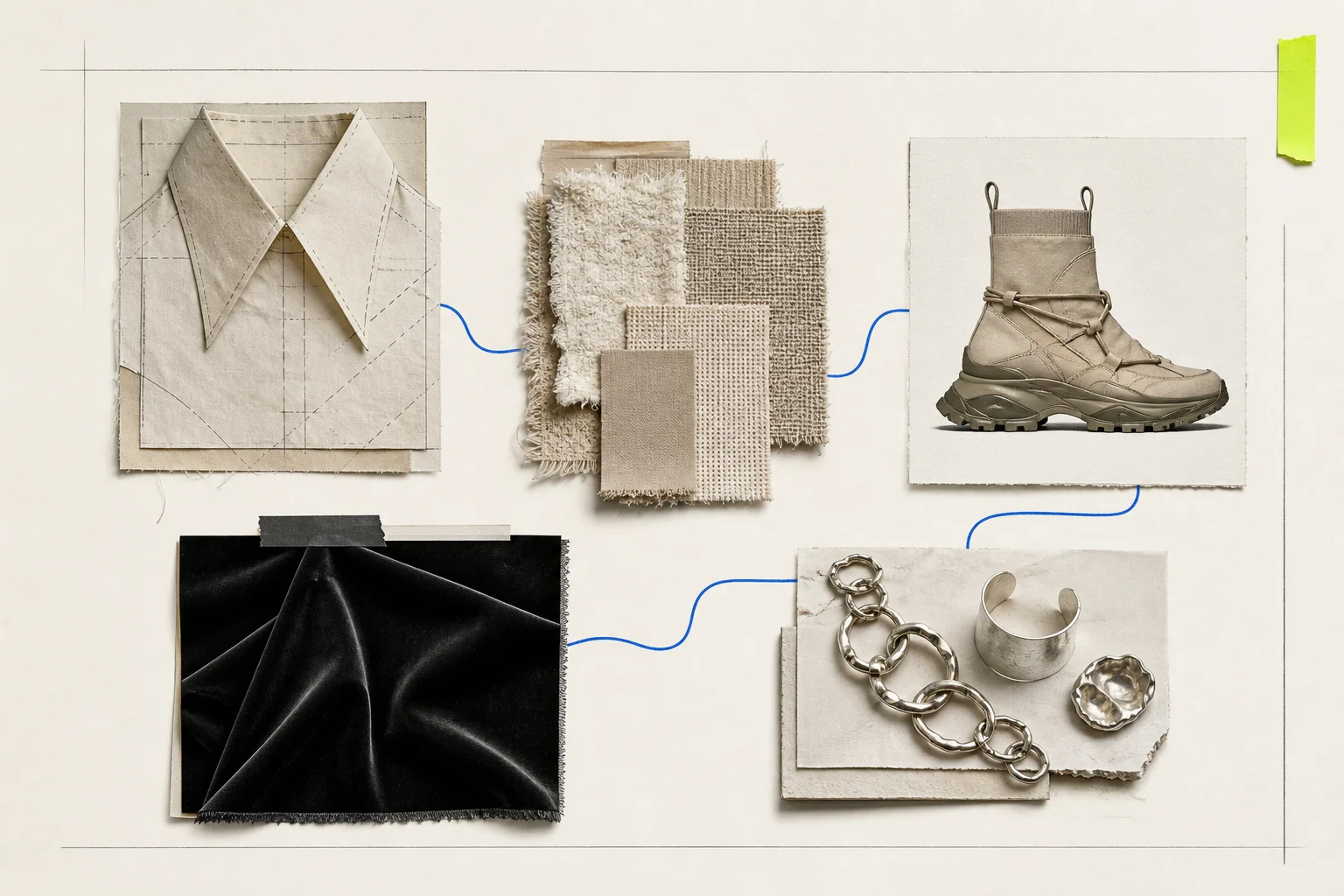
Forecasting is most tempting just before the next show cycle. Visible products are still arriving, buyers are preparing for another market, and a few repeated ideas begin to look like a direction. The risk is that a flexible “signal” becomes a confident prediction only after editors already know what happened.
FashionMember is freezing this draft on September 1, 2026. The CFDA’s preliminary Spring/Summer 2027 New York Fashion Week schedule begins September 10, and applications for the corresponding September Paris womenswear calendar are closed. Those future presentations are outside the evidence window. This article records hypotheses to carry into observation, not findings from shows that have not occurred.
Signal is not trend, and forecast is not fact
A signal is a dated observation that may justify more research. It can appear in a runway look, product page, retailer taxonomy, buyer conversation, material request, customer search, sale, return reason, or cultural practice. Its meaning depends on source and denominator.
A trend requires patterned change across a defined sample and time. A forecast states what may happen within a declared horizon and should include uncertainty, disconfirming evidence, and an expiration date. A commercial recommendation adds inventory, cash, margin, and operational judgment.
Keep these stages separate. The observation “a current product has an exaggerated collar” can be true while “statement collars are returning,” “customers want them,” and “a boutique should buy them” remain unproven.
Signal one: detail is carrying the silhouette
Current first-party pages from Thom Browne, Chloé, and Valentino give collars explicit visual and product-language emphasis through exaggerated points, large scalloped edges, bows, stand-up forms, and ruffles. Chanel’s current blouse and shirt assortment adds a broader wardrobe context.
The hypothesis is that recognizably framed necklines can refresh familiar shirts, blouses, knitwear, jackets, and dresses without requiring an entirely new body silhouette. This may make the detail useful in product images and layered styling.
The disconfirming case is strong: these products may remain concentrated in luxury or vintage-coded niches, create outerwear and care friction, or appear large because editors selected only the most visible examples. The next test needs a locked multi-season runway denominator, a balanced retail panel, physical measurements, and buyer decisions.
Signal two: material is doing the work of color
Current color and collection pages show a continuing vocabulary of beige, cream, brown, stone, softened white, tweed, raffia, suede, mixed fibers, canvas, and knit. Chanel’s Fall/Winter 2026 Pre-Collection explicitly moves between officewear, boyish ease, and evening attire while listing wool, tweed, denim, silk, suede, patent calfskin, mesh, and strass products.
The hypothesis is not that one named neutral will dominate. It is that surface, fiber, gloss, weave, pile, and construction may carry more of the visual distinction within restrained palettes. A textured neutral can appear deeper or warmer because it reflects and traps light differently.
The test requires licensed physical color standards, controlled lighting, material verification, instrument and visual assessment, care testing, and a locked assortment sample. Screen images and marketing color names cannot establish the physical shift.
Signal three: occasionwear is becoming a system
Nordstrom’s current holiday-party assortment crosses dresses, tops, skirts, shoes, bags, jewelry, and outer layers instead of presenting one formal uniform. The 2025 NRF holiday record and Thanksgiving survey establish the wider seasonal relevance of clothing and accessories, though they do not describe independent boutique buying.
The hypothesis is that holiday dressing will be planned as a modular system: one expressive piece combined with existing wardrobe, adaptable across work, family, hosting, travel, ceremony, and evening. Comfort, outerwear compatibility, care, delivery, and repeat use may become as important as sparkle.
This idea fails if customers still prefer highly specific single-event pieces, if modular products reduce basket value, or if the apparent breadth is only a department-store navigation choice. Direct boutique-buyer interviews, physical samples, received inventory, completed returns, and kept sales are required.
Signal four: accessories are widening identity options
Current men’s-jewelry pages at Nordstrom and Tiffany organize chains, bracelets, rings, pendants, earrings, pins, cuff links, diamonds, precious metals, mixed materials, and personalization within a men’s path. The visible category vocabulary is broader than a watch-and-wedding-band shorthand.
The hypothesis is that accessories can support lower-size-risk experimentation, self-purchase, gifting, ceremony, and more individualized styling across merchandising labels. Small objects can alter a familiar wardrobe and travel across seasons.
The disconfirming case is that dynamic SKU breadth overstates demand, watches or duplicate variants inflate category counts, and luxury presentation does not translate to independent retail. The test requires a gender-respectful category protocol, a stable retailer panel, material and size truth, repair and warranty data, completed returns, kept sales, and reorders.
Signal five: utility is becoming visibly hybrid
Current footwear categories mix trail-derived geometry, recovery language, clogs, weather materials, adjustable closures, and everyday styling. The design signal is a shoe that borrows visual or construction cues from several use contexts.
Hybrid does not prove performance. A lugged outsole is not automatically slip resistant; a cushioned-looking form is not a medical benefit; outdoor styling is not workplace protective equipment. Physical tests, declared surfaces, wear conditions, accessibility, care, and claims review remain separate.
The next-season question is whether hybrid utility becomes a durable category with received inventory, repeat use, mature returns, and reorders, or remains a visual styling vocabulary.
The source freeze must precede the shows
For every signal, preserve the source URL, publisher, collection or product identity, access date, image rights, geography, price, availability, and captured text. Archive only where permitted. Record sources that contradict the hypothesis as actively as those that support it.
When the runway cycle begins, freeze the eligible schedule and collection list. The CFDA preliminary calendar identifies 70 runway shows and presentations for September 2026; that number describes the schedule, not an automatic sample. Define which official, appointment, digital, menswear, womenswear, and off-calendar presentations qualify.
Two coders should review every eligible look against written definitions. Publish agreement, missing shows, inaccessible images, and collection changes. Do not add a collection after seeing that it contains the desired signal unless the protocol records the amendment.
Retail evidence should advance in stages
Use a consistent evidence ladder:
- Appearance: an identifiable feature exists in an authorized source.
- Assortment: it appears within a locked eligible product denominator.
- Commitment: a buyer places a documented order.
- Receipt: inventory arrives in saleable condition within the useful window.
- Response: eligible customers buy it with known price and promotion.
- Quality: completed returns and kept sales are measured.
- Persistence: the product reorders, repeats, or survives a comparable season.
Each stage can fail for a different reason. Reporting should not skip from appearance to demand.
An editor roundtable must preserve disagreement
The planned editor roundtable should include fashion history, runway, retail, materials, accessories, footwear, cultural reporting, and visual research. Participants need the same frozen packet before discussion, disclosures of relevant commercial relationships, and an opportunity to score signals independently.
The moderator should ask what evidence would change each editor’s view. Record minority positions, conflicts, source gaps, and terms that need refinement. The roundtable should sharpen hypotheses, not vote a trend into existence.
No such roundtable has yet occurred for this draft. FashionMember will not fabricate consensus or retrospective quotations.
A reproducible fictional signal audit
FashionMember created four invented evidence packets in content/data/FM-125-next-season-signal-audit.csv. The script scripts/fm125-next-season-signal-audit.php checks whether a fictional packet defines the horizon and codebook, freezes published sources, locks runway and retail samples, uses two coders, conducts an editor roundtable, logs conflicts, verifies product identity, price and inventory, includes buyer interviews, receipts, completed returns, kept sales and reorders, and completes rights, claims, and human review.
Two complete fictional packets reach forecast-review; two remain on hold. Every editor, designer, collection, product, retailer, buyer, signal, order, receipt, return, sale, reorder, owner, and outcome is fictional. The audit does not forecast a real season.
What we are carrying is a test plan
The pre-season file contains five useful hypotheses: collar detail, material-led neutrals, modular occasion dressing, wider jewelry identity, and hybrid footwear utility. They are specific enough to code and broad enough to compare across runway, product, and retail evidence.
FashionMember is not yet carrying a prediction. The next publishable step is to collect the forthcoming official runway sample, run the editor roundtable, interview buyers, inspect products, and follow receipts through completed returns and reorders. A forecast earns credibility by making it possible to be wrong.
Sources and verification
- CFDA: Preliminary September 2026 Official NYFW Schedule — official dates, season, schedule scope, and preliminary 70-show context.
- FHCM: Events and September 2026 Application Status — official Paris Fashion Week calendar-process and timing context.
- Chanel: Fall/Winter 2026 Pre-Collection — current first-party wardrobe-use, material, product, and collection context.
- Thom Browne: Supersized Shirt With Exaggerated Point Collar — current first-party exaggerated-collar example.
- Chloé: Puff-Sleeve Blouse With Large Scalloped Collar — current first-party collar, material, fit, and availability example.
- Valentino: Georgette Blouse — current first-party ruffle-collar product example.
- Nordstrom: Women’s Holiday Party Outfits — dynamic first-party occasion-assortment context; not a locked boutique panel.
- NRF: December 2025 Retail Monitor — original holiday and clothing-accessory-store sales context.
- Nordstrom: Men’s Jewelry & Watches — dynamic first-party accessories taxonomy; not a market denominator.
- Tiffany & Co.: Men’s Jewelry — first-party form, material, and personalization context.
- Pantone: Articles and Color of the Year 2026 — current first-party forecast and palette context; not retail-demand evidence.
- Google Merchant Center: Local Product Data Specification — current official product, variant, price, availability, image, and local-data framework.
- FTC: Care Labeling Rule — authoritative regular-care instruction framework.
- FTC: Jewelry Guides — authoritative jewelry marketing and disclosure framework.
How this story was checked
- Sources
- 14 linked records · View list
- Last verified
- Reporting desk
- FashionMember Editorial Desk
- Format
- Analysis
- AI assistance
- Used with editorial review; disclosed above.