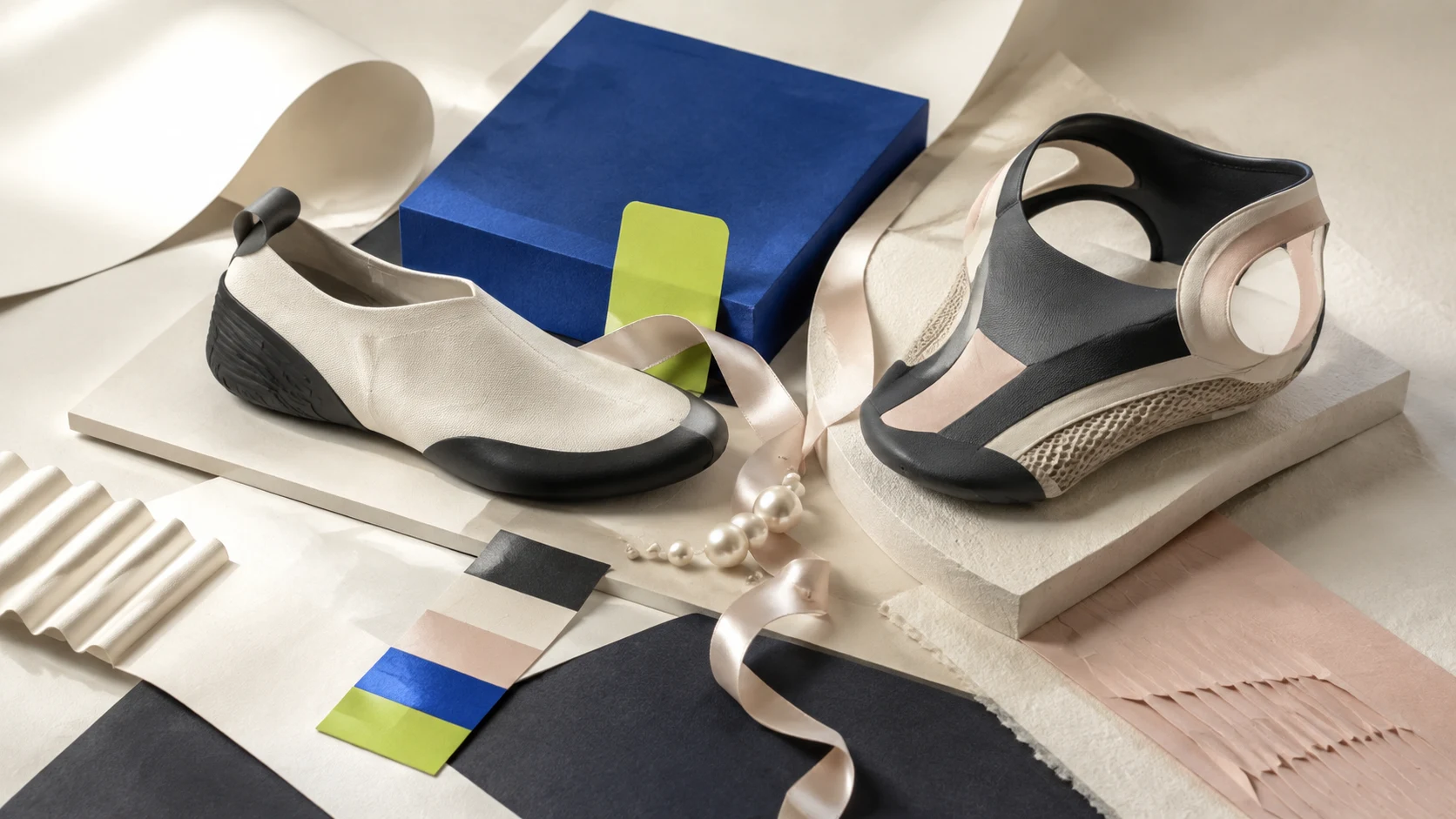
The most useful detail in adidas Originals and Simone Rocha’s Fall/Winter 2026 announcement is not a color or a shoe name. It is the handoff. A collaboration first shown inside a London runway collection is scheduled to launch globally on 10 September through adidas’s CONFIRMED app, adidas.com, adidas stores, Simone Rocha stores, simonerocha.com, and selected retailers.
That distribution list turns an aesthetic experiment into an operating test. The collection asks whether sportswear icons can carry a more ornamental, intimate vocabulary; the launch asks whether a global sports company and an independent fashion house can keep that vocabulary coherent across owned digital, physical, and partner channels. The announcement proves the product and timing. It does not prove demand, sell-through, or the commercial success of the collaboration.
The translation happens in the object
Adidas says the collection includes apparel, footwear, and accessories and reinterprets its Originals design language through Simone Rocha’s interest in femininity, craft, and materiality. The footwear examples are specific. The SR Taekwondo Ballerina adds ribbon lacing and pearl-inspired and diamanté embellishment at the toe. The SR Climacool turns a performance runner into a Mary Jane with a leather upper, cut-out tongue, and sculptural heel counter. The SR Japan Fuzzy Slip On uses a pony-hair-effect upper, an open heel, and pearl-like Three Stripes detailing.
Those descriptions identify three different kinds of design translation. The Taekwondo Ballerina changes the fastening and surface language. The Climacool changes the relationship between a technical reference and the foot, borrowing the visual logic of a Mary Jane while retaining the name of a runner. The fuzzy slip-on changes material cue and wear mode. None of those moves is simply a decoration layer; each changes how a customer reads an athletic archetype.
Simone Rocha’s own project page describes the partnership as a reimagining of sporting archetypes through construction, proportion, embellishment, function, and romance. That phrasing is useful because it keeps the collaboration’s promise at the design level. It does not claim that a ribbon makes a shoe perform differently, or that a pearl-like detail creates a new technology. A product page can make a style legible; it cannot establish comfort, durability, grip, or repairability.
The collection was first introduced during Rocha’s Autumn/Winter 2026 runway show in London in February, according to the adidas release and contemporary coverage. The months between reveal and release matter. They give the partnership time to convert a runway proposition into graded sizes, production specifications, channel allocations, imagery, and customer-service language. The translation is therefore both visual and operational.
Why the launch architecture matters
Adidas has built a particular role for its channels. Its 2025 annual report calls CONFIRMED a digital boutique and premium touchpoint for sneakerheads, streetwear, fashion, and style enthusiasts, and describes membership experiences that connect digital and retail touchpoints. The same report says the company invests in physical stores as places where consumers interact with product, teams, and communities. The Simone Rocha release uses both ideas at once: scarcity and cultural framing in a digital boutique, then a wider physical and partner footprint.
That architecture can protect a collaboration’s meaning, but it creates handoff questions. Does the product story read the same on an app tile, an adidas store fixture, a Simone Rocha product page, and a selected retailer’s size run? Are the material and care details consistent? Does a customer know whether a ribbon or embellishment is decorative, functional, removable, or covered by the same service policy as an ordinary Originals shoe? A launch can be visually unified while the operational record is fragmented.
For buyers, the product mix also changes the decision. A conventional low-profile trainer can be compared through size coverage, color, replenishment, and known conversion history. An embellished ballerina or an open-heel fuzzy slip-on needs additional information: how the detail affects fit, how it behaves in weather, whether the closure survives repeated use, and how the product is packed and displayed. The collaboration’s fashion value may be clear before those questions are answered, but the unanswered questions still sit with a retailer’s staff and returns team.
A collaboration is not a demand result
Adidas enters this launch with a strong recent operating backdrop, but the backdrop should be used carefully. In its first-quarter 2026 release, the company reported lifestyle revenue growth of 6%, global direct-to-consumer growth of 22%, e-commerce growth of 25%, and own-retail growth of 19%. In its 2025 annual report, it said footwear represented 57% of brand net sales, apparel 35%, and accessories 7%.
Those figures show why a fashion collaboration is strategically legible to adidas: Originals sits inside a large footwear business, and collaborations are one of the company’s stated tools for building desirability and demand. They do not tell us how this specific collection will perform. The reported periods precede the 10 September launch, the categories include products far beyond Simone Rocha, and the company does not publish a controlled result for one collaboration in the announcement.
The same discipline applies to the collection’s cultural reach. The adidas campaign, photographed by Justine Kurland, is described as a single tableau vivant whose film moves from quiet portraits to a wider landscape of shared experience. That is a creative choice, not a measurement of community, conversion, or retention. A campaign can make a product’s language easier to understand; it cannot substitute for a channel record.
The material question behind the romantic surface
Fashion collaborations often make materiality visible. Ribbons, pearl-like components, fuzzy surfaces, leather, and cut-outs are easy for an image to communicate. They also create a more complex care and quality brief than a plain textile upper. A retailer needs a defined material description, care instruction, component attachment method, and quality-control tolerance for the detail that gives the product its identity.
The public release does not provide a full bill of materials, test protocol, or repair pathway. FashionMember is not treating the campaign or product descriptions as those records. The practical question for a wholesale team is whether each channel receives the same product data packet: fiber and upper materials, component content, country-of-origin fields, care, size conversion, safety notes, and an escalation route for damaged embellishment. That packet can preserve the creative story while reducing avoidable returns.
For a Los Angeles independent brand studying the launch, the transferable lesson is not to imitate the ornament. It is to map the translation. Start with the core functional or cultural code, name the element that changes its meaning, document the new construction and care burden, and decide which channel can explain it honestly. A partnership can be a design laboratory only when the operating records travel with the idea.
What to watch after 10 September
FashionMember’s base scenario for the first two quarters after launch is strong cultural visibility with uneven channel evidence. This assumes the collection receives the planned global distribution and that adidas and Simone Rocha maintain consistent product information. Visibility may be high before repeat purchase or replenishment is known.
An upside case would show full-price sell-through across at least two channel types, low return rates for the altered constructions, and a clear data handoff from the digital boutique to physical and partner retail. A downside case would show demand concentrated in a few sizes or hero styles, embellishment-related returns, or inconsistent descriptions that make the product harder to sell outside its campaign imagery. Neither case can be inferred from the announcement alone.
The forecast is falsifiable. Watch the launch pages for size availability and care language, retailer assortments for consistent product identity, and future adidas reporting for any explicit collaboration or Originals commentary. Look for whether the company repeats the partnership, extends the product architecture, or changes channel emphasis. A second release can show that the collaboration has a durable place in the calendar; it still cannot prove that every decorative element improved the customer experience.
Adidas and Simone Rocha have made the first move legible: athletic references are being reframed through craft, ornament, and altered proportion, then sent through a deliberately broad launch network. The next evidence will be quieter than the campaign. It will sit in size curves, product data, care questions, returns, replenishment, and the ability of a retailer to explain why a performance archetype now reads as a fashion object. That is where a compelling translation becomes a sustainable commercial system.
Sources and verification
- adidas Originals and Simone Rocha introduce the Fall/Winter 2026 collection — 3 September 2026 release; collection scope, footwear descriptions, campaign framing, and 10 September channel launch.
- Simone Rocha: adidas Originals project page — designer-side description of the collaboration’s construction, proportion, embellishment, and launch timing.
- adidas Annual Report 2025: Product and marketing — product-category mix, Originals positioning, collaboration role, and lifestyle strategy context.
- adidas Annual Report 2025: Business model and e-commerce — physical-retail role, CONFIRMED digital-boutique description, membership touchpoints, and channel architecture.
- adidas first-quarter 2026 results — company-reported lifestyle, e-commerce, own-retail, and direct-to-consumer growth before this launch.
- British Vogue: Simone Rocha’s adidas collaboration — independent runway context for the February 2026 reveal; not evidence of launch demand or sell-through.
This article separates adidas and Simone Rocha descriptions, company-reported channel context, launch logistics, and FashionMember analysis. It does not claim a sales result, customer study, performance test, quality result, or market-wide trend from the collaboration. The synthetic cover is not a photograph or evidence of a real collection, product, runway, or person. It is not investment, legal, or product-safety advice.
How this story was checked
- Sources
- 6 linked records · View list
- Last verified
- Reporting desk
- FashionMember Editorial Desk
- Format
- Analysis
- AI assistance
- Used with editorial review; disclosed above.