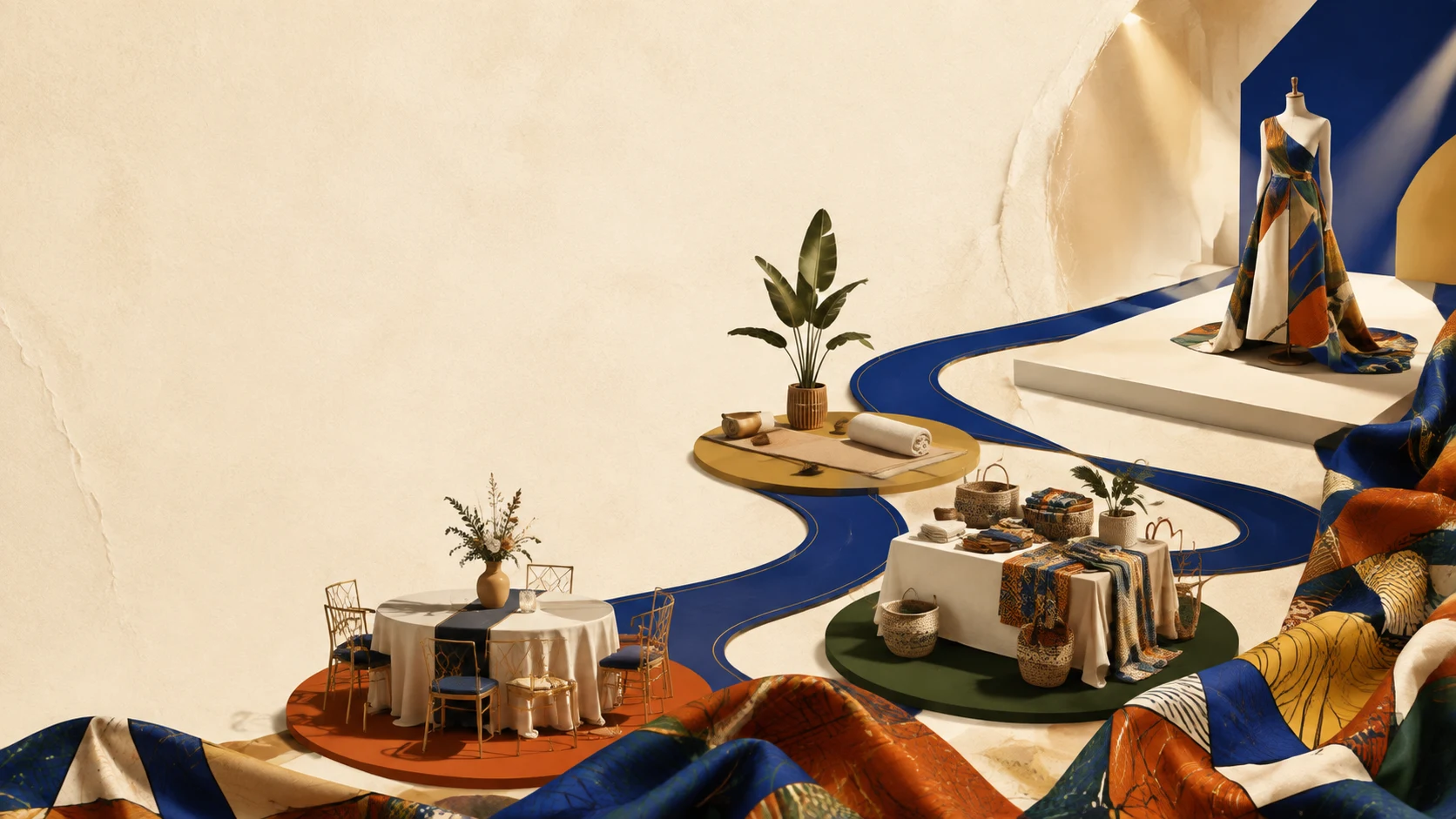
On a weekend when Los Angeles usually asks fashion to pose for one night, Ankara Festival LA is proposing a longer experiment. The organizer’s current program runs September 4–6 and moves through three different kinds of room: a Friday Afro Met Gala at The Fountain LA, a Saturday Pilates and Afrobeats session at The Godfrey Hotel Hollywood, and a Sunday runway and concert at Sunset Room Hollywood. The schedule is an announcement, not a report of what happened. Its value is the structure: a designer can be encountered at a celebration, in a wellness setting, in a marketplace, and finally in a runway production.
That sequence gives independent labels a sharper question than “Will the show get attention?” A community event can create several points of contact, but only a deliberate handoff turns those contacts into a relationship. The label needs a way to explain a garment, capture an opt-in lead, answer a sourcing question, and invite a next step without reducing cultural participation to a sales funnel.
A program with more than one entrance
Ankara Festival’s official site describes the 2026 edition as its 17th annual Los Angeles festival and says it has returned every Labor Day weekend since 2010. It presents fashion alongside music, art, dance, food, culture, runway, and community. The site lists the Friday gala from 8 p.m. to 2 a.m., Saturday’s Pilates session at 10 a.m., and Sunday’s “The Runway” from 4 p.m. to 10 p.m. It also names five runway designers—Soro’Bis from Burkina Faso, Abiola Beauty Concept from Nigeria, AfricStyle Fashion from Cameroon, Mike Sylla Couture from Senegal, and Olumay, listed as Nigeria and Los Angeles.
The program language matters because it sets expectations for what a visitor might do before seeing a collection. A label appearing only in the final runway block may reach a concentrated fashion audience. A label present in a marketplace or conversation can be encountered by people who came for food, music, or family time. The organizer says designers who apply receive full production support, including models, hair and makeup, photography, and a promotional video. That is a useful promise for a small team that cannot finance every production function alone, but it remains an organizer claim until a contract, deliverables, and final assets are reviewed.
The public ticket listing on Eventbrite adds a more granular Sunday agenda: red carpet and cocktails from 4:00 to 5:30 p.m., a runway show from 6:00 to 8:30 p.m., and a music concert from 8:30 to 10:00 p.m. Eventbrite names Sunset Room Hollywood at 1439 N Ivar Avenue and identifies the organizer as AFROBEAT LA. These details corroborate the official site’s Sunday venue and date while making the runway-to-concert handoff explicit.
One public record needs caution. A Los Angeles Department of Cultural Affairs calendar entry for the same September 6 festival currently names Academy LA rather than Sunset Room Hollywood. Because the organizer’s site and the Eventbrite ticket page agree on Sunset Room, this article uses Sunset Room as the current published location but treats the city listing as a reason to verify same-day instructions before traveling. The discrepancy is not a minor footnote for a designer: a venue change can alter load-in, lighting, ticket language, photography permissions, and the audience’s path through the event.
What the sequence can teach a small label
FashionMember’s reading is a four-step community runway test. It is an editorial framework, not Ankara Festival’s official measurement plan.
First, separate the encounter from the explanation. A striking look can start a conversation, but a visitor still needs a plain-language account of the textile, construction, care, price range, and where the brand operates. The explanation can be a small card, a scannable page, or a short conversation with a team member. It should identify what is known and what is still being confirmed. A cultural reference deserves context, not a decorative label.
Second, design a permissioned follow-up. A QR code that quietly harvests a phone number is not a relationship. A clear opt-in can offer a lookbook, a studio appointment, a restock notice, or a note about the next market. Record the consent language and the purpose. If a designer is collecting emails, the form should say who is responsible for the list, how a person can unsubscribe, and what will happen next. The event can create attention; the label has to earn permission to continue.
Third, make the product record portable. A runway appearance and a product page answer different questions. Keep a stable style name, material description, care instruction, size range, fit note, production status, and current price or “price on request” language in one place. If a piece is one-of-one, say so. If it is a sample, say when an order can be discussed. This is where a cultural event becomes useful to a buyer or a curious customer without pretending that an image proves inventory.
Fourth, define the next human step. It might be a vendor appointment, a showroom visit, a made-to-order consultation, or a follow-up message from the designer. The step should have an owner and a response window. “We will be in touch” is not a workflow. “A member of the studio will answer sourcing and size questions within three business days” is one, provided the team can keep the promise.
The marketplace is a test of translation
The festival’s official site invites vendors to bring brands to attendees through a marketplace and invites sponsors to partner with what it calls a large African cultural festival in the United States. The Immigrant Magazine’s August 8 announcement describes a broader six-event program under the theme “Fashion Beyond Borders,” including a Saturday market square and an East Africa Meets West Africa soiree. Those descriptions show the event’s intended breadth, but they do not establish attendance, conversion, designer fees, or vendor sales.
For an independent label, the marketplace is where translation becomes visible. A visitor may recognize a print or silhouette through family, diaspora, or personal style, while another visitor may need a short explanation of its origin and contemporary use. The label can respect both audiences by crediting its references, avoiding claims of singular authenticity, and explaining the choices it actually made. That is editorial discipline and commercial clarity at the same time.
The most useful evidence after the weekend will be modest. How many people asked a product question? How many opted into a clearly described follow-up? Which questions repeated? How many appointments were requested, and how many were completed? A tally does not measure cultural value, but it can reveal whether the event’s several entrances led anywhere. A sales total without the time window, inventory context, and returns status would be too thin to support a market conclusion.
Production details are part of the fashion story
The three venues create different production conditions. The Fountain LA lists its address as 2889 W Olympic Boulevard in Koreatown. The Godfrey Hotel Hollywood publishes its address as 1400 N. Cahuenga Boulevard and describes recurring hospitality programming. Sunset Room Hollywood describes itself as a flexible event space at 1439 N Ivar Avenue with private-event inquiries and venue tours by appointment. None of these public pages specifies Ankara Festival’s final stage plot, dressing-room allocation, lighting package, captioning, or garment-security plan.
Designers should therefore ask for the operational sheet rather than infer it from a polished event page: load-in time, number of looks, model call, steaming access, backstage security, music cue format, photography deliverables, image usage rights, ticket or vendor obligations, and what happens if the venue changes. A runway is a chain of dependencies. A missing garment rack or unclear image license can outlast the applause.
The same caution applies to the organizer’s statement that 5% of tickets go to charity. It is a meaningful claim, but the public page does not identify the recipient, accounting period, or transfer method. FashionMember will not convert that sentence into a verified donation figure. Readers who want to support the cause should ask the organizer for the beneficiary and reporting details, and should distinguish a ticket contribution from a tax-deductible donation.
Three ways the weekend could develop
FashionMember’s base scenario is a useful, repeatable bridge: the festival gives designers a professionally produced moment, and the labels preserve enough product and consent information for interested visitors to continue the conversation. The assumption is that organizers and designers share clear schedules and rights terms. Signals would be stable follow-up pages, answered questions, and appointments that can be traced to the event without overstating causality.
In an upside scenario, the different rooms work as a genuine network. A person sees a designer at the gala, learns more at the market, and meets the collection on Sunday with enough context to make an informed request. The falsifier would be a beautiful runway with no accessible product information, no way to contact the label, or a venue change communicated too late for participants.
In a downside scenario, the event becomes six disconnected moments competing for the same attention. Designers receive images but not usable files, vendors collect leads without clear consent, and the public record retains conflicting venue details. Warning signs would be duplicate forms, unclear ownership of follow-up, and claims about reach or impact that cannot be reconciled with a dated record.
These scenarios are not forecasts of Ankara Festival LA or its designers. They are a way to assess what a community runway leaves behind once the music stops.
What to watch on September 6
The headline runway will be the visible part of Ankara Festival LA, but the more consequential story may be the handoff around it. Can a designer explain a garment without flattening its cultural context? Can a visitor choose a respectful next step? Can an organizer make venue, rights, accessibility, and charitable claims legible enough for participants to verify?
Those questions keep the event from being judged only by a photograph or a crowd-size claim. A runway can be a stage, a marketplace can be a conversation, and a festival can be a bridge—but each role requires a record and an accountable person. For independent fashion, that is the difference between visibility that disappears on Monday and community that can be built again.
Sources and verification
* Ankara Festival LA official program — primary source for the September 4–6 dates, three-venue schedule, published runway lineup, organizer descriptions, and 5% charity statement. * Eventbrite: African Fashion & Music Fest (Ankara Festival 2026) — current ticket listing for the September 6 agenda, Sunset Room Hollywood location, and organizer attribution. * Los Angeles Department of Cultural Affairs event calendar — city calendar record; its Academy LA location conflicts with the organizer and ticket listing and is flagged for reader verification. * The Immigrant Magazine, “The 17th Annual African Fashion and Music Festival Returns…” — published August 8, 2026 announcement describing the “Fashion Beyond Borders” theme and six-event framing; organizer-provided details, not independent attendance or outcome evidence. * The Fountain LA — official venue page confirming 2889 W Olympic Boulevard, Los Angeles. * The Godfrey Hotel Hollywood happenings — official venue page confirming 1400 N Cahuenga Boulevard, Los Angeles. * Sunset Room Hollywood and contact page — official venue pages confirming 1439 N Ivar Avenue and event-inquiry information.
Last verified: September 4, 2026. The festival had not yet taken place. Organizer claims, ticket and venue listings, and the conflicting city-calendar location are separated from FashionMember’s analysis. No attendance, designer sales, product availability, audience conversion, charity transfer, or post-event outcome is claimed.
How this story was checked
- Sources
- 8 linked records · View list
- Last verified
- Reporting desk
- FashionMember Editorial Desk
- Format
- Feature
- AI assistance
- Used with editorial review; disclosed above.