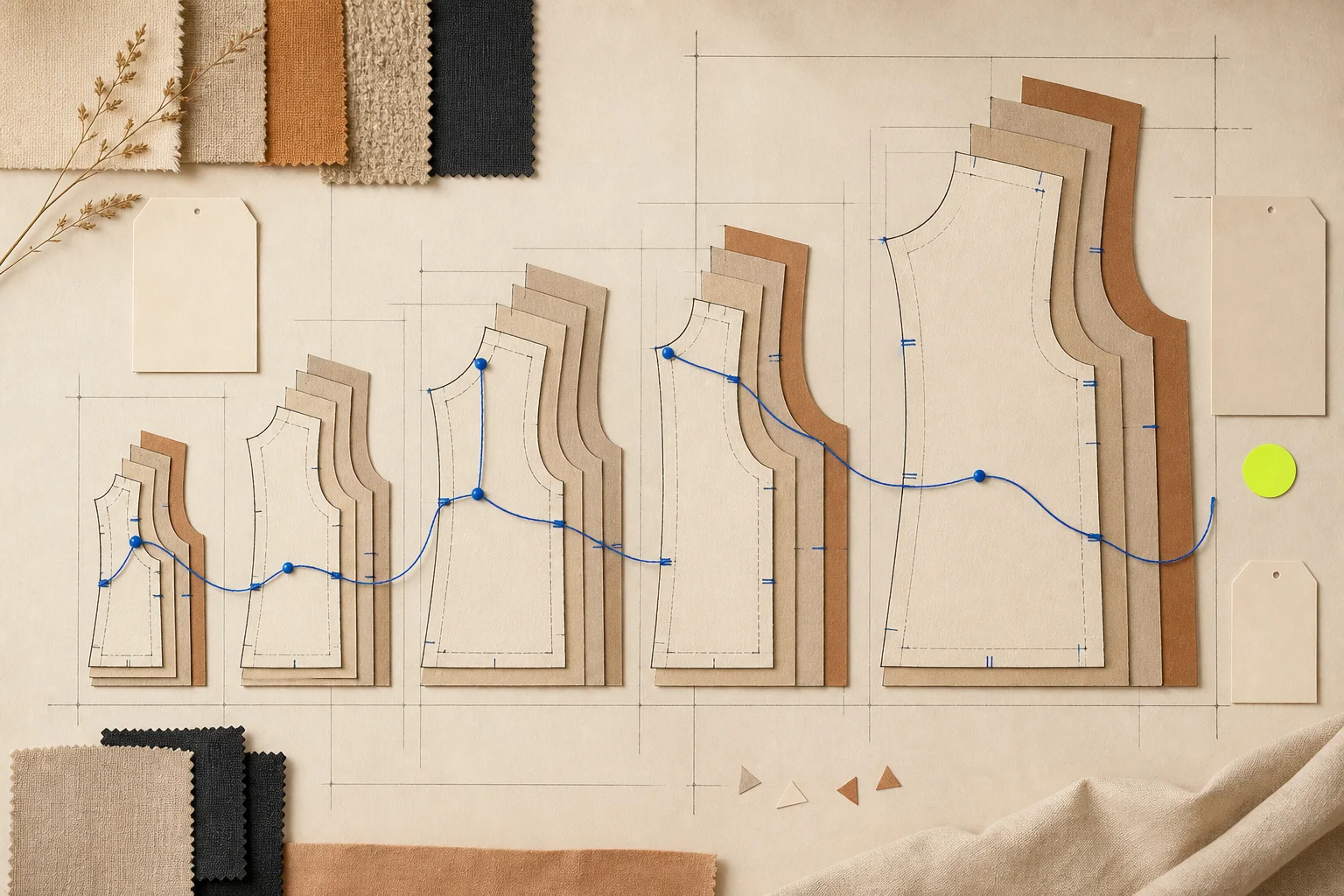
Size inclusivity is easy to announce and difficult to operate. A campaign can add more size labels in one sentence. A working system has to connect bodies to garment measurements, grade a specific construction across a range, make representative physical samples, allocate inventory, describe fit clearly, photograph product responsibly, support exchanges and returns, and learn without treating customers as errors.
That difference matters after the marketing moment. A label may technically offer more sizes while only stocking some of them, fitting only the center, hiding garment measurements, or using one block across fabrics and shapes that behave differently. The credible question is not “How high does the size label go?” It is “What evidence supports each offered size and the experience around it?”
This draft does not evaluate or rank a real brand. FashionMember did not receive authorized measurement, pattern, sample, inventory, return, customer, or sales data and did not conduct fittings or interviews. Any claim about real fit, representation, access, or customer experience remains dependent on those sources and qualified human review.
Define the measurement before publishing the number
Body dimensions and garment dimensions are different. A body measurement describes a person according to a stated protocol. A garment measurement describes a physical product at a defined point and state. Ease connects them, but the appropriate relationship depends on silhouette, fabric, construction, movement, layering, intended use, and design intent.
Every published measurement needs a name, landmarks, orientation, tension, tool, units, rounding rule, tolerance, and diagram. “Chest” may refer to body circumference, a flat garment width, or a doubled flat measurement. “Length” may start at the high shoulder point, center back, waist, or another reference. Ambiguity creates avoidable returns and makes comparisons unreliable.
The National Institute of Standards and Technology’s Body Dimensions for Apparel publication documents measurement and sizing work and explains that body shape varies as well as body size. The Centers for Disease Control and Prevention publishes National Health and Nutrition Examination Survey body-measure data with examination protocols. These are population research resources, not permission to declare that one brand’s block represents everyone.
Document the target population, sample, collection date, exclusions, transformations, and limits before using external body data. Then validate the chosen block with consenting participants relevant to the intended market.
Treat grading as design work
Grading is not a neutral scale command. Grade rules distribute change across points on a pattern. If the underlying block, proportion assumptions, or garment construction do not match the intended wearer, adding more increments can extend the same problem.
For each style, record the base size, nest, grade rule table, critical garment measurements, ease targets, fabric stretch and recovery, seam and trim constraints, balance, and tolerances. Review how pockets, closures, necklines, rises, armholes, hems, prints, and support components behave through the range. A construction that works in the base size may require a different solution elsewhere.
ASTM publishes voluntary apparel body-measurement tables, including a current adult-male standard. A purchased standard can help establish common terminology and reference ranges, but it cannot approve a proprietary size system or replace product-specific fittings.
Sample the range you claim
A digital nest, 3D simulation, or measurement chart can identify questions. None proves how a finished garment will feel and move across all offered sizes. Physical samples remain necessary because fabric, sewing, pressing, wash, hardware, and production tolerances change the real object.
Build a sampling matrix across the offered range rather than fitting only one central size. Include relevant shapes and statures through a consented, paid, and respectful process. Test standing, sitting, walking, reaching, dressing, closures, pocket access, opacity, support, friction, temperature, and intended layers. Record what was observed without medicalizing bodies or blaming the wearer.
The matrix should distinguish a sampled size from an unsampled extrapolation. If time or budget prevents physical coverage, the honest response is to narrow the offer, disclose the evidence gap internally, or hold publication—not to treat a label as validation.
Make the product page do real work
A size chart is most useful when it is specific to the product or a clearly defined block and supported by garment measurements. Include the model or sample wearer’s relevant measurements only with consent and state the garment size shown. Describe intended ease, fabric behavior, lining, adjustable features, and meaningful fit differences from related styles.
Product-data systems also need variant integrity. Google Merchant Center requires the size attribute for relevant apparel listings and documents other variant attributes such as size system and size type. That is channel-specific schema guidance, not a universal definition of inclusive sizing. A correctly formatted field can still contain a misleading value.
The Federal Trade Commission’s apparel materials emphasize fiber, care, and country-of-origin labeling obligations. Fiber content and care affect fit expectations because shrinkage, stretch, recovery, and maintenance can change the wearing experience. Product information must rest on the actual item and appropriate testing, not generic copy inherited from another style.
Inventory is part of availability
Offering a size in a chart while carrying negligible depth, excluding it from key colors, delaying it beyond the main launch, or restricting it to a difficult channel creates a different experience from true availability. Track initial buy, receipts, stockouts, wait time, cancellations, sell-through, markdown, returns, and exchanges by size—while controlling access to sensitive customer information.
Raw rates require context. A size with low stock can appear to sell through quickly. A return rate can be distorted by incomplete cohorts, exchange handling, shipping damage, or incorrect reason codes. Do not interpret a size as undesirable or a body as costly from one metric. Pair quantitative review with consented qualitative research and inspect product, content, service, and availability together.
Representation needs operational backing
Imagery and language should show the offered range without tokenizing people or retouching away evidence of fit. Participants need informed agreements covering purpose, usage, term, territory, edits, captions, compensation, accessibility, and withdrawal or correction routes where applicable.
Service teams need the same measurement definitions as technical design and e-commerce. Give them product-specific guidance, escalation routes, accessible contact options, and authority to report recurring fit problems. Returns should feed structured product learning, not a script that pressures customers to keep unsuitable items.
Testing the size-system record
FashionMember created four invented offers in content/data/FM-120-size-inclusivity-audit.json. The script scripts/fm120-size-inclusivity-audit.php checks only whether each packet contains fictional documentation for measurement definitions, population basis, body-to-garment mapping, grade rules, ease and fabric, physical fitting, chart, imagery and copy, inventory, returns and service, accessibility, and an accountable owner.
For this deliberately strict demonstration, every offered fictional size must have a documented fictional physical sample before the row can reach size-system-review. Two complete rows advance and two are held. That output is not a fit guarantee, grading approval, accessibility certification, population-representation claim, inventory commitment, or product recommendation.
Publish the system and its limits
A credible inclusivity statement should name the styles and markets covered, measurement method, size system, fit-sample scope, date, channels, availability rules, and customer feedback route. It should also state what remains under development.
The strongest evidence will not fit in a campaign tagline. It lives in patterns, samples, product pages, inventory records, consented research, return diagnosis, service procedures, and named owners. When those parts align, broader sizing becomes more than a marketing moment: it becomes a maintained product promise.
Sources and verification
- NIST: Body Dimensions for Apparel — official publication on apparel body-dimension and sizing research; not validation of a brand block.
- CDC/NHANES: Body Measures, 2021–2023 — official variable definitions and examination data documentation.
- CDC FastStats: Body Measurements — official U.S. body-measurement statistics and links to source data.
- ASTM D6240/D6240M-24a — standards-body scope for adult-male body-measurement tables; access to the current licensed standard and expert use remain required.
- Google Merchant Center: Size — current first-party product-data requirement for size in applicable markets.
- Google Merchant Center: Product Data Specification — current first-party variant and product-data schema; not proof that submitted values are accurate.
- FTC: Apparel and Labeling — official U.S. apparel-labeling resources.
- FTC: Threading Your Way Through Textile and Wool Labeling Requirements — official fiber, origin, and identity guidance.
- FTC: Care Labeling Rule — current rule context for care instructions.
How this story was checked
- Sources
- 9 linked records · View list
- Last verified
- Reporting desk
- FashionMember Editorial Desk
- Format
- Analysis
- AI assistance
- Used with editorial review; disclosed above.