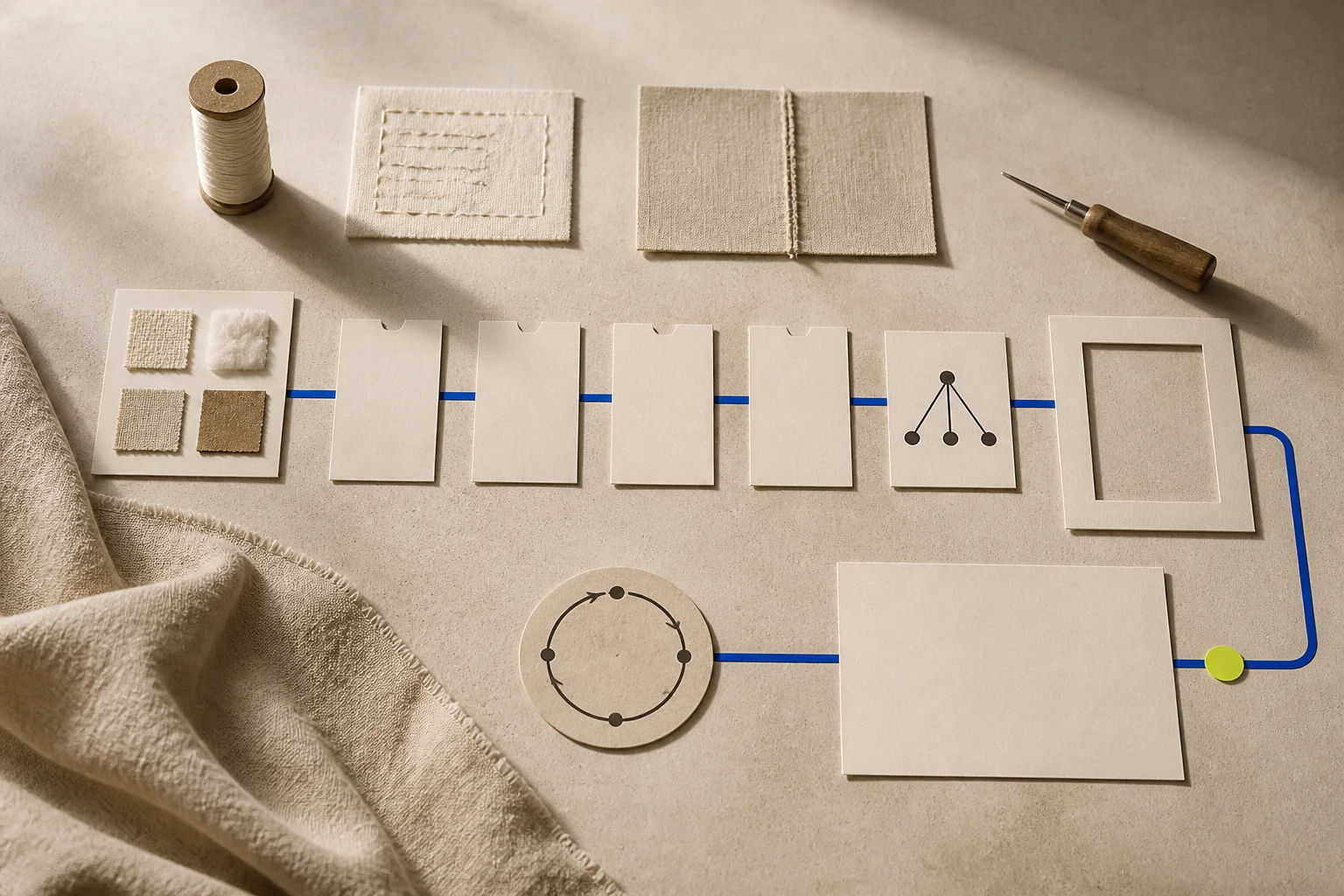
A hand stitch, irregular surface, named technique, workshop photograph, or maker story can slow a customer’s attention. It can suggest that a product has a knowable origin and that someone is accountable for how it was made. But suggestion is not verification. “Craft” can describe a real process, an aesthetic, a small amount of finishing, a marketing category, or an entire production system.
FashionMember reviewed current first-party craft programs and collection language plus official U.S. origin, textile, jewelry, advertising, and image guidance. It has not interviewed independent makers or consumers, inspected products, verified production steps, or measured trust. This draft explains how craft might become a trustworthy signal without declaring that it already has.
Start with the exact claim
Handmade, hand-finished, artisan-made, atelier-made, crafted, traditional, locally made, and made in USA are not interchangeable. The record should preserve the exact words, placement, product, component, market, channel, and date. Then ask what a reasonable customer could infer.
If only embroidery is completed by hand, a headline should not imply that the full garment is handmade. If a brand designed locally but outsourced production, “local craft” needs qualification. If a workshop uses machinery for repeatable steps and handwork for others, describe both. Precision does not diminish skill; it makes the contribution legible.
FTC advertising guidance requires a reasonable basis for objective claims. The Made in USA Rule says unqualified U.S.-origin labels require that a product be “all or virtually all” made in the United States. Textile origin rules add product-specific considerations. A qualified reviewer should assess the exact supply chain and wording before the claim is used on a product or in marketing.
Build a process record
A credible craft packet should identify the maker or team with permission, their role, the product and component, materials and suppliers, technique definition, tools, process sequence, time or labor record, facility, subcontractors, quality checks, repair and care, image rights, and known uncertainty.
Photographs should be connected to the specific step and date. A beautiful workshop image is not proof that every sold unit passed through that workshop. Preserve batch, lot, purchase order, or another authorized link where appropriate without exposing sensitive personal or commercial data.
Loewe’s Craft Prize 2026 rules illustrate the documentation expected in a formal craft context: original work, maker and portfolio information, material, dimensions and weight, technical statement, and photographs with rights. That is a first-party competition framework, not proof of a fashion product’s supply chain or customer trust. It is useful because it shows how quickly the word “craft” becomes a structured evidence problem.
Institutional celebration is not product verification
Chanel’s 2026 Métiers d’art collection publicly celebrates the specialized work of its Maisons d’art. Loewe’s Fall/Winter 2026 campaign links craft and innovation to expressive silhouettes, while Dior’s Cruise 2027 presentation foregrounds savoir-faire. These sources show that major houses continue to use making and specialist skill as part of fashion communication.
They do not prove what an independent brand produces, how a particular retail item was made, or what a customer believes. A balanced article should select a locked set of products, seek direct process evidence, include makers with different scales and business models, and record refusals or unavailable documentation.
Trust must be measured, not inferred from adjectives
Consumer research should define trust before testing it. Possible dimensions include confidence that a claim is accurate, that the product can be repaired, that the maker can be identified, that materials match the description, or that the seller will respond when something goes wrong. These are distinct outcomes.
Recruit participants with informed consent and disclose compensation. Randomize or counterbalance materials where practical. Compare a precise process explanation with a vague craft label while keeping product facts consistent. Ask participants to explain their interpretation before measuring confidence. A preference for visible texture is not the same as trust, and willingness to pay is not proof that a claim is true.
Avoid collecting sensitive demographic information unless it is necessary and justified. Preserve anonymized responses, exclusions, sample size, question order, and uncertainty. Do not generalize a small convenience sample to all consumers.
Physical inspection closes the gap
For each product, verify fiber or material identity where possible, construction, seams, finishing, visible variation, label information, care, repairability, and consistency with the public process description. A hand irregularity may be evidence of a technique, a defect, or neither; consult the maker rather than narrating it alone.
FTC textile guidance provides a framework for fiber content, origin, and responsible-business identity on covered goods. Jewelry claims can involve metal fineness, gemstones, treatments, and other specific disclosures under the Jewelry Guides. These legal and technical systems remind the editor that “made with care” cannot replace a product specification.
Repair and aftercare are particularly useful trust tests. Record whether parts, matching materials, instructions, authorized repair, prices, and turnaround are actually available. Do not promise lifetime service based on a campaign phrase.
Retail evidence tests the signal in context
An authorized retail sample should connect exact products, current prices and inventory, product pages, shelf or staff language, customer questions, completed sales, completed returns, repair requests, and reorders. Staff interviews should distinguish what the maker documented from what the store added.
A higher price does not prove more handwork. A lower return rate does not isolate trust unless products, windows, and customer mix are comparable. Publish denominators and separate ordered, received, available, sold, returned, kept, repaired, and reordered units.
Images require rights and accurate captions. Generated editorial still lifes must be labeled as non-documentary and cannot stand in for a real workshop. W3C guidance supports alternative text based on the image’s function in context.
A reproducible fictional craft audit
FashionMember created four invented evidence packets in content/data/FM-110-craft-trust-audit.json. The script scripts/fm110-craft-trust-audit.php checks whether a fictional packet documents maker identity, process steps, material origin, technique definition, time and labor, subcontractors, image rights, physical inspection, repair and care, origin claims, independent-maker interviews, consumer research, a retail sample, price and inventory, completed returns, a trust measure, claims review, a human editor, ownership, and complete packet arithmetic.
Two complete fictional packets reach craft-review; two remain on hold. Every maker, product, material, process, workshop, consumer, retailer, return, trust result, owner, and claim is fictional. The audit does not verify a real craft practice or certification.
Traceability turns a signal into evidence
Craft can create trust when the public story can be followed from words to a person, process, material, product, care path, and accountable business. Visible making alone is an invitation to investigate, not the conclusion.
Until FashionMember completes maker and consumer interviews, physical inspection, process and origin verification, retailer review, rights, and human editing, it can publish the evidence standard and current institutional context. It cannot claim that craft has produced verified consumer trust.
Sources and verification
- Chanel: Métiers d’art 2026 Collection — current first-party celebration of specialist artisans and materials; not independent process verification.
- Loewe Foundation: Craft Prize 2026 Rules — current first-party documentation and rights requirements for competition entries.
- Loewe: Fall/Winter 2026 Campaign — current first-party craft, innovation, construction, and silhouette language.
- Dior: Cruise 2027 Show — current first-party savoir-faire context; not product-level labor evidence.
- FTC: Made in USA Rule — authoritative requirements for unqualified U.S.-origin labeling.
- FTC: Complying with the Made in USA Standard — authoritative origin-claim guidance and textile-specific context.
- FTC: Threading Your Way Through Textile and Wool Labeling — authoritative U.S. fiber, origin, and responsible-business labeling guidance.
- FTC: Apparel Labeling — official apparel-labeling resource hub.
- FTC: Advertising FAQs for Small Business — authoritative claim-substantiation guidance.
- W3C WAI: Images Tutorial — authoritative image-purpose and alternative-text guidance.
How this story was checked
- Sources
- 10 linked records · View list
- Last verified
- Reporting desk
- FashionMember Editorial Desk
- Format
- Analysis
- AI assistance
- Used with editorial review; disclosed above.