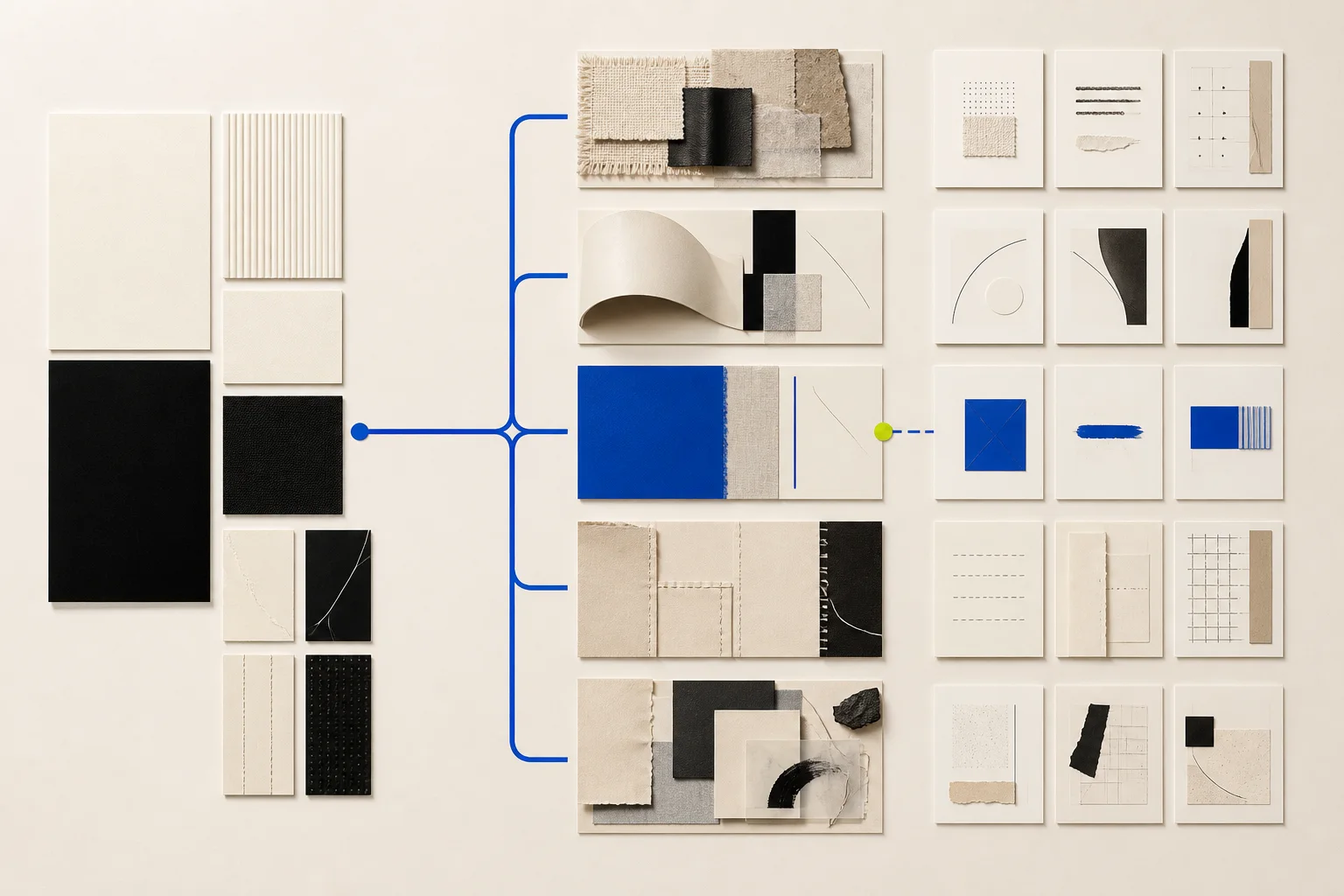
“After minimalism” sounds like a clean turning point: quiet gives way to ornament, neutrals to color, and simplicity to display. Current collection language is less orderly. Restrained silhouettes can carry complicated materials. Bold volume can coexist with practical garments. Craft, bricolage, washed surfaces, silk, raffia, and controlled lines can all appear without forming one successor movement.
FashionMember reviewed current first-party collection pages and official commerce, advertising, origin-claim, and image guidance. It has not coded a locked visual sample, interviewed independent designers, inspected products, or reconciled retailer receipts, completed returns, and kept sales. This draft offers a codebook and reporting plan, not a declaration that minimalism is over.
Define the thing before announcing its end
Minimalism can describe restrained palette, limited visible ornament, clean silhouette, low surface interruption, reduced branding, a small material vocabulary, or a disciplined product range. Those dimensions do not always travel together. A white garment with complex pattern cutting may look quiet while being technically elaborate. A simple T-shirt with a large logo is geometrically restrained but not visually anonymous.
The codebook should score observable variables separately: palette range, contrast, silhouette volume, surface texture, print, embellishment, visible hardware, seam emphasis, material count, branding, layering, modularity, and explicit historical or cultural reference. Two trained coders should test a subset, record disagreement, and revise definitions before the full sample.
Do not equate minimal with durable, ethical, premium, timeless, or commercially safe. Those are separate claims requiring product, supply-chain, use, price, and business evidence.
Current collections show several directions
Prada’s Spring/Summer 2027 menswear note emphasizes choice, distillation, rematerialization, reclassification, and controlled silhouette across familiar garments. That language supports a direction in which restraint remains active but is reworked through proportion and material.
Loewe’s Fall/Winter 2026 campaign describes bold colors, dynamic volumes, craft, and expressive silhouettes. Chanel’s Cruise 2026/27 page combines moving silhouettes with silk foulard, raffia skirts, and washed canvas suiting. Dior’s Cruise 2027 presentation frames everyday dress, couture, and bricolage together.
These first-party pages establish that major houses are publishing several design vocabularies. They do not define independent-brand strategy, prove customer demand, or provide a balanced sample. The final study must freeze eligible collections before coding, include counterexamples, record the access date and region, and secure rights for any reproduced runway or product image.
A better map has multiple axes
Rather than one line from minimal to maximal, the analysis can track several possible movements:
- material emphasis, where texture, finish, transparency, weight, or hand carries the expression;
- expressive volume, where proportion changes while surface remains restrained;
- visible making, where seams, joins, repair, weaving, embroidery, or handwork become legible;
- narrative reference, where archive, place, subculture, memory, or collaboration shapes the product;
- modular utility, where fastening, layering, pockets, reversibility, and adjustment create variety;
- color and ornament, from one disruptive accent to dense pattern or embellishment.
A collection can occupy more than one axis. The code should preserve mixed results rather than force every look into a trend name.
Independent brands design inside constraints
For a small label, restraint may follow minimum order quantities, available fabric, pattern and sample costs, sewing capacity, cash timing, wholesale price architecture, photography budget, and the need to carry components across styles. Expressive design can sometimes reduce complexity—a dramatic proportion in one fabric—but it can also add trims, processes, rejects, care risk, and longer lead times.
Designer interviews should therefore ask what changed in the design brief and why. Did material availability enable the choice? Was visible detail added to communicate value online? Did a retailer request a clearer point of view? Which ideas were removed because of cost, skill, fit, accessibility, care, or delivery risk? Preserve the designer’s words and distinguish them from reporter interpretation.
The business record should connect each sampled product to material, construction steps, minimums, sample revisions, intended price, actual current price, size range, production quantity where authorized, and delivery status. Aesthetic analysis without this context can turn necessity into ideology.
Retail evidence tests legibility, not taste
An authorized retailer sample should record which products were reviewed, ordered, received, displayed, sold, returned, and reordered. Interview buyers about how they described each item to staff and customers. Did texture read in photographs? Did unusual volume create fit questions? Did visible craft justify a price, or did care complexity create hesitation?
Google Merchant Center’s specification is useful for exact product and variant joins: titles, descriptions, identifiers, sizes, prices, availability, and landing pages need to agree. It does not prove that the aesthetic language worked. Product pages and social attention are upstream evidence; completed kept sales and reorders are later stages.
Accessibility review should examine closures, weight, tactile surfaces, sensory load, movement, seated fit, layering, care, and available sizes. An expressive element is neither accessible nor inaccessible in the abstract. Test the exact product with consented participants in relevant contexts.
Claims and references require boundaries
Words such as handcrafted, local, timeless, sustainable, traditional, and made in USA can turn design storytelling into objective or implied claims. FTC advertising guidance requires a reasonable basis before dissemination. The Made in USA Rule sets a demanding standard for unqualified U.S.-origin claims. Product-specific legal review is necessary.
Historical and cultural references require accurate sourcing and, where appropriate, community consultation and permission. A visual resemblance does not establish lineage. Captions should say whether a connection was stated by the designer, documented by a source, or proposed by the reporter.
Generated editorial art must be labeled and must not be used as evidence of a real collection. W3C image guidance helps distinguish informative and decorative use and supports context-specific alternative text.
A reproducible fictional direction audit
FashionMember created four invented evidence packets in content/data/FM-108-post-minimalism-audit.json. The script scripts/fm108-post-minimalism-audit.php checks whether a fictional packet documents current collection sources, a minimalism definition, an after-minimalism codebook, a locked visual sample, two coders, independent-designer interviews, business context, exact product identity, material and construction, accessibility, price and inventory, retailer interviews, received inventory, completed returns, sales quality, claims and rights, a human editor, ownership, and complete look arithmetic.
Two complete fictional packets reach direction-review; two remain on hold. Every collection, look, designer, product, retailer, interview, receipt, return, sale, owner, and result is fictional. The audit verifies packet completeness, not a real movement.
The next language may remain plural
Independent brands do not need to replace minimalism with a costume of excess. They can make a more specific choice about where expression lives: material, volume, construction, color, reference, use, or the relationship among them.
The final FashionMember report should preserve that plurality and connect visual analysis to production and retail evidence. Until the locked sample, interviews, physical inspection, rights, receipts, completed returns, and human review are complete, “after minimalism” is a research question—not a forecast verdict.
Sources and verification
- Prada: Spring/Summer 2027 Menswear — current first-party language on choice, distillation, rematerialization, reclassification, and controlled silhouette.
- Loewe: Fall/Winter 2026 Campaign — current first-party color, volume, craft, construction, and expressive-silhouette context.
- Chanel: Cruise 2026/27 Collection — current first-party material and silhouette examples; not independent-brand or demand evidence.
- Dior: Cruise 2027 Show — current first-party everyday, couture, bricolage, and savoir-faire framing.
- Chanel: Fashion and Current Collections — current first-party collection index used to date eligible public material.
- Google Merchant Center: Product Data Specification — official current product, variant, size, price, availability, and landing-page guidance.
- FTC: Advertising FAQs for Small Business — authoritative substantiation guidance for express and implied claims.
- FTC: Made in USA Rule — authoritative rule context for unqualified U.S.-origin labels.
- W3C WAI: Images Tutorial — authoritative alternative-text and image-purpose guidance.
How this story was checked
- Sources
- 9 linked records · View list
- Last verified
- Reporting desk
- FashionMember Editorial Desk
- Format
- Analysis
- AI assistance
- Used with editorial review; disclosed above.