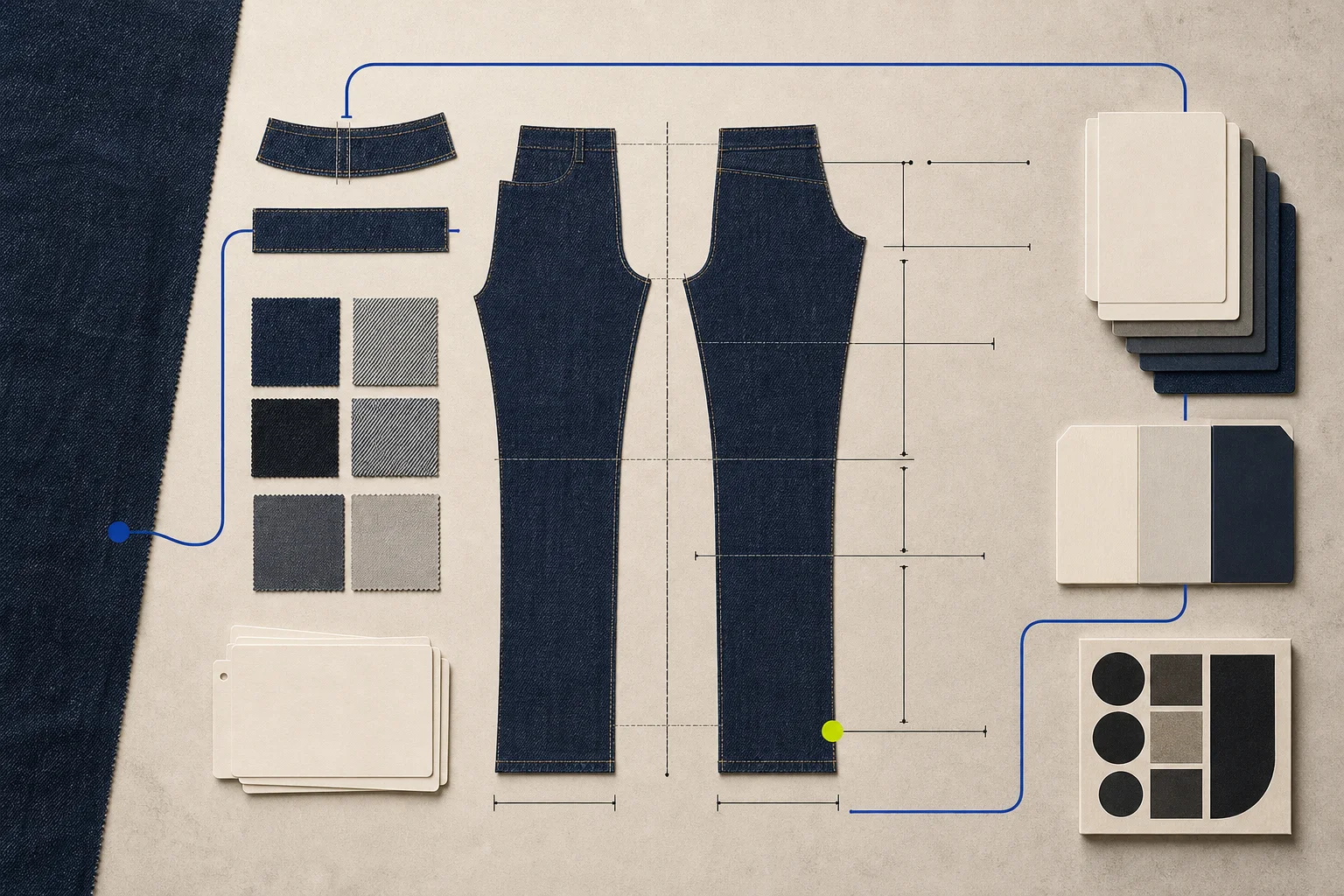
Denim fit is being described with an unusually broad vocabulary: loose straight, baggy, relaxed, classic straight, taper, slim, low rise, mid rise, and high rise can all sit in the same current assortment. That range is more useful than a declaration that one silhouette has “won.” It suggests a market in which several shapes coexist, serve different bodies and uses, and change meaning through rise, fabric, wash, styling, and size grade.
FashionMember reviewed current first-party product information and official product-data, labeling, accessibility, and retail-statistics guidance. It did not lock an authorized retailer sample, physically measure jeans, interview buyers or wearers, or reconcile inventory, completed returns, kept sales, and reorders. This draft therefore defines a responsible fit study. It does not certify a new cycle.
Replace fit names with geometry
A fit label is a starting point, not a measurement. The research record should include waistband circumference, front and back rise, seat or hip, thigh, knee, leg opening, and inseam. It should state where each point was measured, whether the garment was laid flat or measured on a form, how the fabric was conditioned, and the tolerance used. Photographs should show the method without identifying a wearer.
Levi’s current 568 Loose Straight product page, for example, describes a loose fit through the seat and thigh with a straight leg and lists rise, knee, and leg-opening measurements for a reference size. Its 501 ’90s women’s page describes a mid rise, loose hip and thigh, and straight leg. These are useful first-party specifications for exact products. They do not show that every loose or straight jean shares the same geometry, and they are not independent measurements.
The study must preserve exact style, color or wash, size, inseam, generation, region, and access date. A measurement attached to one size cannot silently become a product-family fact. A photograph of one wash cannot verify the hand, stretch, shrinkage, or dimensions of another.
Material changes the experience of shape
Rigid cotton denim, comfort stretch, high-stretch blends, lightweight chambray-like constructions, and heavily washed fabrics can produce different movement and recovery at similar flat measurements. Record fiber content, fabric weight where verified, weave, stretch direction, finish, care, and whether a product was physically inspected.
Words such as rigid, sculpting, flexible, authentic, vintage, or holds its shape may communicate different claims. Do not convert them into measured performance without a protocol. When shrinkage, growth, recovery, abrasion, or color transfer matters, test the exact variant under declared conditions and report the number of units, cycles, equipment, and deviations.
FTC textile guidance explains fiber-content, origin, and business-identity labeling obligations for covered products, while the Care Labeling Rule addresses appropriate care instructions. Those rules do not certify fit or quality. They help define what the product record should preserve and what a reporter should not guess from appearance.
Size grade is part of the silhouette
A named fit can change across the size run. The waist-to-hip relationship, rise, thigh ease, knee position, leg opening, and inseam options may not scale proportionally. A fit study should request the grade rule or measure a predeclared set of sizes rather than treating one sample as universal.
Recruit wearers only with informed consent and appropriate compensation. Include the intended size range, heights, mobility needs, seated use, dressing assistance, sensory needs, and other relevant contexts without turning personal data into a body ranking. Ask about specific tasks: fastening, sitting, walking, bending, pocket access, waistband pressure, hem management, layering, and care. “Flattering” is not a reproducible outcome.
Accessibility review should examine closure force, tactile distinction, pocket reach, internal labels, seam pressure, rigid waistbands, and whether inseam or alteration options are genuinely available. A barrier for one participant is evidence about that context, not a claim about every wearer.
A cycle needs a time series
Current product pages establish that multiple fits are offered now. They do not establish direction. To call the change a cycle, FashionMember would need a stable taxonomy and repeated observations across comparable dates, retailers, categories, price tiers, sizes, and regions.
For each period, count eligible styles and variants separately. Record buyer consideration, order placement, received inventory, days available, markdowns, transfers, eligible sales, completed returns, kept units, and reorders. A style offered in twelve washes should not automatically carry twelve times the silhouette weight, although variant availability matters for customer choice. State the denominator behind every percentage.
Buyer interviews should ask what changed in the intended customer, styling, size curve, price, fabric, rise, and inseam—not simply whether loose jeans are “in.” Retailers may add a fit while keeping their straight core. A reorder can reflect an inventory shortage, a strong size curve, or a single successful wash rather than a category-wide shift.
The Census Bureau’s Monthly Retail Trade estimates can provide broad clothing and accessories context, but the series is not a denim-fit census. It cannot show which rise, opening, or wash was purchased and kept. Macro retail data and store-level product records answer different questions.
Returns need product and timing context
Fit-related return reasons are valuable only after the return window is substantially complete and the denominator is clear. Separate ordered, shipped, delivered, returned, exchanged, and kept units. Preserve the exact variant. A customer selecting “too large” may be describing waist, thigh, rise, length, expectation, or inconsistent labeling.
Use a concise follow-up only with consent. Do not infer body shape, gender, disability, or intent from size and return data. Minimize retention, restrict access, and publish aggregates only when groups are large enough to protect participants.
A reproducible fictional fit audit
FashionMember created four invented evidence packets in content/data/FM-107-denim-fit-audit.csv. The script scripts/fm107-denim-fit-audit.php checks whether a fictional packet documents current product sources, a fit definition, a locked retail sample, exact variant identity, measurement points, size grade, material and stretch, physical measurements, wearer interviews, size, fit and accessibility, price and inventory, buyer interviews, received inventory, completed returns, sales quality, reorders, claims review, a human editor, ownership, and complete variant arithmetic.
Two complete fictional packets reach fit-review; two remain on hold. Every style, measurement, wearer, buyer, retailer, receipt, return, sale, reorder, owner, and result is fictional. The audit proves only that a packet can be checked consistently.
Report plurality before declaring replacement
The useful denim story may be a reshaping rather than a single pendulum: more room at the thigh, a revised rise, straighter lines, varied openings, and several degrees of looseness can coexist. The final article should show exact geometry, material, size grade, wearer context, and retail evidence.
Until a locked sample, physical measurements, interviews, receipts, completed returns, and reorders are reviewed, FashionMember can describe today’s fit vocabulary and the method for testing change. It cannot responsibly name a winning silhouette or a verified cycle.
Sources and verification
- Levi’s: 568 Loose Straight Fit Category — current first-party fit taxonomy and assortment; dynamic and not independent demand evidence.
- Levi’s: 568 Loose Straight Men’s Jeans — current first-party rise, knee, opening, material, and fit description for an exact product.
- Levi’s: 501 ’90s Women’s Jeans — current first-party rise, hip, thigh, leg, and size-reference information.
- Google Merchant Center: Product Data Specification — current official product, variant, size, price, availability, and landing-page consistency guidance.
- FTC: Threading Your Way Through Textile and Wool Labeling — authoritative U.S. fiber, origin, and identity labeling context.
- FTC: Care Labeling Rule — authoritative care-instruction framework; not fit or durability certification.
- U.S. Census Bureau: Monthly Retail Trade — official broad retail estimates and revision context; not denim-fit evidence.
- W3C WAI: Images Tutorial — authoritative image-purpose and alternative-text guidance.
How this story was checked
- Sources
- 8 linked records · View list
- Last verified
- Reporting desk
- FashionMember Editorial Desk
- Format
- Analysis
- AI assistance
- Used with editorial review; disclosed above.