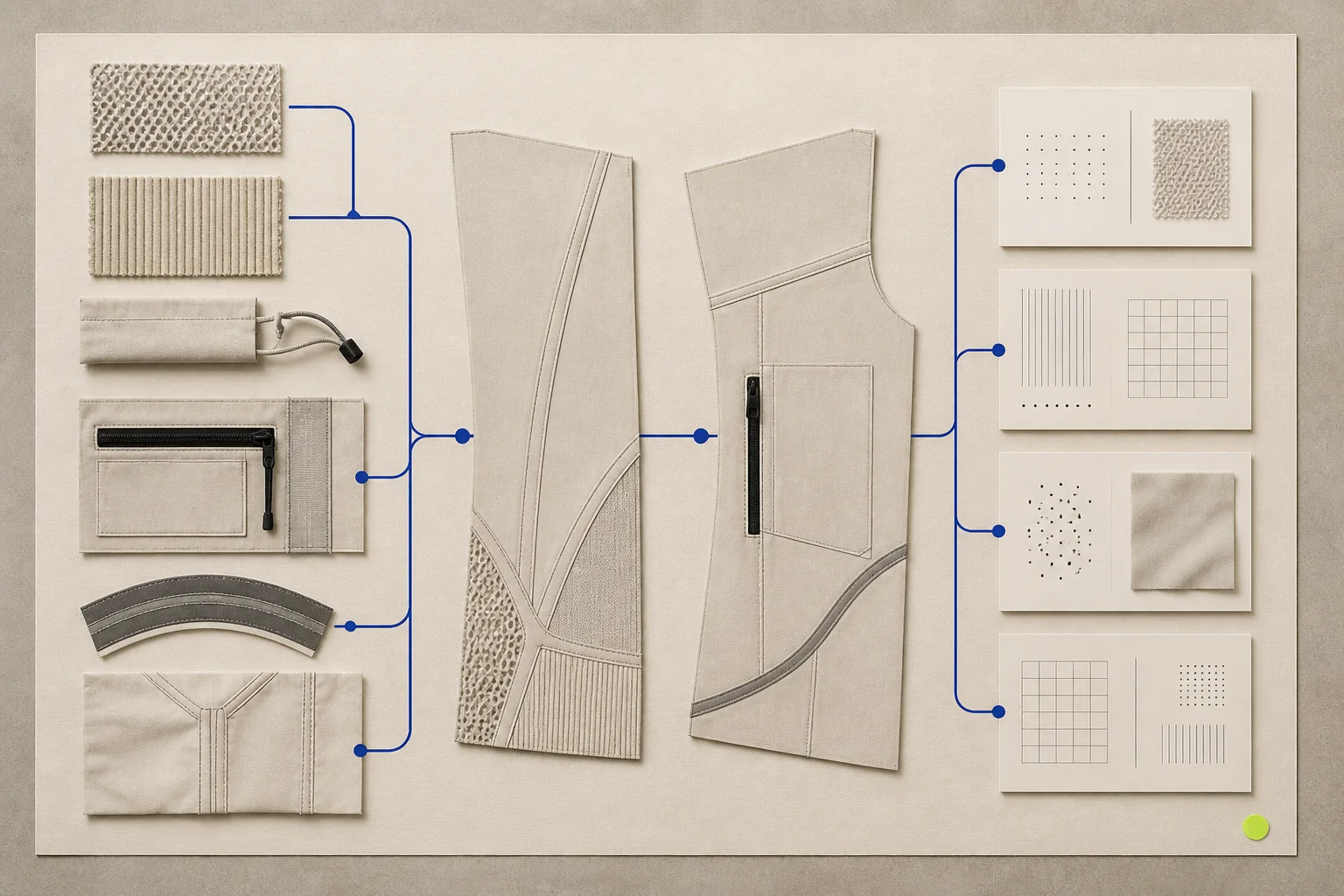
Athletic influence is visible when a drawcord enters a tailored waist, mesh becomes an expressive layer, a track seam reshapes a trouser, rib structure controls a fashion silhouette, or a technical-looking pocket migrates into a bag or jacket meant for ordinary life. These details can move across categories without carrying the tested function of equipment made for sport.
FashionMember has reviewed current first-party collection language and official commerce and advertising guidance. It has not inspected a defined retail sample, tested physical products, interviewed brands or independent retailers, observed wearers, or reconciled sales and completed returns. The present article defines the distinction that a later market report must protect: athletic influence is not automatically performance.
Define influence by observable features
“Sporty” is too subjective for a product study. The codebook should record visible and specified features: mesh or perforation; rib panels; elastic; drawcords; taped, bound, or coverstitched seams; articulated shaping; gussets; zip openings; cargo or device pockets; packable components; reflective-looking surfaces; stretch claims; lightweight construction; sneaker-derived closures; and track- or uniform-referencing color placement.
It should also record the host category. A drawcord on running shorts performs a familiar adjustment role. The same device on a tailored skirt may be functional, decorative, or both. A mesh dress and a ventilated training top do not become comparable because both contain holes.
For every item, preserve exact product and variant identity, brand wording, material specification, care information, price and availability date, and an authorized physical observation where possible. Two coders should classify a test subset and retain disagreement.
Collection language establishes direction, not function
Loewe’s Fall/Winter 2026 campaign says that a sportswear sensibility meets artisanal innovation in expressive silhouettes and pioneering constructions. The brand is explicitly naming a cross-category sensibility. It is not making a general promise that every pictured item has athletic performance.
Prada’s Spring/Summer 2027 menswear page focuses on pragmatic garments—jeans, jean jackets, and T-shirts—being reevaluated through controlled silhouette, rematerialization, and reinterpretation. This is useful evidence for fashion’s continued movement between familiar functional types and new contexts. It does not establish a sports-performance claim or store-level demand.
Pinterest’s current creator trend page presents “sport-luxe street style” as a platform trend. That first-party framing can help construct a dated social query, but it cannot verify product construction, independent-retailer adoption, kept sales, or durability.
A finished article should use a locked sample of eligible collections and products rather than select only pages that fit the thesis. It should include counterexamples and state whether the brand itself uses sport, performance, utility, technical, or no related language.
Performance is a claim category
Words such as moisture-wicking, breathable, cooling, compression, supportive, quick-drying, water-resistant, UV-protective, impact-protective, anti-odor, recovery, or injury-preventing can describe measurable or health-relevant effects. Their meaning depends on the exact product, material, construction, test method, conditions, and duration.
The FTC’s advertising guidance states that advertisers need a reasonable basis for objective claims before dissemination and that evidence depends on the claim. FashionMember should not repeat a performance statement as fact merely because it appears in product copy. Attribute the claim to the maker, request substantiation, inspect what test applies to the sold variant, and obtain qualified review for health or safety implications.
Appearance is especially misleading. A shiny fabric is not necessarily waterproof. Mesh is not proof of useful ventilation. Stretch does not establish recovery, compression, support, or size stability. A reflective-looking strip may not meet any visibility standard. A pocket that resembles running storage may fail under motion.
If the article cannot verify a claim, it should describe the construction without converting it into a benefit.
Product data must follow the exact variant
Google Merchant Center’s product specification emphasizes accurate titles, descriptions, identifiers, variant attributes, prices, availability, and landing-page consistency. That structure is valuable for the research join. A material or performance claim from one color, generation, or product family should not be attached to another merely because the names are similar.
The study should capture item group and variant IDs, composition, lining, trim, closure, weight where measured, size range, care, country of origin where disclosed, and the source date. Photograph labels and construction only with authorization. Preserve AI-image metadata and disclosure for generated editorial art, but never use generated art as evidence of a physical product.
Price and stock are dynamic. Record the observed date and region, and do not imply universal availability. A product page is not evidence that an independent retailer ordered or received the item.
Test in the context of the claim
A fashion item that borrows an athletic detail can still be evaluated for ordinary use: closure operation, pocket access, movement, opacity, lining, abrasion points, care, drying after the labeled method, color transfer, and construction durability. Those observations should be reported as a declared test, not a lab certification.
When a brand makes performance claims, use an appropriate standard or qualified laboratory and predefine the pass criteria. Test the exact variant in enough samples to support the scope. Record conditioning, wash cycles, environment, equipment, uncertainty, and deviations. One editorial wear does not substantiate a population-wide outcome.
Wearer research should recruit across intended contexts, sizes, disabilities, climates, and mobility needs. Participation must be consented and compensated where appropriate. Do not infer athletic ability or health from a body. Report fit and access barriers without presenting one participant as representative of everyone.
FTC care-label rules provide a baseline for care instructions on covered textile apparel. Care evidence matters because coatings, bonded seams, elastic, prints, and mixed materials can change through cleaning. A garment that looks technical but has demanding care may still succeed as fashion; the tradeoff simply belongs in the review.
Retail evidence begins after receipt
To test movement beyond performancewear, define independent retailers, categories, price tiers, geography, and dates. Count eligible products both inside and outside designated performance departments. Record buyer rationale, order placement, accepted quantities, receipts, availability, markdowns, transfers, kept sales, completed returns, and reorders.
The denominator must distinguish styles and variants. A jacket sold in six colors is one silhouette and six color variants. State which count supports which claim. Separate a sports brand’s fashion collaboration, a fashion brand’s sportswear reference, and a retailer’s styling choice.
Completed return reasons may expose expectation gaps: insufficient support, opacity, noise, pocket function, heat, fit, care, or a mismatch between technical appearance and actual use. Returns do not diagnose design without customer consent and product review, but they can guide the next question.
Market growth should not be inferred from a few first-party collections. A later article needs a current, defined market dataset and matched retailer records. Revenue for broad sportswear or apparel categories is too coarse to establish this specific crossover.
A reproducible fictional influence audit
FashionMember created four invented evidence packets in content/data/FM-106-athletic-influence-audit.json. The script scripts/fm106-athletic-influence-audit.php checks whether a fictional packet documents current collection sources, an athletic-influence definition, separation of performance claims, an authorized retailer sample, product identity, a construction codebook, material specifications, physical or lab tests, wearer contexts, size, fit and accessibility, care and durability, price and inventory, completed returns, brand and retailer interviews, claim substantiation, a human editor, ownership, and complete item arithmetic.
Two complete fictional packets reach influence-review; two remain on hold. Every collection, garment, feature, test, wearer, retailer, interview, owner, and result is fictional. The audit does not establish real performance, demand, sales, or product quality.
Fashion can borrow without overpromising
The interesting story is not that every fashion garment has become gym equipment. It is that designers can relocate familiar systems of adjustment, movement, storage, and visual identity into new wardrobe roles. Sometimes the reference is functional; sometimes it is aesthetic; often it is mixed.
FashionMember should make that distinction visible at product level. Until physical tests, authorized retailer evidence, completed returns, and human review exist, this draft can document the research vocabulary and current first-party examples—but it cannot claim market growth or performance.
Sources and verification
- Loewe: Fall/Winter 2026 Campaign — current first-party statement connecting sportswear sensibility, construction, craft, and expressive silhouettes.
- Loewe: Fall/Winter 2026 Precollection — current first-party sportswear and experimental-fashion context; not independent product testing.
- Prada: Spring/Summer 2027 Menswear — current first-party pragmatic-garment and reinterpretation language.
- Pinterest Creators: Summer 2026 Trends — current first-party “sport-luxe street style” framing; not store-level or performance evidence.
- Google Merchant Center: Product Data Specification — current official product, variant, price, availability, and AI-image metadata guidance.
- FTC: Advertising FAQs for Small Business — authoritative substantiation guidance for objective advertising claims.
- FTC: Care Labeling Rule — authoritative care-instruction framework; not proof of performance or durability.
- W3C WAI: Images Tutorial — authoritative image-purpose and alternative-text guidance.
How this story was checked
- Sources
- 8 linked records · View list
- Last verified
- Reporting desk
- FashionMember Editorial Desk
- Format
- Analysis
- AI assistance
- Used with editorial review; disclosed above.