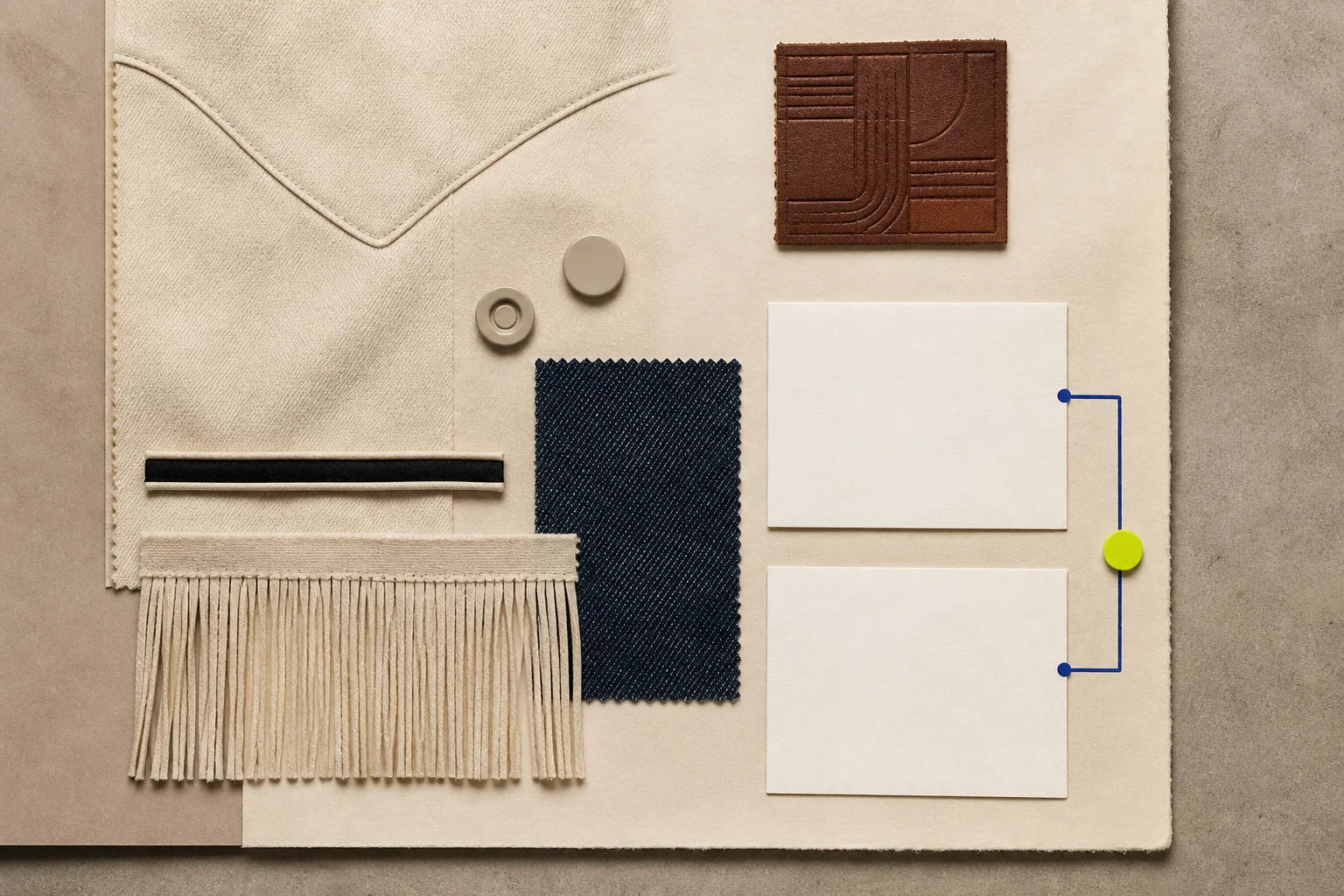
The Western detail does not return from one clean past. It arrives through workwear, ranching and horsemanship, Indigenous and Mexican material histories, the vaquero tradition, Black cowboy history, rodeo, Hollywood costume, country and regional music, vintage collecting, denim commerce, and repeated fashion reinterpretation. Los Angeles is connected to several of those systems, but connection is not proof of current store demand.
FashionMember has reviewed public museum, archive, and current product sources. It has not completed an authorized Los Angeles retailer sample, buyer interviews, physical garment inspections, receipts, returns, or community review. The responsible present-tense claim is therefore narrower: a recognizable detail vocabulary remains available for reinterpretation, and its meaning must be researched rather than flattened into “cowboy style.”
Start with the construction, not the costume
A useful codebook names what can be observed. Western shirt features may include shaped front and back yokes, pointed pocket flaps, smile pockets, snap closures, contrast piping, embroidery, decorative stitching, and reinforced panels. Other garments and accessories may use fringe, denim twill and wash, tooled or embossed leather, substantial belts and buckles, pull-on boot forms, chaps references, or saddle-derived construction.
These details should not be counted as one interchangeable bucket. A yoke can be structural or decorative. Snaps can support quick fastening or simply quote a visual code. Fringe can arise from different material traditions and social meanings. A generic boot shape does not establish a cowboy connection without construction and source context.
Record category, exact product identity, material, construction, placement, proportion, brand description, access date, availability, and whether the term “Western” comes from the maker or the reporter. Physical inspection should confirm online descriptions where the article discusses material or technique.
The history is plural
The Autry Museum’s ongoing Cowboy Gallery describes the cowboy as a fusion of ethnic traditions and adaptations to Western environments. Its earlier Dress Codes exhibition examined Western style through items including blue jeans, the plaid shirt, the fringed leather jacket, and the cowboy boot, connecting them to identity, hybridity, and reinvention.
The National Cowboy & Western Heritage Museum’s American Cowboy Gallery traces working-cowboy history from Spanish colonial times and displays changing regional equipment. Its Western Wares exhibition explicitly asked how designs with roots on the range moved into fashion and popular goods.
Those institutional frames make one editorial rule unavoidable: “Western” must not erase the people and communities whose work, art, ceremony, and identity generated distinct objects. The museum’s Native American Gallery emphasizes the material and cultural diversity of Native peoples of the West. An object made for ceremony is not a neutral motif bank.
FashionMember should commission qualified historians and seek community review when an article touches specific Indigenous, Mexican, vaquero, charro, or Black cowboy histories. Reviewers should be paid, credited with permission, and able to challenge the premise. A surface resemblance is not authorization to reproduce a culturally specific design.
Hollywood made utility legible as image
Los Angeles adds a powerful image-making layer. Levi Strauss & Co.’s archive history of Hollywood Westerns describes how riveted denim associated with workers and cowboys became readily available to costume houses and visible on screen. This is a company-authored history, but it documents an important bridge between Western work clothing, California film production, and mass visual recognition.
Cinema did not invent all the garments it used, and screen visibility did not preserve every source accurately. A current article should separate documented material history from costume conventions and brand marketing. It should also ask which depictions were excluded, stereotyped, or made anonymous.
The recurrence mechanism may be less “the West returns” than “a familiar image vocabulary becomes available for another story.” Music, celebrity styling, television, festivals, resale, and social platforms can reactivate that vocabulary. Each channel needs dated evidence; none should be assumed from memory.
Current product pages are observations, not a market census
Ralph Lauren’s current RRL product pages provide clear examples of an ongoing commercial vocabulary. A cotton twill Western shirt lists snapped placket, pockets, cuffs, and front and back yokes. Other product pages describe indigo, denim, suede, piping, smile pockets, concho-like buttons, and vintage references.
These first-party pages help refine the detail codebook. They do not prove that Los Angeles buyers selected the products, that customers bought and kept them, or that the details are growing. Availability can change, and a dynamic product page captured on one date is not a season-wide assortment.
A current retail study should define a sample of Los Angeles independent stores, showrooms, categories, and price tiers. It should log every eligible product during a fixed period, including products without Western details. The denominator matters: ten Western-coded shirts among twenty shirts is different from ten among two thousand total items.
Test recurrence across stages
The article should distinguish at least five stages: public collection or product appearance; buyer consideration; order placement; inventory receipt and availability; and completed kept sales or reorders. A vintage dealer’s one-of-one object cannot be measured like a multi-variant wholesale style, so the method should segment vintage, new branded retail, independent designer, and costume or specialty categories.
Buyer interviews should ask which detail mattered, what source language they used, whether the purchase served a core customer or an editorial display, and what prior comparable item informed the decision. The reporter should request permission before using nonpublic order or sales information.
Completed returns may reveal fit, material transfer, stiffness, weight, care, expectation, or styling barriers. They should not be interpreted without eligible-sales and return-window denominators. Reorders should be linked to the exact style or verified product family.
Material claims need physical evidence
Tooled, embossed, hand-finished, full-grain, vintage, and handcrafted are different claims. Do not infer them from an image. Document the maker’s specification, country of origin where relevant, physical construction, finishing method, care, and visible variation. FTC care-label guidance establishes responsibilities for care instructions; it does not certify quality or durability.
If a detail references an archive object, verify image rights and the accuracy of the comparison. Side-by-side imagery can imply lineage even when the relationship is only visual. Captions should identify whether a connection is documented by the maker, proposed by the reporter, or rejected after expert review.
Accessibility belongs in the product discussion. Snaps, heavy buckles, tight boot shafts, rigid leather, fringe, and care requirements can affect use. These are test questions, not universal benefits or problems. Include disabled wearers and relevant experts with consent rather than speculating from construction alone.
A reproducible fictional detail audit
FashionMember created four invented evidence packets in content/data/FM-105-western-detail-audit.csv. The script scripts/fm105-western-detail-audit.php checks whether a fictional packet documents historical sources, current collection sources, a detail codebook, cultural context, museum or historian and community review, an authorized retailer sample, product identity, material and construction, image rights, buyer interviews, inventory receipts, completed returns, sales quality, claims, a human editor, ownership, and complete item arithmetic.
Two complete fictional packets reach detail-review; two remain on hold. Every artifact, garment, product, retailer, buyer, receipt, return, reviewer, owner, and result is fictional. The audit does not establish real history, cultural permission, LA adoption, or demand.
Return is not repetition without context
Western details can recur because they are functional, visually legible, materially satisfying, commercially familiar, tied to living communities, or available for reinvention. Those explanations can overlap, and their balance changes by product and audience.
The final Los Angeles story should combine accountable history with a dated retailer sample and community-informed interpretation. Until then, FashionMember can describe the evidence pathway and the public examples, but it should not claim that the city is wearing a verified new Western wave.
Sources and verification
- Autry Museum: Cowboy Gallery — current institutional history framing the cowboy through fused traditions and Western environments.
- Autry Museum: Dress Codes Exhibition Release — museum description of six Western style icons, identity, hybridity, and reinvention.
- National Cowboy & Western Heritage Museum: Western Wares — museum account of range-rooted design entering fashion and popular goods.
- National Cowboy & Western Heritage Museum: American Cowboy Gallery — institutional working-cowboy and regional-equipment context.
- National Cowboy & Western Heritage Museum: Native American Gallery — institutional statement on cultural and material diversity; not permission to reproduce specific motifs.
- Levi Strauss & Co.: History of Levi’s in Hollywood Westerns — company-archive account of denim, cowboys, and film costume; a first-party historical source.
- Ralph Lauren: Cotton Twill Western Shirt — current first-party yoke and snap construction example; dynamic availability and not a retail sample.
- Ralph Lauren: Slim Fit Western Workshirt — first-party piping, yoke, pocket, and material example; not independent demand evidence.
- FTC: Care Labeling Rule — authoritative care-instruction framework; not a quality certification.
- W3C WAI: Images Tutorial — authoritative image-purpose and alternative-text guidance.
How this story was checked
- Sources
- 10 linked records · View list
- Last verified
- Reporting desk
- FashionMember Editorial Desk
- Format
- Analysis
- AI assistance
- Used with editorial review; disclosed above.