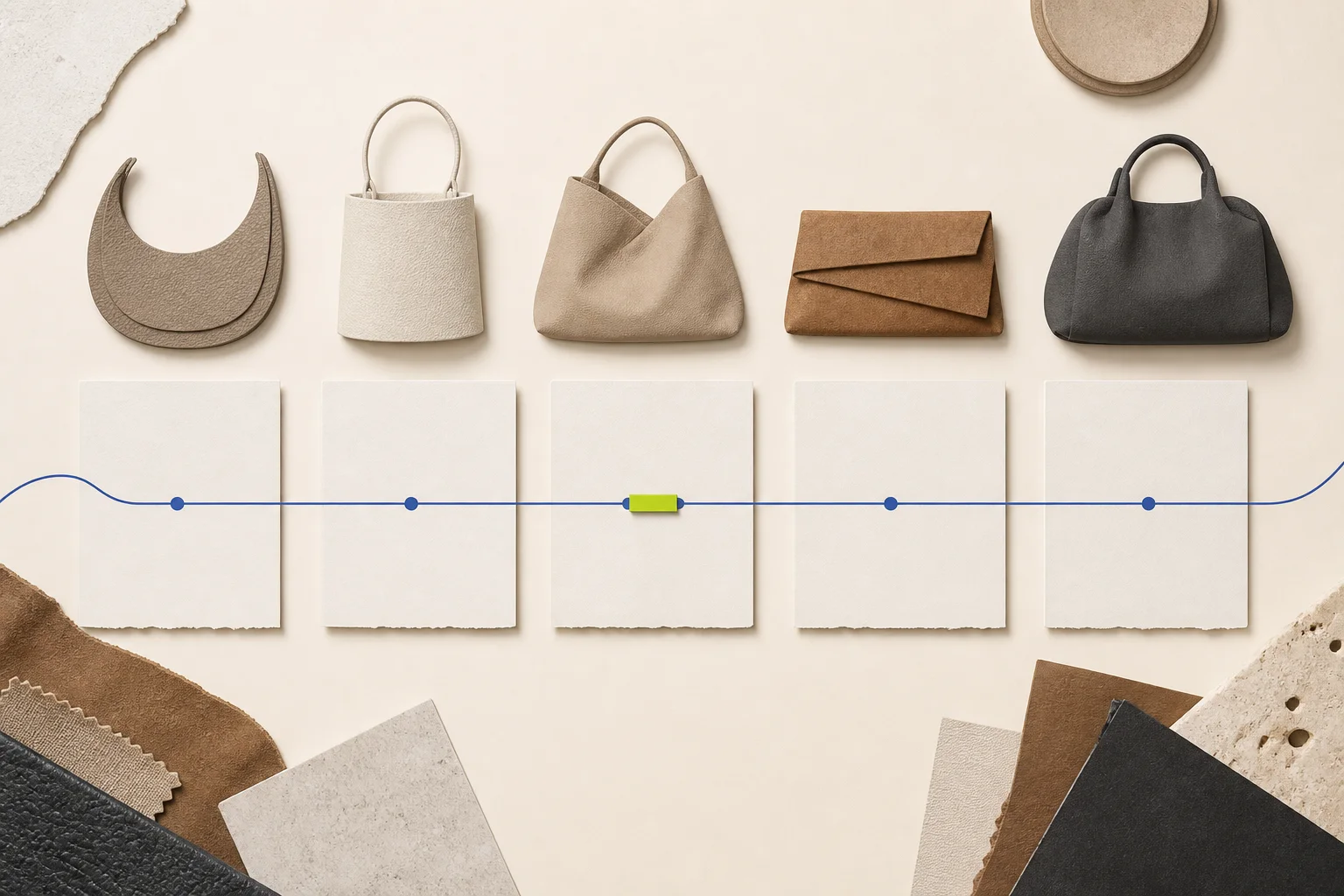
The public collection pages available by September 1, 2026 make several bag forms easy to watch: crescent bases, buckets, relaxed top-handle bodies, layered clutches, and softened utility shapes such as shoppers or bowling bags. They do not show that these forms have moved into independent retail.
That second claim requires another evidence chain. A runway appearance is a creative signal. A brand product page can show that a version entered the house’s own commercial assortment. An independent retailer’s selection, receipt, sale, return, and reorder are separate events. This draft verifies only the first-party public layer.
FashionMember did not license runway images, lock a complete collection sample, inspect bags, survey independent stores, interview buyers, or reconcile sales and returns. The headline names the reporting question, not the result.
Five shapes worth coding
Dior’s Cruise 2027 presentation names three new bag silhouettes: a streamlined reinterpretation of a Saddle, a bucket form, and a shoulder bag with a crescent-shaped base. Loewe’s Fall/Winter 2026 materials introduce a Whisker bag and new editions of established lines, while its precollection highlights a Scarf bag, a layered Flamenco clutch, the Cala, and new Amazona 180 sizes. Chanel’s current handbag catalog includes flap, hobo, bucket, shopping, and bowling forms across varied materials.
These first-party pages support a provisional codebook:
- Crescent or curved-base shoulder: the bottom or body describes a visible arc.
- Bucket or gathered vertical: an upright cavity organized around a drawstring or open top.
- Relaxed top handle: a softened body anchored by one primary handle.
- Layered or folded clutch: overlapping panels or folds define the body.
- Soft utility: shoppers, hobos, or bowling forms translated through pliable materials and flexible carry.
The families overlap. A bag can be both crescent and top-handle, or bucket and soft utility. Researchers should allow a primary and secondary code and record disagreement rather than forcing one label.
Shape is only the visible beginning
A bag silhouette becomes useful through dimensions, opening, capacity, weight, structure, carry modes, and interaction with the body. A dramatic curve may reduce usable space. A relaxed body may collapse around contents. A small top handle may be visually central while an included strap does most of the practical work.
Product-level review should record external and internal dimensions, empty weight, opening width, closure, lining, pockets, base behavior, handle clearance, strap range, attachment points, hardware, feet, included components, and what the brand says fits. Capacity claims should be tested with disclosed objects rather than accepted from an image.
Accessibility matters. Evaluate closure force, zipper travel, one-handed use, tactile differentiation, reach when seated, strap adjustment, and whether the bag can attach securely to a mobility device without creating a hazard. One tester cannot represent every need.
Material changes the shape in use
Loewe’s public collection descriptions distinguish soft calfskin, nappa, suede, and intarsia constructions. Chanel’s current catalog shows similar forms across calfskin, suede, shearling, canvas, raffia, and mixed fibers. Those pages are seller-authored product information, not independent material verification.
The same pattern can behave differently across materials. Grain, thickness, reinforcement, lining, seams, edge finish, coating, and hardware determine whether a body stands, folds, stretches, scratches, sheds, or changes with wear. A silhouette taxonomy without material and construction will confuse a rigid outline with a soft one that only resembles it when staged.
Physical inspection should examine stress points, attachment reinforcement, closure alignment, base stability, abrasion zones, color transfer, snagging, and care. Conclusions must remain specific to the exact product version.
Commercial availability is not independent adoption
A brand’s own product page can establish that the brand offers an item under current conditions. It cannot show that multi-brand independent buyers selected it or that comparable shapes are selling across stores.
An independent-retail sample should be defined before browsing. State geography, store type, price tiers, categories, dates, inclusion rules, and whether the store is authorized to be studied or named. Preserve product IDs, designer, shape codes, material, dimensions, price, stock state, delivery, and access date. Avoid counting the same syndicated inventory across multiple pages as separate adoption.
Buyer interviews should distinguish consideration, market appointment, order, cancellation, receipt, floor placement, sale, completed return, and reorder. A buyer may like a shape but decline it because of price, delivery, capacity, terms, brand mix, or customer history. That negative evidence is essential.
Sales quality needs a denominator
One sold-out bag can result from one received unit. A larger buy can appear slower while producing more sales and margin. Compare units received, days available, locations, full-price share, promotions, transfers, cancellations, exchanges, completed returns, damage, and customer feedback.
Return reasons can expose shape problems: opening too narrow, strap too short, bag heavier than expected, capacity unclear, closure difficult, color or material mismatch, or image scale misleading. They can also reflect service or fulfillment rather than design. Preserve the reason taxonomy and review notes before assigning cause.
Do not convert confidential store information into a public league table. Aggregate only with permission and enough stores to avoid identifying individual performance. A brand or retailer mention should not be paid placement hidden inside an editorial trend claim.
Images require rights and product fidelity
Runway and product imagery is copyrighted, and the right to view does not confer the right to republish. A factual collage needs licenses, correct credits, product identity, and a record of any crop or alteration. A generated image should remain clearly conceptual and must not imitate a recognizable bag design or appear as product evidence.
The W3C Images Tutorial explains that informative images need text alternatives conveying essential information. For bags, an accessible description may need to identify overall form, handle and strap arrangement, opening, or relevant construction. Color alone should not distinguish the coded families.
Following the bag from runway to retail
FashionMember created four invented evidence packets in content/data/FM-099-bag-pathway-audit.json. The script scripts/fm099-bag-pathway-audit.php checks whether a fictional packet documents collection sources and dates, a silhouette taxonomy, locked runway sample, authorized images, a retailer and independent-retailer sample, product identity, dimensions and capacity, material and construction, carry modes, price and inventory, buyer interviews, received inventory, completed returns, sales quality, claims review, a human editor, ownership, and complete bag arithmetic.
Two complete fictional packets reach pathway-review; two remain on hold. Every runway sample, bag, retailer, buyer, receipt, return, owner, and outcome is fictional. The result is not a runway count, adoption finding, product test, demand result, ranking, or publication approval.
Follow the shape through the system
The early shapes are editorially legible: curves, buckets, relaxed handles, layered clutches, and softened utility. The stronger story is not a gallery of silhouettes. It is an evidence trail that follows a form from collection context to exact product, independent buyer decision, received inventory, customer use, and completed return.
Until that trail exists, FashionMember can say what to watch and how to verify it. It cannot say which shape has won independent retail.
Sources and verification
- Dior: Cruise 2027 Show — first-party naming of new bag silhouettes; not independent-retail evidence.
- Loewe: Fall/Winter 2026 Campaign — first-party new-bag and construction context.
- Loewe: Fall/Winter 2026 Precollection — first-party bag-line overview; current availability can change.
- Loewe: Spring/Summer 2026 Women’s Runway — first-party introduction of the Amazona 180 and craft context.
- Chanel: Handbags — current first-party catalog showing forms and materials; not an independent retailer sample.
- Google Merchant Center: Product Data Specification — official product and apparel attribute requirements.
- Google Merchant Center: Local Product Data Specification — official description and image-consistency guidance.
- FTC: Advertising FAQs for Small Business — official truthfulness and substantiation guidance.
- W3C WAI: Images Tutorial — authoritative image-alternative guidance.
How this story was checked
- Sources
- 9 linked records · View list
- Last verified
- Reporting desk
- FashionMember Editorial Desk
- Format
- Analysis
- AI assistance
- Used with editorial review; disclosed above.