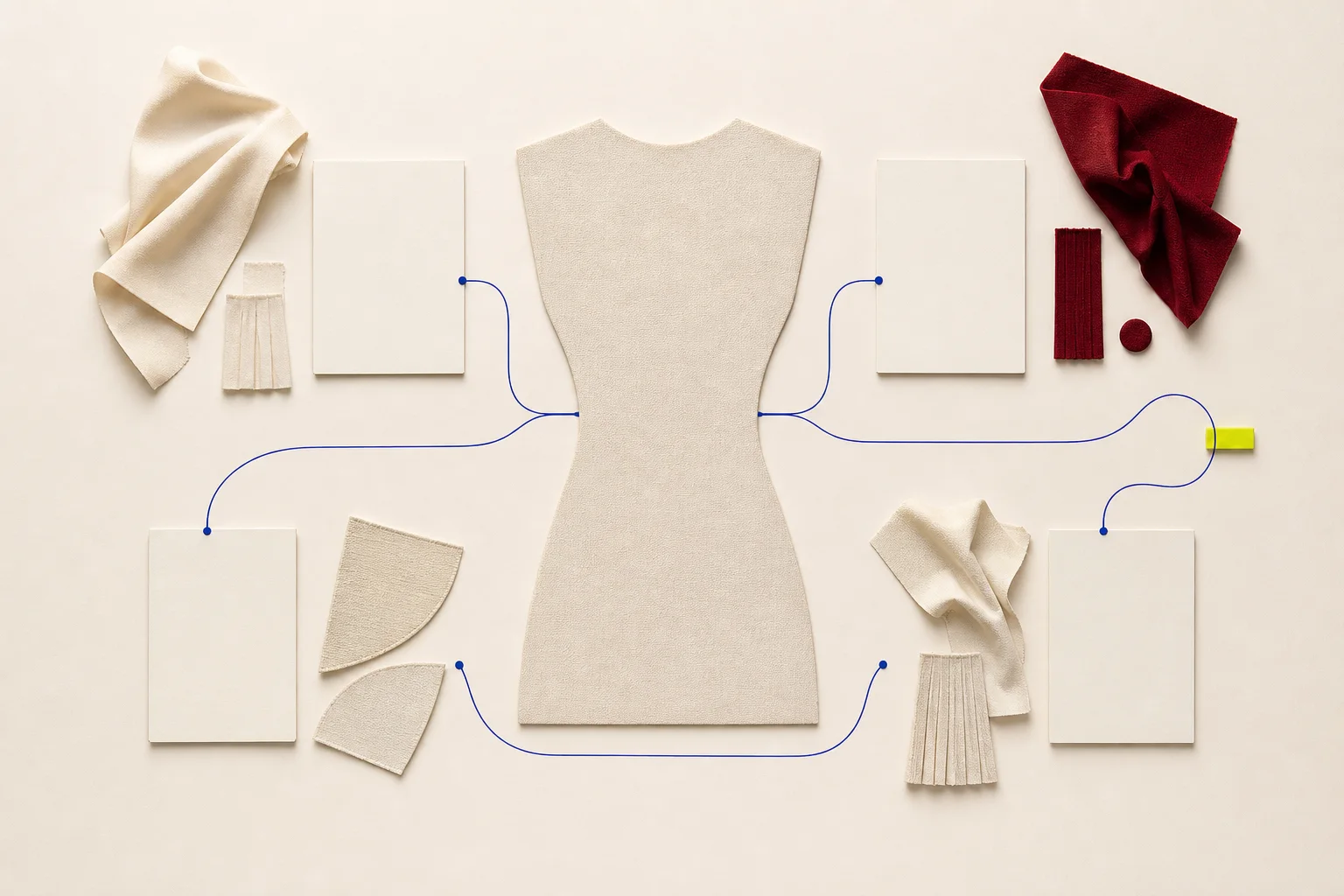
Occasionwear used to be described as if the event determined the garment: cocktail, wedding guest, gala, evening. Current collection and retail language is testing a different proposition. The piece may begin with an occasion but earn its value by changing with layers, shoes, accessories, climate, formality, and repeat use.
That proposition is plausible, not proven. FashionMember has not analyzed independent retail sales, interviewed showrooms, recruited wearers, or tested products through a completed return window. A brand’s “day-to-night” filter and a runway combination can identify what to study; neither establishes how customers actually dress or what stores are buying.
As of September 1, 2026, the public record supports four forms of flexibility: category mixing, adjustable formality, physical adaptability, and repeatable product information.
Category mixing widens the styling range
Dior’s Cruise 2027 collection places embroidered-lace evening dresses near bouclé jackets, patchwork scarves, shearling, sequined suits, and pajama shirts worn with leather trousers. The house calls the relationship one in which the everyday becomes couture. That is a creative statement, not a claim about use, but it shows day and evening codes being presented in one vocabulary.
Chanel’s Cruise 2026/27 page similarly moves between a reinvented little black dress, silk-foulard ensembles, raffia skirts, and washed-canvas suiting. Prada’s Spring/Summer 2027 menswear note treats familiar garments as articles that resist easy classification of function or era.
These examples suggest that flexibility may come less from a reversible mechanism and more from the boundaries a collection permits. A scarf, knit, jacket, shoe, or practical bag can shift how a formal piece reads. But styling potential must be separated from what is included with the product and what a customer would need to buy separately.
Day-to-night is a claim that needs a day and a night
Ralph Lauren currently offers a “Day to Night” dress filter and a Spring 2026 occasion edit that describes eveningwear ranging from tailored to languid. These are useful examples of first-party merchandising language. They do not prove that a particular garment works across tasks or that customers wear it that way.
To evaluate a day-to-night claim, define both contexts. “Day” might mean an office, travel, ceremony setup, or outdoor lunch. “Night” might mean a seated dinner, performance, wedding, or formal reception. Each introduces different movement, temperature, lighting, footwear, carrying, care, and dress-code expectations.
A test should state what can change between contexts. If the garment works only after adding a second jacket, changing undergarments, carrying special shoes, and paying for immediate cleaning, that is a possible styling route—not effortless versatility.
Physical flexibility matters more than a lookbook sequence
An event garment has to move through arrival, sitting, eating, dancing, stairs, restrooms, temperature changes, and transport. A still image cannot establish these conditions.
Inspect range of motion, seated fit, closure effort, weight distribution, strap security, opacity, lining, seam pressure, hem risk, pocket use, and compatibility with needed underlayers or mobility devices. Test the exact size and product version. A stretch fiber percentage does not by itself prove comfort; construction and fit determine how stretch is experienced.
Accessibility should not be added after styling. Some decorative closures create dexterity barriers. Long trains, unstable straps, heavy embellishment, scratchy seams, or inaccessible pockets can reduce use. Participants should define their own needs rather than having editors infer them.
Modularity has to survive inventory reality
Occasionwear can become modular through detachable straps, removable overlays, separate skirts, matching jackets, coordinated scarves, or components designed to change coverage. It can also become modular through an assortment of compatible separates.
The retailer must verify every promised configuration. Are all components sold, photographed, and named clearly? Do their colors match under event lighting? Are sizes available together? Are care methods compatible? Can a lost component be replaced? Is the total price visible before the customer commits?
Google Merchant Center’s current product-data guidance emphasizes exact variant identity, color, size, material, and landing-page consistency. These requirements do not validate occasionwear flexibility, but they establish the minimum information needed to represent configurations without confusing customers.
Care determines whether repeat wear is realistic
The FTC Care Labeling Rule requires covered manufacturers and importers to provide regular care instructions and a reasonable basis for them. For occasionwear, care can be the difference between a reusable piece and a one-night burden.
Record whether embellishment, pleating, coating, dye, lining, trim, or detachable parts alter cleaning. Verify the sewn label against online instructions. Ask what happens after a spill, minor snag, lost button, loosened bead, or hem damage. A product can be delicate and still have value, but the customer needs the limitation before purchase.
Repeat-wear claims require follow-up. A survey immediately after an event measures intention or satisfaction, not continued use. Recontact participants after enough time for another relevant occasion and report nonuse as well as reuse.
A credible retail and wearer study
Lock a sample across defined independent retailers, categories, price tiers, sizes, and dates. Preserve product identity, availability, promotion, components, material, care, and return terms. Interview showroom and retail buyers about what they considered, ordered, received, reordered, or declined—without converting confidential information into a public ranking.
For consented wearers, define the event and alternative wardrobe. Record styling changes, preparation time, carrying burden, movement, comfort, accessibility, care, alterations, total cost, and whether purchased items remain kept after returns close. Separate people who already owned the garment from people who bought for the study.
Retail outcomes should include availability, full-price share, exchanges, completed returns, reasons, and customer-service contacts. One sellout is weak evidence when the buy was small. A flexible garment is not automatically a commercially flexible assortment.
Testing a flexible-occasionwear claim
FashionMember created four invented evidence packets in content/data/FM-098-flexible-occasionwear-audit.csv. The script scripts/fm098-flexible-occasionwear-audit.php checks whether a fictional packet documents current sources, occasion scope, an authorized retail sample, showroom and wearer interviews, a day-to-night claim, modular styling, movement and comfort, size and fit, dress-code context, care, inventory and price, completed returns, accessibility, claims review, a human editor, ownership, and complete look arithmetic.
Two complete fictional packets reach occasion-review; two remain on hold. Every look, retailer, showroom, wearer, event, owner, and result is fictional. The result is not a dress-code judgment, product test, demand finding, ranking, or publication approval.
Flexibility is a promise about use
Occasionwear becomes more flexible when it supports more than one context without hiding fit, care, component, or cost tradeoffs. The creative evidence shows designers and retailers making room for that idea. It does not show how widely customers accept it.
The responsible article therefore moves from image to use. It asks what changes, what stays, what the wearer carries, how the product behaves, what the full system costs, and whether the piece returns to the wardrobe after the event. Only then does flexibility become evidence rather than an adjective.
Sources and verification
- Dior: Cruise 2027 Show — first-party mixing of evening, tailoring, and relaxed references; not wearer or retail evidence.
- Chanel: Cruise 2026/27 Collection — first-party movement and category context; not a product-use test.
- Prada: Spring/Summer 2027 Menswear — first-party framing of familiar garments beyond fixed function or era.
- Ralph Lauren: Day-to-Night Dresses — current first-party merchandising filter; product availability and terms are dynamic.
- Ralph Lauren Collection: Spring 2026 — first-party occasion edit and product language; not independent outcome evidence.
- Google Merchant Center: Product Data Specification — current official apparel variant, size, color, and material requirements.
- Google Merchant Center: Clothing and Accessories Best Practices — current first-party data-consistency guidance.
- FTC: Care Labeling Rule Text — authoritative federal care-labeling requirements for covered products.
- W3C WAI: Images Tutorial — authoritative guidance for informative image alternatives.
How this story was checked
- Sources
- 9 linked records · View list
- Last verified
- Reporting desk
- FashionMember Editorial Desk
- Format
- Analysis
- AI assistance
- Used with editorial review; disclosed above.