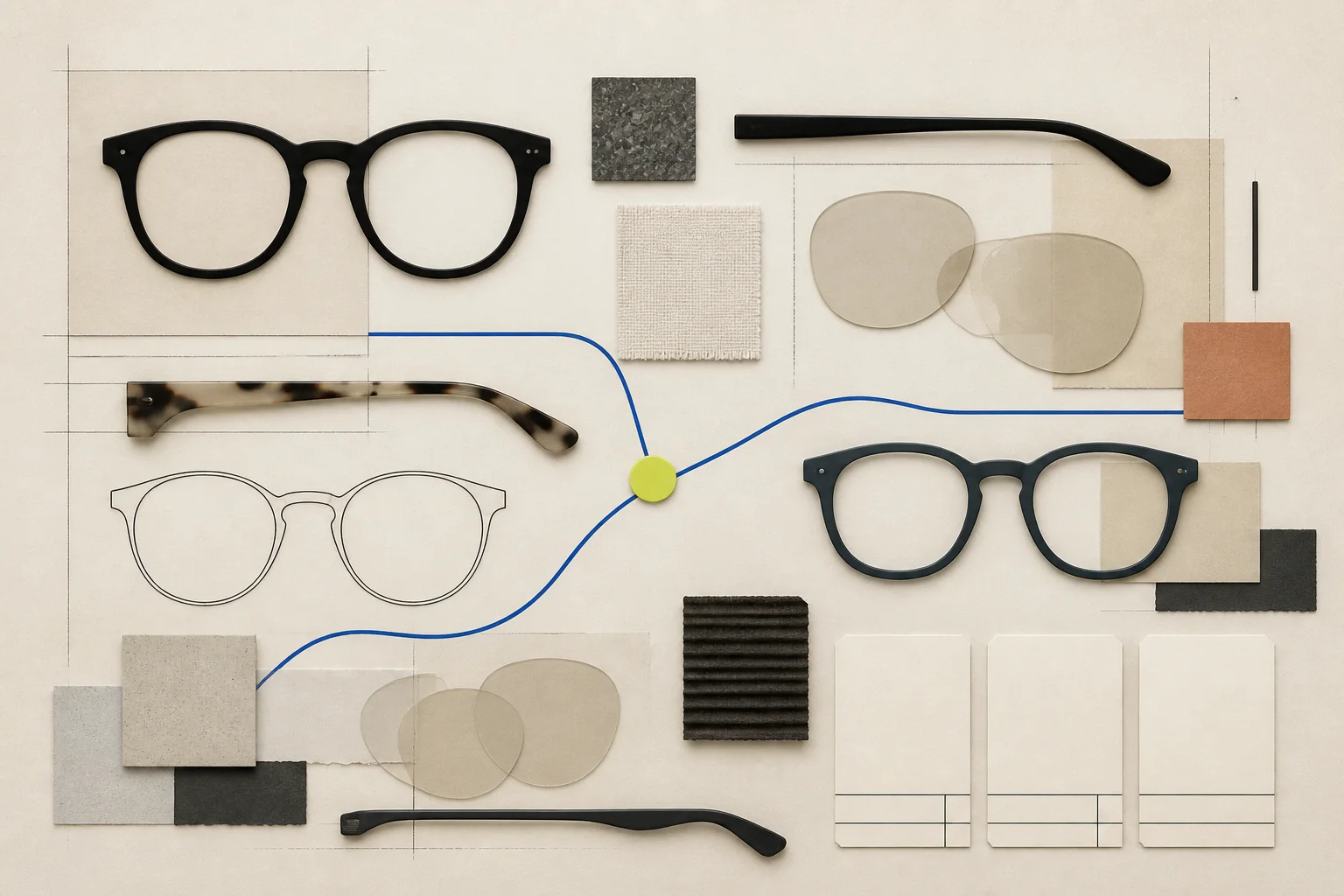
Smart eyewear is often introduced through its most novel function: a camera, open-ear audio, an assistant, navigation, translation, or a display. Yet the product meets the customer first as a frame. It sits on the bridge, touches the temples, changes the outline of the face, moves with the head, and becomes visible in social situations where an ordinary phone might stay in a pocket.
That makes fashion performance a prerequisite rather than a decorative layer. A device can have capable software and still fail as eyewear if the frame feels heavy after an hour, the available shapes do not work across faces, prescription service is confusing, controls are awkward, the recording signal is unclear to nearby people, or charging turns a daily accessory into another object left at home.
This is not a product ranking or wear test. FashionMember did not obtain, measure, charge, fit, prescribe, connect, or compare any real device. Current manufacturer pages are used only to map the questions a future physical test should ask. Their claims need independent verification on the exact model, software version, region, prescription configuration, and user.
Begin with the frame, not the feature list
An eyewear test should document the exact frame identity before scoring anything: model, size, bridge, temple length, lens configuration, finish, software version, region, and date. “Smart glasses” is too broad a unit of comparison. Different shapes can distribute mass differently even within one product family, and a prescription lens can change the final object.
Record the current manufacturer specification separately from an observed result. Weight belongs in the spec snapshot until the finished test unit is weighed. Battery duration belongs to a claim column until a controlled usage protocol is completed. Compatibility belongs to a dated requirements record, not a permanent promise.
Then evaluate the ordinary eyewear questions. Does the frame remain level? Is there slipping, temple pressure, bridge pressure, lash contact, heat, or localized discomfort? Does it stay stable while walking and turning? Can a trained optical professional make appropriate adjustments, and what would those adjustments do to electronics, seals, microphones, speakers, or warranty conditions?
The U.S. Food and Drug Administration identifies spectacle frames and lenses as medical devices and publishes guidance on impact-resistant lenses. That does not mean an editorial team can certify a product. It means optical configuration, lens impact requirements, prescription fulfillment, labeling, and professional service cannot be reduced to a lifestyle impression.
Test appearance as a system
Fashion fit is not one universal “looks good” score. Photograph the frame only with informed consent and controlled, repeatable views. Record frame scale, brow relationship, lens depth, temple profile, visible hardware, finish, and how the object reads with several wardrobe contexts. Keep aesthetic observations attributed to the people who made them.
The most useful test asks whether the customer would choose the frame without the electronics. If not, the technology must overcome a daily style compromise. If yes, the next question is whether its added cues—thicker temples, microphones, buttons, speakers, indicator lights, or charging contacts—change that answer.
Selection also matters. A category is not inclusive merely because one silhouette is marketed broadly. A responsible review needs multiple authorized wearers, documented fit boundaries, prescription options, relevant accessibility needs, and an optician or qualified specialist. It must not infer population coverage from a small editorial sample.
Treat controls and feedback as part of the silhouette
Interaction occurs on a moving body. Test whether touch, buttons, voice, and companion-app controls can be found and understood without constant visual confirmation. Record false activations, missed activations, glove or hair interference, and whether feedback is audible, tactile, visible, or available through more than one channel.
Open-ear audio should be evaluated for clarity and awareness in lawful, safe conditions. Volume leakage, wind, traffic, and conversation all require controlled protocols. Amazon’s current Echo Frames materials warn users to remain aware of their surroundings; its Alexa documentation also explains that audio is streamed after the wake word is detected. Those are first-party descriptions, not findings about any tested device here.
Accessibility cannot be appended at the end. A test plan should include the ability to set up, control, charge, understand status, recover from errors, and obtain support. Manufacturer accessibility pages can identify claimed functions, but people with relevant lived experience must evaluate whether the complete workflow is usable.
Bystanders are part of the product experience
Camera-equipped eyewear changes a shared space. Meta says its current glasses use a capture LED and describes research into making that signal visible. A light is still only one control. A review should observe whether nearby people notice it at several angles and lighting conditions, understand what it means, and can respond without conflict.
The test must also map what happens after capture: local storage, phone transfer, cloud processing, account requirements, deletion, sharing, voice recordings, location or sensor data, and support access. The NIST Privacy Framework offers a general way for organizations to identify and manage privacy risk, while the Federal Trade Commission advises connected-product companies to build security in, limit data collection, control access, and keep software updated.
These frameworks do not declare a specific pair of glasses private or secure. They help an editorial team ask for evidence. Do not simulate covert recording, enter sensitive spaces, record nonparticipants, or upload personal material just to stress a product. Legal and privacy review should set the protocol before testing begins.
Battery and care decide whether it becomes daily wear
A controlled battery protocol should state the starting charge, settings, paired phone, network, temperature, feature mix, observation window, and interruptions. Record heat at the frame and case, charging behavior, idle drain, recharge time, and what stops working at low power. Manufacturer battery claims are scenario-dependent and should not be copied into a verdict.
Care is equally practical. Document cleaning instructions, resistance claims, prohibited exposure, storage, repair, lens replacement, battery service, warranty, and end-of-life options. A pair of ordinary glasses can remain useful for years through optical adjustment and lens replacement. Electronics can introduce shorter service cycles, region-specific support, unavailable parts, or software dependencies. Those are fashion-value questions because they determine how long the frame can remain in a wardrobe.
A reproducible fictional gate
FashionMember created four invented candidates in content/data/FM-096-smart-eyewear-wear-test.json. The script scripts/fm096-smart-eyewear-wear-test.php checks only whether a review packet contains a dated fictional specification, optical basis, fit observations, controls, audio awareness, camera signal, battery and heat, data flow, accessibility, care and repair, a positive observation window, a fictional weight, and an accountable owner.
Two complete fictional rows advance to wear-test-review; two incomplete rows are held. The result is not a product score. It proves only that required fields are present in a synthetic fixture. The script cannot determine optical safety, medical suitability, comfort, privacy, accessibility, reliability, style, value, or whether a customer should buy anything.
Publish a layered verdict
A credible smart-eyewear review should end with separate findings: frame and optical service; short and extended wear; style range; controls and feedback; audio awareness; capture and bystander signaling; data flow and privacy; battery, heat, and charging; accessibility; care, repair, and support. Each finding needs its method, limits, date, and reviewer.
That structure resists the easy headline that one device “wins.” The enduring question is more demanding: does this object work as eyewear in real wardrobes and shared spaces, while its technical system remains understandable and supportable? Until both halves are tested, novelty is not evidence of fashion readiness.
Sources and verification
- FDA: Impact-Resistant Lenses—Questions and Answers — official U.S. guidance on spectacle-lens impact resistance; not a certification of any product discussed here.
- FDA: Sunglasses, Spectacle Frames, Spectacle Lenses, and Magnifying Spectacles — official regulatory context for eyewear devices.
- Meta: Responsible Testing Approach — first-party description of prototype testing, capture indication, bystander privacy, and media handling; independently unverified here.
- Meta: Responsible Innovation — first-party explanation of controls, capture LED, privacy settings, and intended use.
- Amazon: Echo Frames Safety and Compliance Information — first-party safety, surroundings, temperature, and radio-frequency information.
- Amazon: Alexa and Smart Glasses FAQs — first-party account of wake-word audio streaming and cloud behavior.
- Amazon: Accessibility Features for Echo Frames — first-party accessibility feature description; lived-experience testing remains required.
- NIST Privacy Framework — voluntary organizational privacy-risk framework.
- FTC: Careful Connections—Keeping the Internet of Things Secure — official connected-product security guidance.
How this story was checked
- Sources
- 9 linked records · View list
- Last verified
- Reporting desk
- FashionMember Editorial Desk
- Format
- Analysis
- AI assistance
- Used with editorial review; disclosed above.