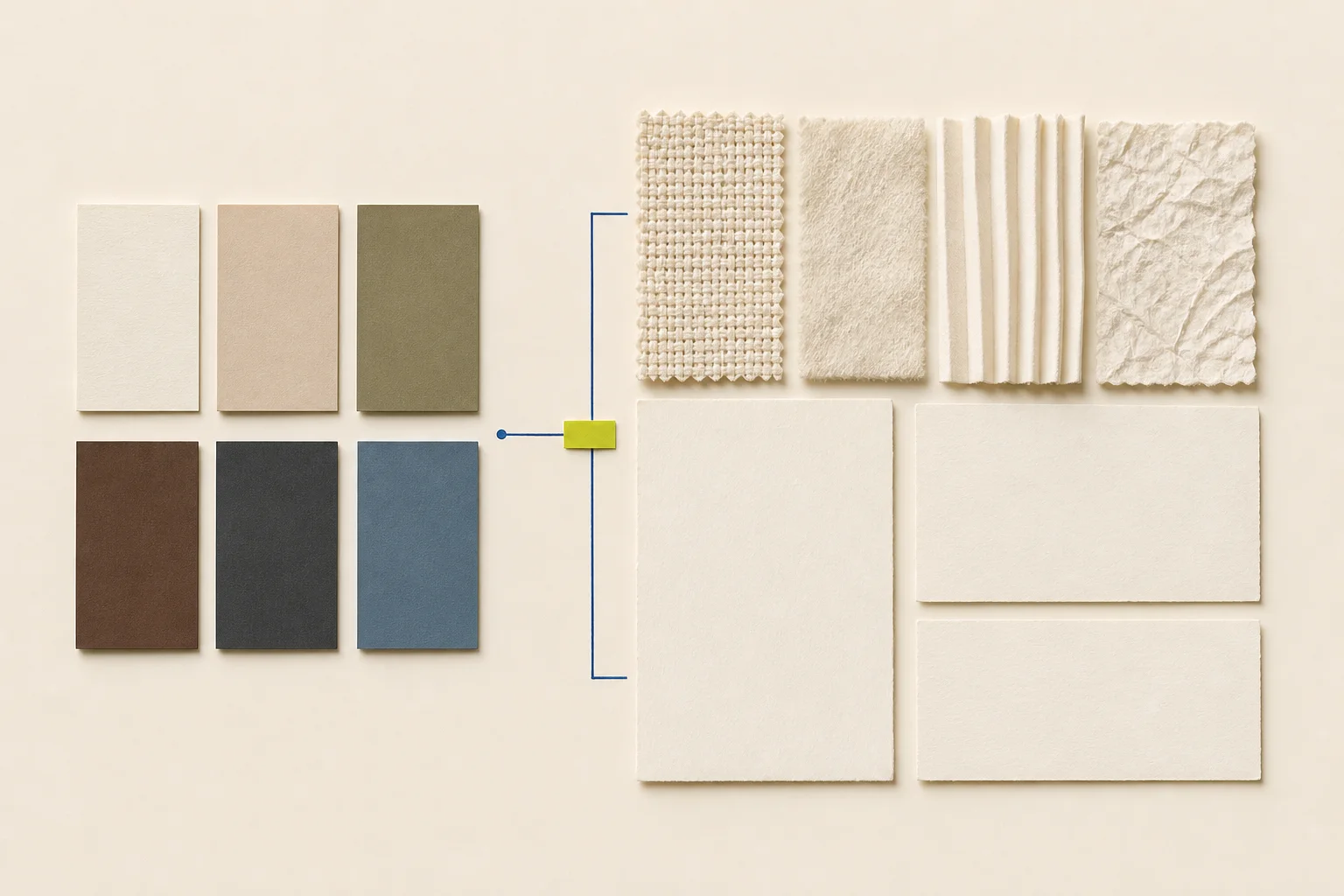
Color remains one of fashion’s fastest signals. It organizes a rail, catches a thumbnail, creates a collection rhythm, and gives shoppers a familiar filter. Yet current collection language also points to a harder-to-compress source of value: how a surface folds, frays, shines, catches, compresses, or moves.
The headline is therefore a hypothesis, not a ranking. Texture is not replacing color, and FashionMember has not measured a market-wide increase in texture-led demand. The defensible observation is narrower: texture is carrying more kinds of information at once. It can help create silhouette, distinguish a material, shape photography, change care and comfort, and affect whether a product feels worth its price.
As of September 1, 2026, this draft draws on public brand-authored collection pages and official product-data and accessibility guidance. It does not include a locked retailer assortment, physical samples, customer research, sales, or a materials-expert interview. Those omissions prevent claims about prevalence, quality, or consumer preference.
Surface is becoming structure
Chanel’s Cruise 2026/27 note connects silhouettes in motion with silk foulard, raffia, and washed cotton canvas. Dior’s Cruise 2027 presentation names frayed bouclé, embroidered lace, patchwork scarves, and shearling. Loewe’s recent collection pages foreground folded and paneled leather, fringe, embroidery, sculpted shearling, and vivid material effects.
These first-party descriptions do not prove a common trend. They do show why texture cannot be treated as decoration added after shape. Raffia and silk do not fall the same way. Fraying changes the edge of a tailored garment. Shearling changes volume. Folded leather creates structure through thickness and construction. The visible surface is also a mechanical behavior.
For editorial work, that means “textured” is too broad. A useful taxonomy separates weave or knit relief, pile, nap, brushing, wrinkling, crinkling, quilting, embroidery, fringe, lace, perforation, coating, gloss, translucency, grain, distressing, and construction-led folding. It also records whether the effect is inherent to the material, applied as a finish, or created through garment construction.
Color is easier to name; texture is easier to lose
Commerce systems have long treated color as a concise structured field. Texture often disappears into a product title, a marketing paragraph, or an image. That makes it harder for shoppers to compare and harder for search systems to retrieve accurately.
Google Merchant Center’s product-data specification includes attributes for color, material, and pattern. Its local product guidance says descriptions can contain visual characteristics such as shape, pattern, texture, and design, while product images should match attributes including color, pattern, and material. These rules are not evidence that texture is more popular. They demonstrate that material and surface information belongs in the factual product record.
A retailer should not solve the gap by generating elaborate adjectives. “Luxe,” “buttery,” and “premium” may be subjective claims. Better data begins with fiber composition, construction, finish, lining, weight where verified, visible surface, care, and condition. A product-specific statement such as “brushed twill with a raised nap” is more useful than a vague declaration of softness—provided the specification and physical sample support it.
Photography has to translate touch
Texture creates a special online problem: the customer cannot feel it. A single front-facing image may show color accurately while flattening pile, grain, transparency, or reflectivity. Detail images, side light, macro views, motion, and scale references can make surface behavior more legible, but they can also exaggerate it.
The image set should therefore answer distinct questions. What does the whole garment look like? Where is the textured area? How large is the repeat? How does it behave in motion? Does light change the appearance? Is the reverse or interior relevant? Each view needs consistent color management and a clear relation to the exact product variant.
Artificial imagery adds another risk. A generated surface can invent fibers, seams, pile, drape, or sheen. If used editorially, it should be labeled non-documentary. It should not stand in for a product photograph or physical textile evidence.
Accessibility turns texture into language
The W3C Web Accessibility Initiative explains that informative images require text alternatives conveying essential information. “Product photo” is not enough when surface or construction affects the purchase decision. The description should communicate the relevant visible fact without pretending to deliver touch.
For example, an accessible product record might say that a jacket has a pronounced looped surface, a smooth lining, and frayed cuff edges. It should avoid unsupported sensations such as “feels weightless” unless that is sourced and useful. Long visual descriptions can sit near the image or in expandable product details; the alt text itself should remain purposeful in context.
Accessibility review should also test magnification, contrast around textured backgrounds, focus states, captions, and whether essential care or material information exists as text rather than inside an image.
Perceived value needs physical proof
Texture can make a product look labor-intensive or materially rich. It can also hide weak construction, shed, pill, snag, flatten, transfer, or require difficult care. A high-resolution image cannot establish durability or quality.
Before describing a texture as premium, a team should connect the claim to the specification and inspect the sample. Verify fiber content, construction, finish, abrasion or snag behavior appropriate to use, seam interaction, colorfastness where relevant, care method, expected variation, and repairability. A materials expert can help interpret tests, but the claim should still be scoped to the exact product and version.
Customer research may reveal that one surface is loved in hand but avoided because of maintenance, sensory preference, climate, or styling difficulty. Those responses should be segmented rather than averaged into a universal verdict. Texture is experienced differently across bodies, environments, and access needs.
How to compare texture and color without a false contest
A credible study would lock a current, authorized retailer sample and code both dimensions. For every product, record category, price tier, color family, color count, pattern, material, construction, texture type, finish, image coverage, written detail, care, availability, and access date. Use two coders for subjective categories and record disagreements.
Then ask separate questions:
- How often does the assortment use surface or construction as a primary differentiator?
- Is texture documented in structured data, prose, imagery, or all three?
- How many products provide an adequate detail view and accessible description?
- Do customer questions, returns, or reviews identify missing material information?
- Does full-price performance persist after controlling for category, availability, price, promotion, color, and season?
Even a strong association would not prove that texture caused sales. The study should report color as a baseline and retain products where color—not texture—is the central proposition.
How the texture evidence held up
FashionMember created four invented evidence-packet rows in content/data/FM-092-texture-evidence-ledger.csv. The script scripts/fm092-texture-evidence-audit.php checks whether a fictional packet documents current collection sources, source dates, a texture taxonomy, a color baseline, an authorized retail sample, product specifications, physical samples, composition, finish and construction, a hand-feel method, image accessibility, merchant data, claim substantiation, materials-expert review, a human editor, ownership, and complete item arithmetic.
Two complete fictional rows reach texture-review; two are held. Every item, retailer, sample, expert, owner, and outcome is fictional. The audit does not score real materials or show that texture drives demand, sales, ranking, or trend direction. It tests only whether an invented packet contains the gates people would need to review.
The editorial opportunity
Texture earns attention because it resists simplification. It forces the story to connect design, construction, data, imagery, accessibility, care, and use. Color still gives fashion one of its clearest organizing languages. Texture adds another layer of evidence about how a product is made and how it may live.
The strongest article will not declare a winner. It will make surfaces more legible without converting adjectives into facts. That means current sources, exact products, physical verification, careful photography, accessible descriptions, and claims that remain no broader than the evidence.
Sources and verification
- Chanel: Cruise 2026/27 Collection — first-party material and silhouette descriptions; not independent trend or quality evidence.
- Loewe: Spring/Summer 2026 Women’s Runway — first-party examples of folds, panels, and material-led form.
- Loewe: Fall/Winter 2026 Runway — first-party making and texture context; not a retail sample.
- Loewe: Fall/Winter 2026 Campaign — first-party visual framing of textures, color, and stripes; not outcome evidence.
- Dior: Cruise 2027 Show — first-party examples of fraying, lace, patchwork, and shearling.
- Google Merchant Center: Product Data Specification — official attribute requirements and definitions for product feeds.
- Google Merchant Center: Local Product Data Specification — official guidance on descriptions and image/attribute consistency.
- Google Merchant Center: Best Practices for Apparel and Accessories — current first-party apparel listing guidance.
- W3C WAI: Images Tutorial — authoritative accessibility guidance for informative images and text alternatives.
How this story was checked
- Sources
- 9 linked records · View list
- Last verified
- Reporting desk
- FashionMember Editorial Desk
- Format
- Analysis
- AI assistance
- Used with editorial review; disclosed above.