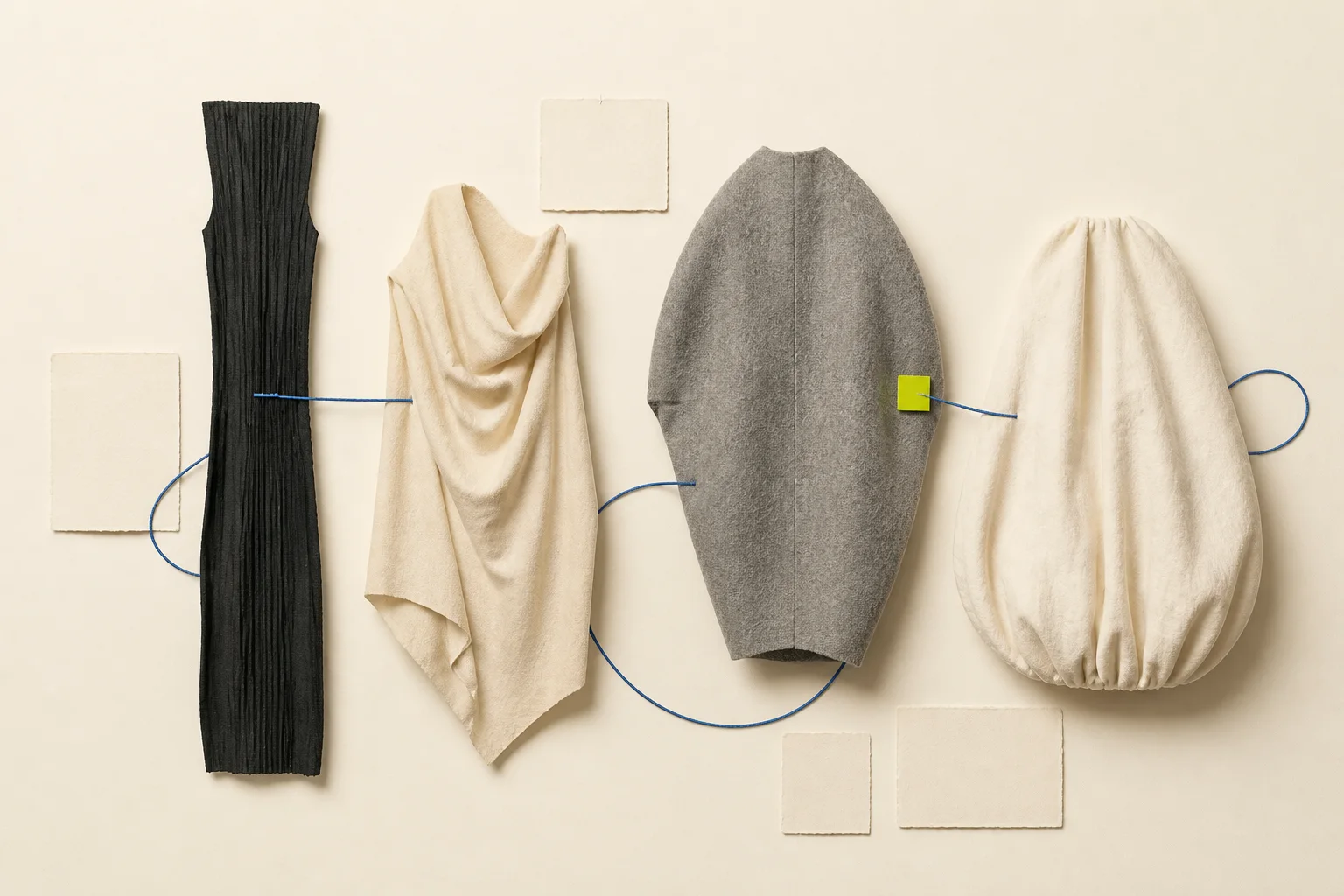
The earliest public outlines of the next fashion season are not converging on one uniform shape. They are testing a tension: exact lines against fabric in motion, spare layers against controlled volume, and recognizable garment types against construction that makes them feel unfamiliar.
That is a signal, not a forecast. As of September 1, 2026, “next season” in this article means the limited set of brand-authored Spring and Cruise 2027 material already public—not the complete women’s Spring 2027 market. Major collections, market appointments, commercial edits, regional assortments, and customer reactions are still missing. A headline can name the question; it cannot manufacture the evidence.
FashionMember did not count every look in a locked runway sample, license runway photography, interview buyers, or inspect retailer orders for this draft. The useful task now is to define what to watch and what would be required before a creative observation becomes a buying claim.
Signal one: a cleaner continuous line
Prada’s Spring/Summer 2027 menswear note describes an exact, controlled approach and a refined linear constant across familiar garment types. The important word for analysis is not “minimal.” It is continuity. A silhouette can feel new because the line from shoulder to hem is uninterrupted, because closures recede, or because several known categories are reclassified through proportion.
That line should be coded rather than admired vaguely. Does the shoulder extend or fall? Is the torso close, straight, or displaced? Where does volume begin? How does the hem relate to the body in motion? A disciplined codebook keeps “clean,” “long,” and “relaxed” from becoming interchangeable adjectives.
Prada’s public note is one house’s account of its own collection. It does not establish how often the line appears across the market, how stores will edit it, or whether customers will wear it. A trend brief should therefore record the source, collection, garment category, view, and date before comparing it with anything else.
Signal two: volume that can move or adjust
Balenciaga’s Spring 2027 presentation uses the language of lightweight architecture, minimized layers, ribbons that adjust garments, and balloon, draped, or cocoon-like constructions. Louis Vuitton’s Cruise 2027 note also places emphasis on silhouettes shaped by youth and creative freedom. Read together, these sources suggest that volume is not merely being added. It is being made mobile, compressible, or responsive to styling.
That distinction matters commercially. A dramatic fixed shape and an adjustable shape can look related in an image but behave differently on a rack, in sizing, under outerwear, and across climates. A buyer would need the physical sample: weight, balance, fastening, ease, hem behavior, seated comfort, layering, size grading, and care. Without those checks, “wearable volume” is only a visual hypothesis.
Accessibility also belongs in the silhouette review. A ribbon closure may offer useful adjustability or create a dexterity obstacle. A cocoon may provide generous ease or restrict reach at a particular seam. Images do not settle those questions.
Signal three: drape and movement as structure
Chanel’s Cruise 2026/27 description centers silhouettes in motion and identifies silk-foulard ensembles, raffia skirts, washed-cotton-canvas suiting, and other material-specific expressions. The brand language matters because it links outline to fabric behavior. Drape is not a shape pasted onto a garment; it is the result of fiber, yarn, weave or knit, finish, cut, gravity, and movement.
Loewe’s Spring/Summer 2026 women’s collection, although from an earlier season, is useful as a method reference. Its official materials emphasize physicality and show how folding, panels, and leather construction can create form. Loewe’s Fall/Winter 2026 notes similarly foreground making through fringed and embroidered leather, sculpted shearling, and molded footwear. These are not evidence for one 2027 direction, but they demonstrate why silhouette research must preserve construction and material alongside the outline.
If editors reduce such looks to “fluid” or “sculptural,” they discard the operational information. A better record distinguishes hanging drape, wrapped drape, folded volume, padded or molded structure, and movement created by fringe or panels.
Signal four: familiar categories with altered edges
Dior’s Cruise 2027 page describes bouclé jackets with frayed cuffs, embroidered-lace evening dresses, patchwork scarves, and shearling coats. The examples do not form one silhouette family. They suggest that familiar categories can be refreshed where material, edge, and surface interrupt the expected outline.
This creates a useful warning for trend analysis: the “new silhouette” may sometimes be a styling or construction effect rather than a new block. A frayed boundary can soften a tailored jacket. A scarf can extend or fragment a line. Shearling changes perceived bulk and proportion. Classifying only the underlying category can miss the visual change; classifying only the image can overstate it.
Retail research should keep both layers: the technical block or category, and the perceived silhouette after material, styling, and movement.
A responsible next-season sample
Before FashionMember could publish frequency language such as “dominant,” “rising,” or “defining,” the sample would need to be locked. The protocol should state:
- the collections, markets, dates, and garment categories included;
- whether every look or only officially published looks can be observed;
- one primary and one secondary silhouette code per look;
- two independent coders and a recorded disagreement process;
- separation of brand-authored descriptions from editor interpretation;
- image rights and a text-only alternative for any visual evidence;
- retailer and showroom checks after commercial assortments become visible; and
- buyer interviews that distinguish inspiration, consideration, order, receipt, and reorder.
The denominator is central. Ten examples across five selected campaigns do not support the same statement as ten examples across a complete, reproducible collection set. The draft must report absences, ambiguous looks, and inaccessible evidence as well as positive observations.
What buyers should test later
Once sellable samples exist, buyers can translate the creative signal into specific questions. Which shapes work across the store’s actual size range? Which require education or special display? What is the alteration burden? Can customers sit, reach, layer, commute, and care for the garment? Does the shape hold after wear? Does the assortment offer a usable bridge between established fits and experimental volume?
Climate and channel change the answer. A lightly draped layer may travel across seasons in Los Angeles while a sculpted shearling shape has a narrower use window. An editorial flagship and a small multi-brand store also take different inventory risks. A universal next-season ranking would erase those conditions.
Order data would still not prove consumer demand. Purchase orders show merchant commitments under particular terms. Receipts, availability, full-price selling, completed returns, customer feedback, and reorders provide later evidence. Each stage should retain its own date and scope.
What the silhouette audit exposed
FashionMember created four invented evidence-packet rows in content/data/FM-091-silhouette-signal-ledger.json. The script scripts/fm091-silhouette-signal-audit.php checks whether a fictional packet documents its period definition, official sources, source dates, locked sample, inclusion rule, codebook, double coding, disagreement review, retailer sample, buyer interviews, climate/size/accessibility review, image rights, claim recheck, human editor, accountable owner, and complete look arithmetic.
Two complete fictional rows reach signal-review; two remain on hold. The exercise does not count a real collection or establish a trend. Every look count, retailer sample, buyer review, owner, and result in the fixture is fictional. signal-review means only that an invented packet is structurally ready for people to review.
Read the signal without forcing the conclusion
The preliminary design language is coherent enough to watch: controlled linearity, adjustable or kinetic volume, drape shaped by material, and familiar categories altered at their edges. It is not yet coherent enough to call a universal direction.
That restraint makes the brief more useful, not less. Editors can build a transparent observation set. Designers can identify construction questions. Buyers can prepare fit and assortment tests. When the wider season and commercial evidence arrive, the team can revise the thesis rather than defend a premature prediction.
Sources and verification
- Chanel: Cruise 2026/27 Collection — current first-party collection presentation and material/silhouette language; not independent trend evidence.
- Chanel Fashion — current first-party collection index used to confirm brand context and availability.
- Loewe: Spring/Summer 2026 Women’s Runway — first-party collection and construction context; an earlier-season method reference, not 2027 frequency evidence.
- Loewe: Fall/Winter 2026 Runway — first-party making and material descriptions; not a market-wide direction.
- Prada: Spring/Summer 2027 Menswear — first-party collection note about controlled linear silhouettes; menswear scope must remain explicit.
- Dior: Cruise 2027 Show — first-party collection examples; not retailer or customer evidence.
- Louis Vuitton: Cruise 2027 Show — first-party creative framing; not a demand forecast.
- Balenciaga: Spring 2027 — first-party construction and silhouette language; not independent verification of prevalence or wearability.
How this story was checked
- Sources
- 8 linked records · View list
- Last verified
- Reporting desk
- FashionMember Editorial Desk
- Format
- Analysis
- AI assistance
- Used with editorial review; disclosed above.