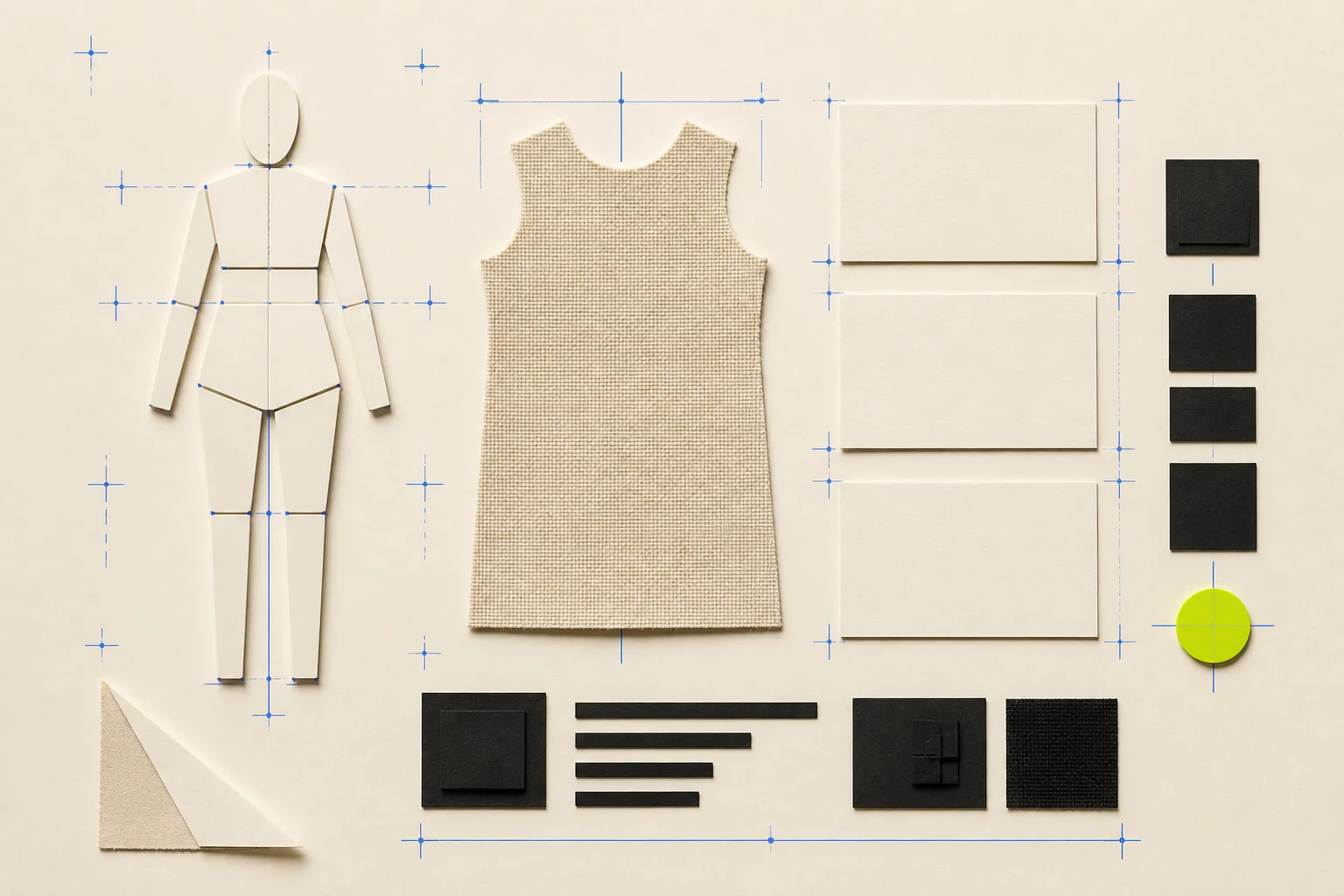
Virtual try-on now works well enough to be useful for exploration. That is not the same as working well enough to answer “Will this fit?”
In August 2026, current Google merchant documentation draws the line clearly: its AI try-on combines a user photo with product imagery to visualize how a garment might look, but the representation is not perfect and does not indicate fit, recommend a size, or confirm size availability. That is a more useful starting point than marketing language that treats every generated outfit as a fitting room.
FashionMember has not completed the hands-on test in this headline. We reviewed official materials and built a test-readiness audit. No person’s image or live service was used.
There are several different products called try-on
The category includes:
- a garment visualized on a selectable model;
- a garment transferred to a shopper’s full-body photograph;
- a synthetic full-body representation derived from a selfie and a selected size;
- footwear or accessory placement;
- 3D or augmented-reality rendering;
- video try-on;
- measurement- or history-based size recommendation.
These methods answer different questions. A visually plausible image may help with color, styling, proportion, or confidence. A size recommender estimates a size from data and rules. A 3D simulation may use explicit geometry and material parameters. Do not merge their claims.
Google’s December 2025 announcement says U.S. shoppers can generate a full-body digital version from a selfie and usual size, then use it for shopping try-on. Its current public try-on page also warns that generative AI is experimental and can make mistakes. Availability, categories, regions, account requirements, and behavior can change, so every test needs a dated service record.
Define “works” with observable criteria
For each method, freeze the intended use and acceptance rubric. A FashionMember protocol would score:
- preservation of garment color, print, texture, closures, pockets, hems, trims, and construction;
- preservation of the person’s identifiable features and body proportions when a real person is an input;
- plausible occlusion, layering, drape, folds, stretch, shadows, and contact points;
- consistency across repeat generations;
- correct product and variant link after visualization;
- response time, failure, and recovery;
- accessible operation and alternative information;
- privacy notice, consent, deletion, retention, and training statements;
- clarity that the image does not establish fit or size;
- customer understanding, measured rather than assumed.
Some errors are ordinary image defects. Others are claims. If a generated image removes a pocket, lengthens a hem, changes transparency, alters a print, or makes a coated fabric appear protective in conditions it was not tested for, the result can misrepresent the product.
Inputs determine much of the result
Google’s merchant guidance recommends high-resolution product images, ideally 1024 pixels or higher, showing the complete garment in a clear, simple presentation. It lists category-specific practices such as unobscured garment details and straightforward poses. The same page says output quality depends on both merchant and user imagery.
Record the exact product ID, variant, source image, image rights, capture date, resolution, crop, background, model pose, and any edits. For user images, record only what is necessary and permitted. Do not reuse a person’s photo for a new purpose merely because it already exists in an account.
Test difficult cases intentionally: dark-on-dark garments, reflective and transparent materials, loose layers, asymmetry, fine patterns, unusual closures, adaptive apparel, extended sizes, mobility devices, seated poses, head coverings, and garments whose meaning changes when altered.
Research progress does not remove product risk
Google Research’s Fashion-VDM paper describes a video diffusion method intended to preserve a person’s identity and motion while transferring a garment across a video. Its abstract also acknowledges the challenge of garment details and temporal consistency in video virtual try-on. A research result is evidence about a method and evaluation setting, not certification of a shopping product.
The evaluation should open the actual output at full size and compare it with the source garment and, when authorized, a physical sample. Automated similarity metrics can support triage, but a qualified human must inspect construction and claims. Record severity and whether the defect could change a purchase decision.
Fit, size, and appearance are separate
A generated jacket may look balanced while the real shoulder is too narrow. The image may show a trouser break without knowing inseam, rise, fabric recovery, or the shopper’s preference. Selecting “M” for a synthetic avatar does not prove that a merchant’s M will fit.
Keep the product page’s actual size chart, garment measurements, model measurements, fit notes, material behavior, return terms, and inventory visible. Do not let the try-on image cover or contradict them. If a different service provides a size recommendation, evaluate that decision separately with its own confidence, reasons, abstention rules, and outcome study.
Never describe a virtual try-on as reducing returns without a controlled measurement. It could reduce uncertainty, increase conversion, increase multi-item exploration, or create new disappointment. A return-rate change can also reflect product mix, promotion, season, policy, or customer acquisition.
Privacy begins before upload
A person’s photograph can be personal information even when it is not used for biometric identification. Depending on processing, body and face information can create additional risk. Document the controller, processor, collection purpose, retention, deletion path, security, access, training use, sharing, and international transfer.
Google’s merchant page states that its described try-on experience does not collect or store biometric data and does not use people’s photos for training. That statement belongs to the current named experience and must be rechecked; it is not evidence about another vendor or an independent implementation.
The California Attorney General’s current CCPA overview explains that California consumers may have rights concerning access, deletion, correction, sale or sharing, sensitive-information use, and non-discrimination, subject to statutory scope. The business should obtain qualified privacy advice and accurately describe its own data flow.
Use project-owned fictional images in development. For human testing, obtain informed consent that covers the tool, intended output, reviewers, retention, publication, withdrawal, and foreseeable generation errors. Never upload a model, employee, customer, or creator’s image based on a vague existing release.
Accessibility cannot depend on the image
The try-on result should have an appropriate text alternative or adjacent explanation of what the tool did and did not establish. Controls need accessible names, visible focus, keyboard operation, adequate contrast, error identification, and status updates that assistive technologies can perceive.
Provide product facts outside the generated visual. Do not communicate size, availability, selection, or success only through color or pose. Offer a path to the original product images and a way to skip the experience entirely.
A reproducible fictional intake
FashionMember created six fictional cases in content/data/FM-011-virtual-try-on-test-intake.json. The script scripts/fm011-virtual-try-on-audit.php checks method, device, region, category, input rights, archived privacy notice, output archive, garment and body review, fit-claim boundary, accessibility review, and the fictional flag.
Three cases route to test-ready because their documentation can enter an authorized evaluation. Three route to hold because input rights, privacy notice, device, output archive, garment or body review, fit boundary, or accessibility review is missing.
Test-ready does not mean accurate or safe. All devices, accounts, garments, people, services, and outputs are invented. The audit does not establish product availability, visual accuracy, garment fidelity, body fidelity, fit, size, privacy compliance, accessibility, or shopping outcome.
Run the hands-on test without turning it into a demo
Predeclare methods, dates, devices, operating systems, browsers, regions, account states, product categories, number of repeats, and scoring rubric. Randomize order. Use rights-cleared inputs and qualified garment reviewers. Archive source files and outputs only as permitted.
Include a conventional product-image control. Ask consented users what they believe each method communicates. A visualization fails if users consistently interpret it as a size guarantee despite a small disclaimer.
NIST’s Generative AI Profile recommends contextual risk analysis, representative testing, documentation, human oversight, incident handling, and attention to confabulation, privacy, bias, and synthetic-content risks. A public launch should include a feedback route, correction or removal process, monitored failures, and an authority to disable the feature.
The live test gate remains open
To report what actually worked, FashionMember must test named current services under authorized accounts, use consented participants and rights-cleared garments, archive method and device details, conduct product-fidelity and accessibility reviews, evaluate user understanding, complete privacy and legal review, and give the platforms a chance to correct material factual descriptions.
Today’s strongest defensible claim is narrower: virtual try-on can create a useful style visualization. The merchant and shopper still need product truth, size information, rights, privacy, and a clear explanation of the image’s limits.
Sources and verification
- Google Merchant Center Help: How Google’s try-on tool works — official current method, image guidance, limitations, privacy statements, and fit/size boundary.
- Google: Generate a digital version of yourself to virtually try on clothes — official December 2025 selfie-to-digital-version announcement.
- Google Shopping Try On — current public product page and experimental-error notice; availability and terms must be rechecked.
- Google Research: Fashion-VDM — primary research abstract on video try-on, identity, motion, garment detail, and temporal consistency.
- NIST AI 600-1: Generative AI Profile — official generative-AI risk-management profile.
- California Department of Justice: CCPA — official current California privacy-rights overview; exact application requires qualified review.
- W3C WCAG 2.2 — official web accessibility standard used for the interaction and alternative-information review.
How this story was checked
- Sources
- 7 linked records · View list
- Last verified
- Reporting desk
- FashionMember AI & Retail Desk
- Format
- Analysis
- AI assistance
- Used with editorial review; disclosed above.