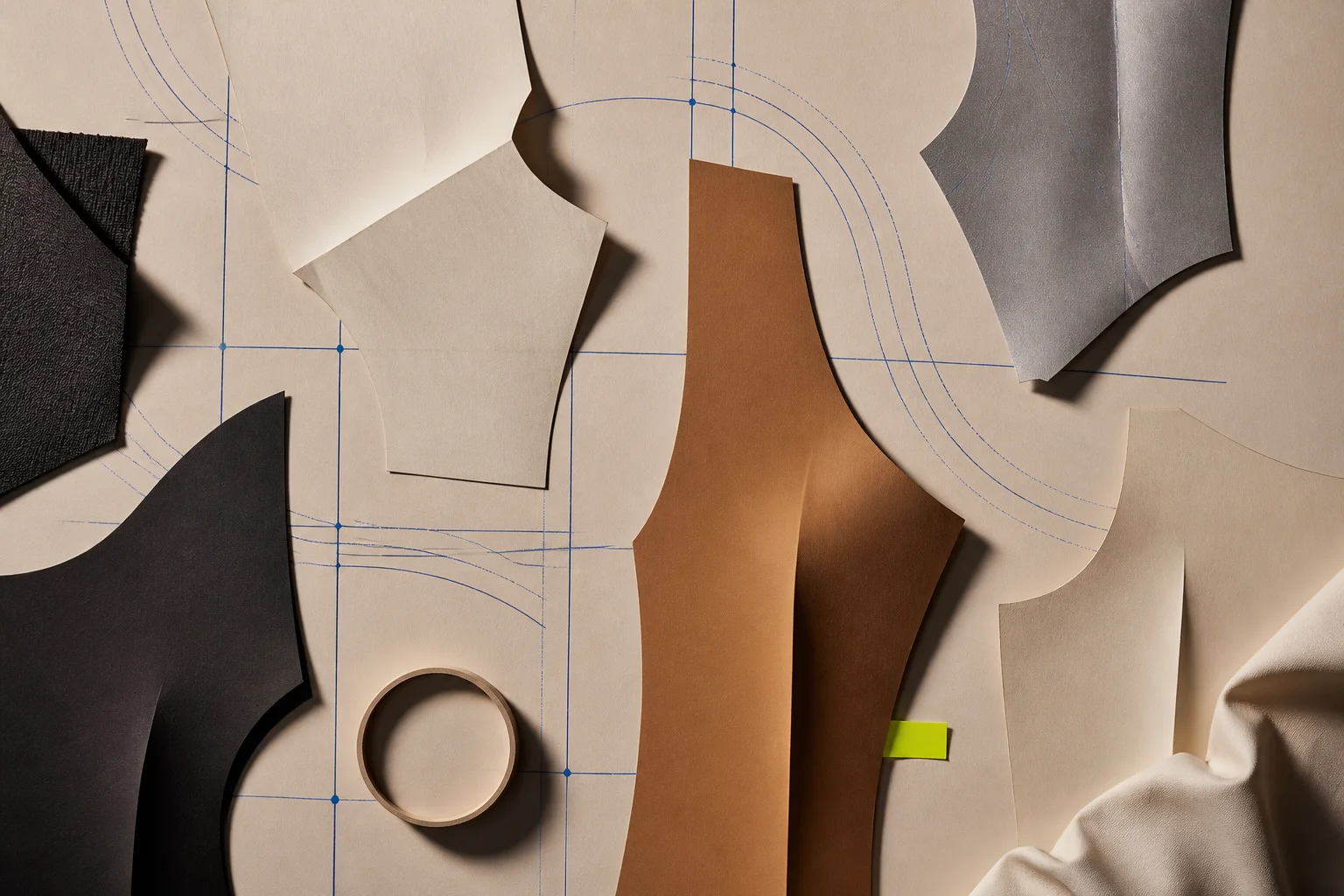
A generated fashion image can suggest proportion, seam direction, volume, layering, and mood in seconds. It cannot tell a cutting room exactly what to cut.
The distance between those two states is patternmaking. That distance includes body measurements, garment measurements, balance, ease, grain, seam allowance, notches, construction order, material behavior, grading, and fit. A useful AI workflow makes that distance visible instead of presenting an attractive concept as a finished technical answer.
FashionMember has not yet completed the patternmaker interview and rights-cleared comparison originally required for this test. This article therefore documents a review framework and a fictional intake, not a tool verdict or a production result.
Separate the concept from the pattern
Start with an unambiguous label. A generated image is a concept reference unless qualified people have converted and verified it. A generated outline is not a production pattern. A 3D rendering is not a fit approval. A plausible seam is not evidence that it can be sewn in the chosen material.
Record the source image, prompt, model and version where available, generation date, selected output, edits, source rights, similarity review, and intended use. Preserve rejected outputs when they explain a decision. A patternmaker should be able to see which features are essential and which are merely visual artifacts.
Before drafting, translate the image into written design intent: garment type, intended wearer, base size, silhouette, length, closure, pockets, collar or neckline, sleeve, hem, lining, functional requirements, and acceptable variation. If an image contradicts the written brief, a human owner decides which one controls.
Build on an explicit measurement basis
Pattern work needs a defined body and measurement method. ISO 8559-1:2017, confirmed current in 2026, defines anthropometric measurements used for apparel and physical or digital databases. It does not provide one universal body or guarantee fit. It provides vocabulary and methods that make measurement records less ambiguous.
Document the target population, source of the body data, base size, posture assumptions, measurement points, units, and version. Then create garment points of measure with tolerances. Body measurements and finished-garment measurements are related but not interchangeable; the difference may include wearing ease, design ease, material response, and construction needs.
CLO’s current Pattern Drafter documentation illustrates how a digital workflow can combine measurement points, pattern drafting, grading, and an AI-assisted draft from a sketch. Its own limits matter: the AI Pattern Drafter is identified as beta, is tied to supported avatar conditions, and may produce different results from the same prompt. That makes the output a reviewable proposal, not an authoritative block.
Convert visible lines into construction decisions
Every line in a concept needs classification. Is it a seam, dart, tuck, fold, opening, edge, topstitch, print, shadow, or accidental generation artifact? The answer changes the pattern pieces and assembly.
For each piece, specify grainline, cut quantity, cut direction, nap or one-way restrictions, fold placement, seam allowance, notches, drill or match points, internal construction, and piece identification. Specify seam and stitch classes appropriate to the material and end use. ASTM D6193-16(2025) is a current terminology and practice reference for stitches and seams; it emphasizes variables such as strength, elasticity, material, and end use. It is not a substitute for an engineer or factory selecting and testing a construction.
Seam performance must be tested, not inferred from the rendering. ASTM D1683/D1683M provides a test method for seam failure in woven fabrics. The applicable method and acceptance criteria depend on product, fabric, construction, customer requirements, and current standards.
Simulate the material you intend to use
A drape result is only as meaningful as its inputs. Record fiber content, construction, weight, thickness, stretch and recovery, bending and shear behavior, finish, directionality, and test method. A generic “silk” preset cannot validate a particular satin, and a scanned texture cannot establish mechanical behavior.
Digital fit maps can help reviewers locate questions. CLO’s Garment Fit Maps expose stress, strain, fit, and pressure views in a simulated garment. The maps depend on the avatar, pattern, material parameters, pose, simulation settings, and software assumptions. Treat them as diagnostic views that guide patternmaker attention. Do not convert a green region into a universal claim of comfort or correct fit.
Visual review should cover front, back, side, inside, motion-relevant poses, and critical details. Record clipping, unstable folds, implausible tension, seam mismatch, and features hidden by the pose. A clean render can still contain an impossible sewing sequence.
Keep grading and marker work in the loop
A base-size concept does not describe a size range. A patternmaker must establish grade rules, preserve or intentionally change design relationships, and examine edge sizes. Review pocket access, closure length, seam intersection, armhole and sleeve relationships, neckline, rise, length, and decorative placement across the range.
Marker planning introduces another physical constraint. CLO’s Nest Patterns documentation describes direction options, spacing, fabric width, and non-overlap logic used to arrange pattern pieces. The result can support consumption planning, but only when the production pattern, fabric direction, width, defects, repeats, shrinkage, and cutting method are accurate.
The physical sample remains a release gate
Print or cut a controlled pattern version. Verify scale. Sew the intended construction in the intended or properly characterized material. Compare the physical garment with the approved written specification, not only the generated image.
Conduct fit with qualified people and an appropriate process. Measure the garment, document deviations, photograph with permission, record movement and use issues, revise the pattern, and preserve version history. Test critical seams, closures, finishes, care, safety, durability, and labeling as required. Approve grading and production separately.
A generated concept may save time by clarifying an idea early. It may also add time if it contains contradictory details or creates unrealistic expectations. Measure both.
A reproducible fictional intake
FashionMember created four invented concepts in content/data/FM-027-pattern-concept-intake.json and a deterministic audit in scripts/fm027-pattern-concept-audit.php. The intake checks sketch rights, body-measurement basis, points of measure, seam allowance, notches, grainlines, seam and stitch specification, fabric parameters, grading, 3D simulation, patternmaker review, and a physical-sample plan.
Two fictional packets route to review-ready because every listed field contains a fictional value. Two route to hold because critical inputs remain open or partial. Review-ready does not mean the pattern exists, fits, can be manufactured, or may be sold. It means only that a human patternmaker has a more complete packet to examine.
What a real test must do
The promised comparison requires a rights-cleared concept, an identified generator and version, a qualified patternmaker, a frozen brief, a documented manual baseline, controlled time capture, version history, a characterized material, 3D review, physical samples, fit sessions, grading, construction and seam evaluation, and permission to publish the evidence.
Report correction rounds and failures, not just the final image. The most credible result may be that generation helped with visual exploration but did not reduce patternmaking work. That is still useful evidence.
Sources and verification
- CLO: Pattern Drafter — current first-party measurement, draft, grading, and beta AI Pattern Drafter documentation.
- ISO 8559-1:2017 — current anthropometric definitions for apparel measurement and databases.
- CLO: Garment Fit Maps — first-party stress, strain, fit, and pressure visualization documentation.
- CLO: Garment Fit Maps Guide — first-party interpretation workflow and cautions.
- ASTM D6193-16(2025) — current stitches-and-seams terminology and practice context.
- ASTM D1683/D1683M — seam-failure test-method context for woven fabrics.
- CLO: Nest Patterns — first-party marker arrangement and fabric-consumption workflow.
How this story was checked
- Sources
- 7 linked records · View list
- Last verified
- Reporting desk
- FashionMember AI & Retail Desk
- Format
- Analysis
- AI assistance
- Used with editorial review; disclosed above.