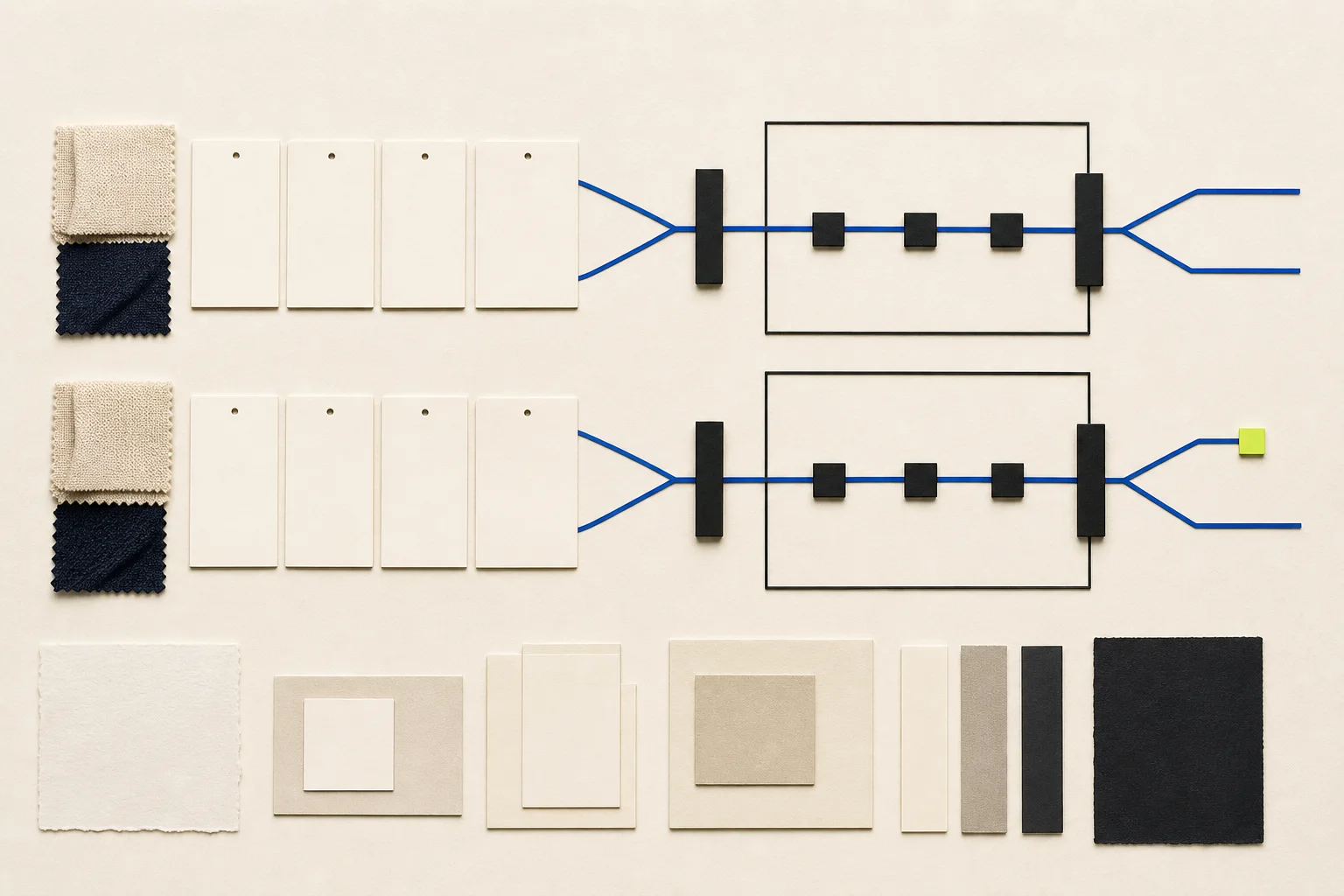
Better fit information can reduce uncertainty. Whether it reduces returns is an empirical question, not a feature description.
The evidence is not one-directional. A published randomized field experiment found that providing virtual fit information improved commercial outcomes and reduced certain fulfillment costs in its setting. A 2025 observational study using a large fashion-platform dataset found that size-finder use was associated with a small increase in returns while also being associated with higher later customer value. Different products, users, methods, assignments, and outcomes can produce different results.
FashionMember has not verified a retailer case study. We built a measurement protocol and an invented two-arm fixture. No causal result is reported.
Define the intervention precisely
“Fit intelligence” may include:
- a conventional garment-measurement chart;
- model measurements and worn size;
- customer fit reviews;
- a rules-based size quiz;
- comparison with a garment the shopper already owns;
- body measurements mapped to product dimensions;
- purchase and return history;
- image or scan-derived measurements;
- virtual fit visualization;
- a personalized size recommendation with confidence and reasons.
A study must name the exact method, version, inputs, eligible categories, and shopper interaction. If the control has only a generic size table while the treatment also adds garment measurements, fit notes, and a clearer interface, the experiment tests the information package—not only the model.
Specify the decision. Does the system select one size, rank several sizes, say how body areas may feel, or abstain? A calibrated “insufficient information” response can be safer than false precision.
Product data is part of fit
The system cannot repair inconsistent source measurements. For every style and variant, record:
- size label and market-specific size system;
- finished garment measurements with method and tolerance;
- construction, stretch, recovery, shrinkage, lining, and ease;
- silhouette and intended wearing ease;
- model measurements, pose, styling, and worn size where published;
- known production changes by color, factory, or batch;
- measurement date, sample identity, owner, and approval status.
Body measurements are not garment measurements. Preferred fit is not identical to body size. A shopper may choose different ease for a fitted shirt, overshirt, coat, performance layer, or formal garment. Mobility, sensory needs, layering, posture, and cultural styling also matter.
The 2026 Textiles paper “An Interpretable Multi-Dimensional Fit Evaluation Framework” treats apparel recommendation as a relationship among body measurements, garment dimensions, and style-dependent targets. Its study and reported accuracy belong to that defined research setting; they do not validate a commercial product or guarantee return reduction elsewhere.
Return reasons are noisy labels
“Too small” can mean a wrong recommendation, an inaccurate chart, unusual ease, production variance, body-area mismatch, customer preference, or a product different from the page. “Didn’t like it” can conceal color, fabric, styling, or fit. A customer may select the fastest available reason.
Preserve the original reason and allow structured secondary detail without forcing intimate information. Record who or what assigned the code, confidence, free-text treatment, and missingness. Audit differences across channels and customer groups.
Do not train directly on refunds as if they were objective fit labels. A kept item is not necessarily a good fit; the shopper may accept inconvenience, miss the return date, or resell it. A returned item may fit but fail on color, quality, delivery, or expectation.
Choose outcomes before opening the dashboard
A defensible study reports at least:
- assignment, eligibility, exposure, and recommendation-completion rates;
- purchasing sessions and conversion;
- units ordered per purchasing session;
- multi-size or “bracketing” orders;
- total unit returns after the complete return window;
- fit-attributed returns with reason-capture coverage;
- exchanges and replacement outcomes;
- net revenue, gross margin, shipping, processing, and inventory effects;
- complaints, recommendation corrections, and abstentions;
- performance and missingness by category and relevant user groups;
- data entry, page-speed, privacy, and accessibility burden.
Report both intent-to-treat and appropriate exposure analyses if the design supports them. Intent-to-treat keeps the benefit of assignment even when shoppers ignore the tool. Exposure analysis can answer a different question but is more vulnerable to selection: people who open a size finder may already have higher fit uncertainty.
Wait for the return window. A treatment that increases late-season purchases can look unusually successful if its orders have had less time to come back.
Evidence should shape, not prewrite, the answer
Gallino and Moreno’s randomized field experiments studied virtual fit information in online retail and reported increases in conversion and order value plus lower fulfillment costs connected with returns and home try-on behavior in that setting. The study demonstrates that experimental evaluation is possible; it is not a universal effect size for fashion retailers.
The 2025 open-access study “Fits like a glove?” analyzed 496,365 items ordered by 75,707 customers on a major fashion platform. It reported that size-finder users were slightly more likely to return an item, while higher use was associated with higher subsequent customer lifetime value. Because tool use was not simply random assignment, interpretation requires the authors’ methods and limitations. The result is a warning against choosing “return rate down” as the only acceptable story.
Research on size-inclusive model photography also shows that fit information is broader than an algorithm. A 2024 paper across multiple studies reported that own-size model representation can reduce perceived fit risk in specified contexts. Product-page information, return policy, and representation can interact with the decision.
A reproducible fictional fixture
FashionMember created two invented arms in content/data/FM-013-fit-return-fixture.csv. Both use the same fictional analysis plan and eligibility rule, cover a complete made-up return window, and have more than 90 percent invented reason capture. The script scripts/fm013-fit-return-audit.php validates denominators and then calculates purchase, unit-return, fit-return, and multi-size-order rates.
In the constructed control, the purchase rate is 10.97 percent, unit-return rate 32.74 percent, fit-return rate 20.28 percent, and multi-size orders equal 15.97 percent of purchasing sessions. In the constructed fit-intelligence arm, the corresponding figures are 11.83, 30.23, 16.28, and 12.11 percent.
Every number was invented to test the calculation. There was no assignment mechanism, retailer, shopper, product, purchase, recommendation, or return. The differences have no sampling uncertainty because they are not sampled observations and cannot support a causal claim.
Protect privacy and customer dignity
Use the least intrusive input that can answer the fit task. Explain why each measurement or history field is needed, whether it is optional, how long it is retained, who receives it, whether it trains a model, and how it can be corrected or deleted.
Do not infer sex, health, pregnancy, disability, race, or identity from body data to make a recommendation. Do not display body judgments in shaming language. Avoid rigid labels such as “ideal” or “normal.” Let shoppers edit measurements, select fit preference, skip the tool, and see the source product information.
California privacy law may apply to personal information, inferences, and certain sensitive data depending on the facts and business scope. Obtain qualified review rather than copying another vendor’s notice. Test deletion and correction through every processor and derived feature store.
Accessibility is part of accuracy
Size tools need programmatic labels, logical focus, keyboard access, clear instructions, error suggestions, perceivable status messages, and support at zoom. Units should be explicit. Diagrams require text alternatives. A customer should be able to compare sizes without drag gestures or color alone.
Plain-language explanations should distinguish body measurement, garment measurement, preference, and uncertainty. Provide a non-personalized path with the same core product facts. Record abandonment caused by the tool rather than treating it as missing data.
Operate a safe experiment
Predeclare eligibility, randomization unit, sample-size rationale, primary outcome, guardrails, return window, missing-data rules, and practical decision threshold. Freeze the interface and model version or log every change. Separate staff, bot, fraud, and test orders with documented rules.
Monitor unusually high abstention, unavailable variants, measurement conflicts, subgroup error, and harmful wording. Give customer service a way to see what was recommended without exposing unnecessary body data. Make correction and incident routes visible.
NIST’s AI Risk Management Framework recommends context-specific evaluation, privacy and fairness measurement, uncertainty, domain-expert input, monitoring, and documented responses. A fit system should be paused when its measurement source changes or a product category falls outside validated conditions.
The retailer case-study gate remains open
To publish a verified answer, FashionMember must work with a consenting retailer and fit provider, archive product and model documentation, preregister an appropriate experiment, secure and minimize customer data, complete the return window, reconcile costs and reasons, audit accessibility and subgroup performance, and obtain merchant, customer-service, privacy, security, statistical, and legal review.
Better fit intelligence may reduce some returns. It may also increase purchasing, expose poor product data, or shift which customers return. The decision belongs in a complete customer and business measurement—not a single vendor percentage.
Sources and verification
- Gallino and Moreno: The Value of Fit Information in Online Retail — primary randomized field-experiment paper; results are setting-specific.
- Fits like a glove? Knowledge and use of size finders and high-end fashion retail returns — open-access primary observational study with return and customer-value findings.
- Textiles 2026: An Interpretable Multi-Dimensional Fit Evaluation Framework — primary current research on body measurements, garment dimensions, fit targets, and interpretability.
- One size does not fit all — primary multi-study research on model-size representation and perceived fit risk.
- California Department of Justice: CCPA — official current California privacy-rights overview; exact application requires qualified review.
- W3C WCAG 2.2 — official web accessibility standard used for the tool-interaction review.
- NIST AI RMF Core — official voluntary guidance for context, privacy, fairness, evaluation, uncertainty, expert input, and monitoring.
How this story was checked
- Sources
- 7 linked records · View list
- Last verified
- Reporting desk
- FashionMember AI & Retail Desk
- Format
- Analysis
- AI assistance
- Used with editorial review; disclosed above.