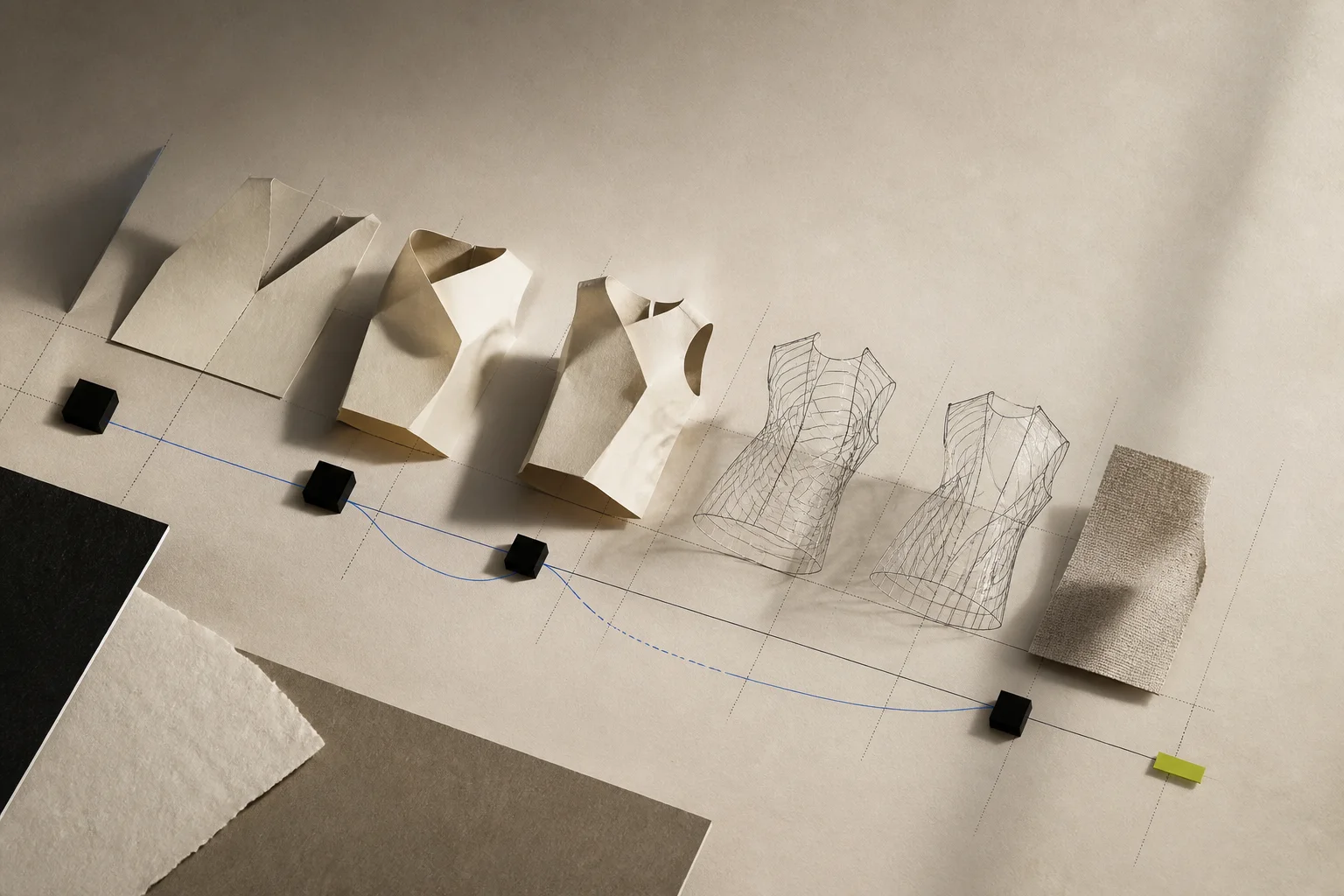
The strongest case for 3D sampling is not that physical samples disappear. It is that teams can remove avoidable uncertainty before they spend fabric, freight, and sewing time.
A digital garment can expose a missing seam, incorrect proportion, impossible pocket, mismatched panel, unclear colorway, or poor communication earlier. It can also create false confidence when the pattern, body, material, construction, or simulation is wrong. The saving is therefore conditional: a question must be resolved digitally and stay resolved in the physical product.
FashionMember has not collected verified workflow and time data from a real team for this article. The numerical example below is deliberately fictional. It demonstrates how to structure a study without presenting invented savings as a case study.
Define what counts as a sample
Teams use “sample” to mean different things: concept mock-up, 3D iteration, muslin, proto, fit sample, salesman sample, size set, pre-production sample, photo sample, or shipment sample. Counting all digital files as equivalent to sewn approvals produces misleading comparisons.
Create a stage dictionary before measurement. For every iteration record its purpose, inputs, owner, start and finish, review participants, decision, defects found, revisions, and whether it prevented or merely deferred physical work. A digital colorway reviewed for assortment is not a fit sample. A 3D fit review is not a pre-production approval.
Freeze the release criteria for each stage. Otherwise a team can appear faster simply because it moved unresolved work downstream.
Start with a production-relevant pattern
3D software can visualize a poor pattern beautifully. The pattern version, seam allowances, internal lines, grain, notches, layer order, trims, shrinkage assumptions, and construction intent need version control.
CLO’s current Pattern Drafter documentation connects measurement points, pattern drafting, grading, and an AI-assisted beta workflow. The beta limitations are a reminder that an automatically drafted result requires patternmaker review. A study should record whether digital iterations began from an approved block, a manually drafted pattern, an imported vendor pattern, or an AI proposal.
The body basis must also be explicit. ISO 8559-1:2017 defines anthropometric measurements used for apparel and databases. A named standard does not make an avatar representative. Record the target population, measurement source, posture, size, pose, and any adjustments.
Measure the material, not just its appearance
The visual texture on a digital garment is not its mechanical behavior. Capture material identity, lot, fiber and construction, weight, thickness, width, stretch and recovery, bending, shear, friction, finish, shrinkage, and the methods and devices used. Preserve the parameter file with the physical swatch and version.
When parameters are estimated, label them. If a supplier later changes a finish or construction, invalidate dependent simulations. A 3D workflow should make uncertainty traceable instead of hiding it in a preset name.
CLO’s Garment Fit Maps display simulated stress, strain, fit, and pressure. These views can focus a review, but the colors depend on the underlying pattern, fabric, avatar, pose, and software settings. The accompanying Fit Maps Guide should be read as tool guidance, not clinical or universal fit proof.
Capture all labor and waiting time
Track active hours by role: design, 3D, patternmaking, technical design, materials, graphics, merchandising, product development, factory, fit, and approval. Record training, troubleshooting, file cleanup, conversion, rendering, meetings, review, and correction. Track elapsed waiting separately from hands-on labor.
Costs should include software, hardware, service, scanning or testing, training, contractor work, physical material, trims, sewing, freight, duties, photography where affected, and rejected outputs. Do not report only sample-room invoices while treating new digital labor as free.
Use cost per accepted stage output or approved style, not cost per render. Report distributions and ranges because a simple knit top and a tailored, lined, asymmetric garment are not equivalent.
Test the handoff to physical development
The first sewn sample is not a ceremonial confirmation. It tests whether digital decisions survived paper, fabric, machinery, operator method, pressing, trim behavior, and wear.
Measure the physical sample against the specification. Compare visible silhouette and details, but also balance, ease, mobility, seam behavior, stretch recovery, opacity, weight, hand, closure function, durability, care, safety, and labeling. Use appropriate qualified reviewers and current test methods.
ASTM D6193-16(2025) provides current seam and stitch terminology and selection context. ASTM D1683/D1683M covers seam-failure testing for woven fabrics. These references show why a visual simulation cannot approve construction performance.
Record every mismatch and assign it to a cause: source specification, pattern, material characterization, avatar, construction interpretation, software behavior, file handoff, physical process, or review error. Only then can the team learn what 3D actually prevented.
Consumption is another testable claim
Digital marker planning can estimate fabric use earlier. CLO’s Nest Patterns documents arrangement rules including direction, spacing, width, and non-overlap. A credible consumption comparison must use the approved graded pieces and production constraints: nap, repeat, one-way artwork, defects, usable width, shrinkage, spreading and cutting method, and order quantities.
Do not turn an early marker estimate into a sustainability claim. Measure ordered, cut, used, damaged, remnant, and discarded material under a defined boundary. Account for electricity, hardware, resampling, and rebound effects if making a broader environmental assessment.
Our fictional comparison fixture
The file content/data/FM-028-3d-sampling-fixture.csv contains six invented style records. The script scripts/fm028-3d-sampling-audit.php totals 3D hours, physical samples, physical-sample hours, material cost, and shipping cost by fictional workflow.
Four invented “3D-first” rows total 58.5 digital hours, five physical samples, 49 physical-sample hours, $1,190 in material, and $270 in shipping. Two invented “physical-first” rows total four digital hours, nine physical samples, 76 physical-sample hours, $2,300 in material, and $485 in shipping. One 3D-first record routes to hold because its avatar, fit review, construction review, and physical validation are incomplete.
Those totals are not a benchmark or saving. The groups contain different fictional styles, the sample is tiny, costs omit many categories, no statistical design exists, and none of the records describes a real project. The numbers are included to make the accounting logic inspectable.
A credible field study
Use matched styles or randomized eligible work where feasible. Predefine complexity, stages, acceptance, metrics, exclusions, time horizon, and analysis. Archive patterns, materials, parameter files, avatars, renders, samples, review notes, costs, and decisions with permission. Include edge sizes and difficult materials, not only showcase successes.
Interview designers, patternmakers, technical designers, sample makers, factory partners, fit reviewers, and merchandisers. A time saving for one role can be a burden transfer to another. Report training and maturity because an experienced 3D team cannot be compared fairly with a first-week control.
The result worth publishing is not “3D saved 50 percent.” It is a bounded statement about which questions moved earlier, which physical samples remained necessary, what inputs determined reliability, and where the workflow failed.
Sources and verification
- CLO: Pattern Drafter — current first-party pattern, measurement, grading, and beta AI-drafting documentation.
- ISO 8559-1:2017 — current anthropometric measurement definitions for apparel.
- CLO: Garment Fit Maps — first-party simulated stress, strain, fit, and pressure views.
- CLO: Garment Fit Maps Guide — first-party interpretation workflow.
- CLO: Nest Patterns — first-party marker arrangement and consumption planning.
- ASTM D6193-16(2025) — current seam and stitch practice context.
- ASTM D1683/D1683M — physical seam-failure test context.
How this story was checked
- Sources
- 7 linked records · View list
- Last verified
- Reporting desk
- FashionMember AI & Retail Desk
- Format
- Analysis
- AI assistance
- Used with editorial review; disclosed above.