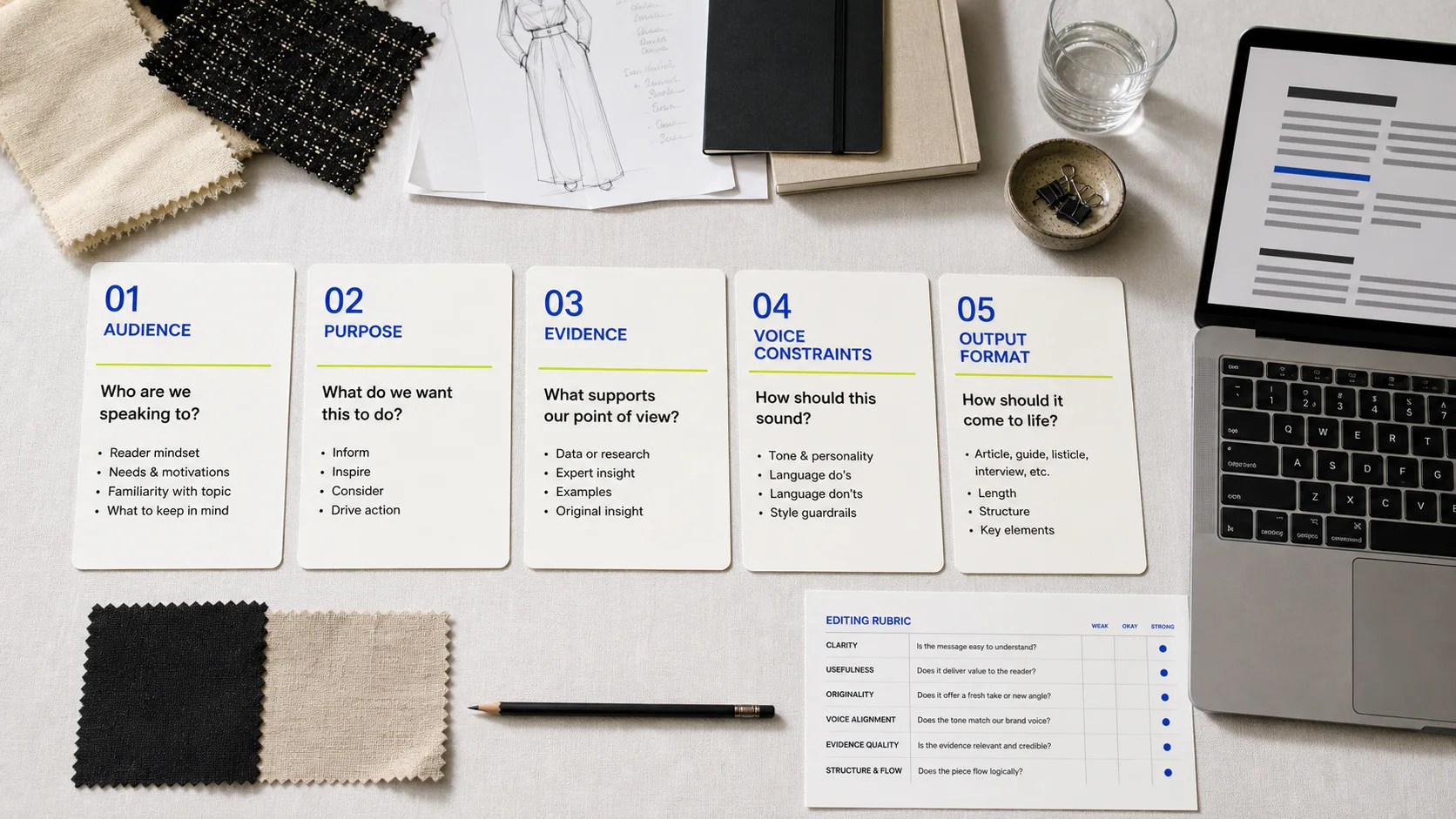
The instruction “write in our brand voice” leaves nearly every consequential choice unstated: audience, purpose, evidence, tone, banned language, structure, and risk tolerance. Different employees—and different model runs—can interpret the same phrase differently.
A reliable prompt separates those decisions, versions them, and tests them against real tasks. The result should reduce factual drift and preserve recognizable editorial choices without making every sentence sound identical.
The five-part prompt
1. Audience
Describe the reader’s situation, not a demographic stereotype.
Weak: “Write for fashionable Gen Z women.”
Stronger: “Write for a customer comparing this jacket with two alternatives. They know basic garment terms, care about construction and care burden, and have not seen the product in person.”
2. Purpose
Name what the copy should help the reader do: understand a material, compare two products, choose a variant, prepare for an appointment, or decide whether to continue reading.
One output should have one primary purpose. If the team needs product copy, SEO metadata, a social caption, and a wholesale pitch, create separate tasks with shared evidence.
3. Evidence
Provide an authoritative source block. Distinguish verified facts, optional context, and unknowns.
VERIFIED PRODUCT FACTS
- Product: Field Jacket
- Color: Ink
- Material: 100% cotton twill
- Construction: unlined; adjustable drawcord waist; four patch pockets
- Care: machine wash cold
- Sizes: XS–XL
- Price: $148
- Fulfillment: ships in 2–3 business days

UNKNOWN OR UNVERIFIED
- water resistance
- fiber certification
- country of origin
- environmental impact
The instruction should say: use only verified facts; do not turn an unknown into a claim; do not infer sustainability, performance, or origin from material alone.
4. Voice constraints
Describe observable choices rather than personality adjectives.
Instead of “elevated, authentic, and playful,” specify:
- begin with material or construction, not lifestyle fantasy;
- use concrete nouns and active verbs;
- average sentence length between 10 and 18 words;
- use at most one adjective before a noun;
- allow technical garment terms when they help comparison;
- avoid “luxury,” “timeless,” “must-have,” “sustainable,” and “perfect”;
- never address an imagined body type;
- do not manufacture urgency.
Examples are useful when they demonstrate these rules. They should not contain facts that the model can accidentally copy into a different product.
5. Output contract
Specify the form that downstream people or systems need.
OUTPUT
- 70–90 words
- one headline of no more than six words
- one paragraph
- no bullet list
- return a second section called CHECKS listing any unsupported claim you removed
Official prompt-design documentation from Google and Anthropic similarly emphasizes clear instructions, context, examples, and explicit output structure. The exact syntax matters less than keeping the sections stable and testable.
The complete template
The project includes a reusable version at content/resources/FM-022-brand-voice-system.md. Its core order is:
- task and purpose;
- audience situation;
- verified evidence and unknowns;
- voice rules and banned language;
- output contract;
- self-check instructions.
Store the template in version control or a change log. Record the model, date, task, and prompt version used for production copy.
A small reproducible test
FashionMember ran one illustrative test in the current Codex session using the fictional Field Jacket facts above. The test compares:
- a one-line control prompt asking for polished brand copy;
- the structured five-part prompt with evidence and forbidden claims.
The two archived outputs are evaluated by scripts/fm022-evaluate-output.php. The script checks only objective constraints: word range, required facts, and prohibited claims. It does not grade beauty, originality, or whether a person likes the voice.
In the stored fixture, the control output fails because it introduces “premium,” “water-resistant,” and “sustainable”—none of which appears in the evidence block. The structured output passes the mechanical checks and explicitly keeps unverified claims out. This is a demonstration, not proof that one prompt will generalize across models or tasks.
Run the test:
php scripts/fm022-evaluate-output.php content/data/FM-022-prompt-test.jsonBuild an evaluation set
A production team should collect 20 to 50 representative tasks:
- a technical product with verified specifications;
- a product with missing origin information;
- a final-sale promotion;
- a delayed preorder;
- a material story with certification evidence;
- a product that should not receive an environmental claim;
- a fit note that must avoid body judgment;
- a correction to previously published copy;
- a wholesale description with ordering facts;
- a brand story containing a founder quote.
For each task, define hard failures and editorial preferences separately.
Hard failures: invented fact, wrong price, altered quote, missing disclosure, prohibited claim, wrong format.
Editorial preferences: rhythm, specificity, warmth, originality, and alignment with the publication’s point of view.
Automated checks are useful for the first group. A human editor remains responsible for the second.
Version prompts like a product
When the team changes a rule, rerun the same evaluation set and compare failures. Do not approve a new prompt because one fresh example sounds better.
Record:
- prompt version and change reason;
- model and relevant settings;
- evaluation cases used;
- hard-failure count;
- human-review notes;
- known categories where the system should abstain;
- approval date and owner.
OpenAI’s Evals API provides a formal way to define data sources and graders for model tests. A small fashion team can begin with a spreadsheet and a script. The essential practice is the same: repeat the task against known criteria instead of trusting a memorable demo.
The editor’s role
A prompt can enforce a word count and ban “must-have.” It cannot decide whether the article deserves to exist, whether the material evidence is adequate, whether the joke fits the moment, or whether the copy respects the reader.
Use the prompt system to make constraints visible. Use an editor to make meaning.
Sources and verification
- Google AI for Developers: Prompt design strategies, accessed August 31, 2026.
- Anthropic: Prompting best practices, accessed August 31, 2026.
- OpenAI API: Evals reference, accessed August 31, 2026.
- Google AI for Developers: Model alignment, accessed August 31, 2026.
How this story was checked
- Sources
- 4 linked records · View list
- Last verified
- Reporting desk
- FashionMember AI & Retail Desk
- Format
- Analysis
- AI assistance
- Used with editorial review; disclosed above.