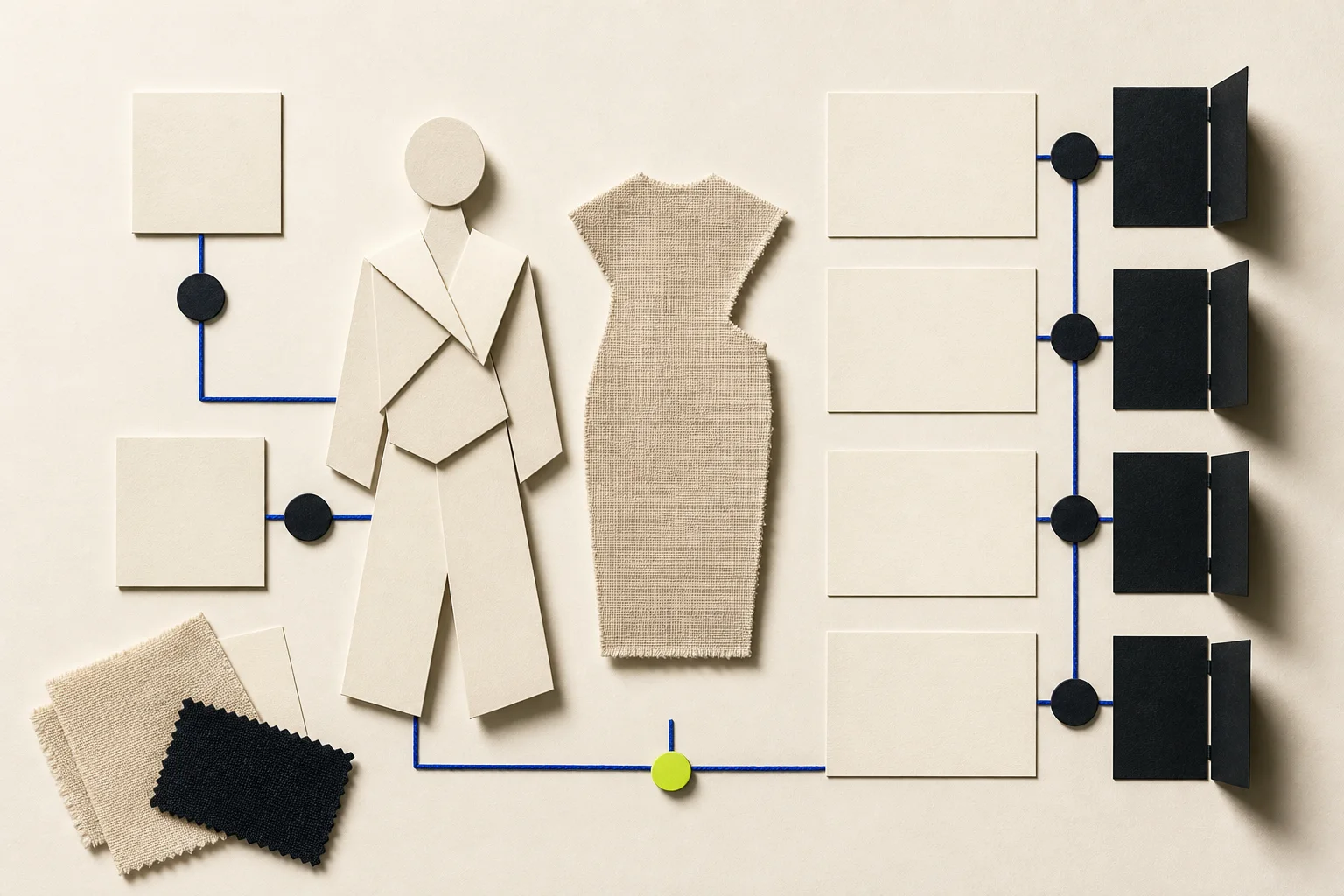
A synthetic person can be produced without booking a studio. That does not make the complete campaign inexpensive, rights-cleared, representative, or trustworthy.
The production category includes at least three different practices: a fully invented person, an authorized digital replica of an identifiable person, and a real model photographed inside an AI-generated or heavily AI-edited scene. Each has a different consent, contract, labor, disclosure, and risk profile.
FashionMember has not interviewed the agencies, models, and brands required by the original brief. This article is a U.S.- and California-focused operating framework, not legal advice or a verified business case.
Name the image mode accurately
Create a record for every final asset:
- fully AI-generated person and scene;
- synthetic body with a photographed product composite;
- authorized digital replica of a named model;
- human model with AI-generated background or edit;
- human photograph with conventional retouching;
- composite containing multiple human and generated ingredients.
Do not use “virtual model” as a catch-all. Record whether a reasonable viewer could identify or associate the image with a real person, whether that resemblance was intended, which source assets contributed, and who reviewed similarity.
The U.S. Copyright Office’s Digital Replicas report defines a digital replica as an image, video, or audio recording digitally created or manipulated to realistically but falsely depict an individual. Its policy analysis discusses both authorized and unauthorized uses and recommends federal protection against certain unauthorized replicas. The report is not a rights clearance for a campaign.
Build the business case around accepted outputs
Compare like with like. Freeze the number, channel, territory, resolution, crop, product, variant, disclosure, accessibility, and approval requirements. Then count:
- concept and briefing labor;
- source photography and product preparation;
- model, agency, photographer, stylist, hair, makeup, studio, travel, and usage costs where applicable;
- generation, compute, vendor, storage, and integration fees;
- selection, retouching, compositing, and color work;
- product-fidelity, likeness, rights, claims, and representation review;
- rejected generations and correction rounds;
- metadata, disclosure, accessibility, localization, and channel adaptation;
- consent negotiation, contract administration, legal review, provenance, archiving, correction, and withdrawal;
- post-publication complaints and replacement assets.
Cost per generated image is a poor denominator. Use cost per accepted, deployable asset after every required review. Track elapsed time and staff burden separately. A faster first image can still create a slower approval process.
Do not assume a synthetic person has zero talent cost. A licensed digital replica may require negotiated compensation and scope. A fully invented person still depends on creative direction, tool terms, source rights, review labor, and the work of people whose jobs are affected.
Consent must be specific and durable
An identifiable person’s consent should address intended use, product, media, territory, duration, edits, generation of new material, training, reuse, sublicensing, exclusivity, compensation, approval, security, retention, termination, and what happens after the relationship ends. Obtain qualified counsel; a generic photo release may not cover independent generation of new performances or appearances.
California’s governor announced the signing of AB 2602 and AB 1836 in September 2024 as protections concerning performers’ digital likenesses, including consent-related rules. Exact statutory application to fashion, advertising, employment, and a particular contract requires current legal analysis. Do not reduce those laws to a social-media slogan.
SAG-AFTRA’s current AI resources show how negotiated performer frameworks distinguish digital replicas and independently created digital replicas and emphasize clear, conspicuous consent and reasonably specific intended use in covered settings. A fashion brand should not copy contract language from a different agreement without counsel, but the operational lesson is direct: scope cannot remain an unspecified future blank check.
For a fully synthetic person, perform a documented similarity review. Do not intentionally evoke a model, celebrity, employee, customer, or creator without authorization. Create a correction and removal channel for people who believe an asset resembles them.
A generated person cannot give an endorsement
An image can imply lived experience. A synthetic person wearing a performance garment in rain, demonstrating comfort, appearing as a customer testimonial, or speaking about results can communicate product and endorsement claims.
FTC guidance says endorsements must be honest and not misleading, reflect actual experience where experience is represented, and disclose material connections that would affect credibility. A nonexistent person has no experience. Do not present a synthetic model as a satisfied customer, expert, founder, worker, or real campaign participant.
The underlying product claims still need evidence. Disclosure that an image is AI-generated does not cure a deceptive performance, origin, environmental, fit, or availability impression.
Product fidelity is a release gate
Compare the final image with the approved physical product and source record. Inspect color, material, transparency, print, texture, silhouette, length, seams, pockets, closures, hardware, branding, labels, fit behavior, and every visible claim-bearing feature.
Record each correction and its cause. If a generated image repeatedly changes a difficult product, the correct result may be to use photography. Do not publish a beautiful composite that depicts an unavailable or impossible variant.
Keep body and garment review separate. A technically correct garment can still be placed on a body in a degrading, stereotyped, anatomically implausible, or inaccessible context. Include qualified human reviewers with authority to reject the asset.
Labor is part of the governance record
Document which roles were removed, added, or changed. Interview affected models, photographers, stylists, retouchers, casting professionals, creative directors, and production staff rather than declaring that AI “automated” their work.
Set rules for portfolio use, credit, compensation, reskilling, review, and dispute. Do not require an employee or contractor to surrender broad replica rights as an unnoticed condition in a general services agreement. Preserve human creative decisions and authorship records.
The U.S. Copyright Office’s separate Part 2 report explains that copyright analysis focuses on human-authored expression and that prompts alone generally do not provide sufficient human control over expressive elements. Copyrightability, ownership by contract, source rights, likeness permission, and advertising clearance are different questions.
Disclose in the customer’s field of view
Use plain, specific language such as “AI-generated person and scene” or “human model photographed in an AI-generated setting.” Place it where the audience encounters the asset, not only in hidden metadata or a distant policy.
C2PA Content Credentials can record provenance and AI-related actions in a cryptographically bound manifest. C2PA guidance stresses that provenance does not decide whether the recorded content is true, lawful, or good. Test whether credentials survive resizing, optimization, content delivery, social platforms, and screenshots. Preserve a separate internal asset ledger.
Provide meaningful alt text and captions. The disclosure should not replace a description of the garment or scene, and the image should not be the only source of product facts.
A reproducible fictional business-case intake
FashionMember created five invented production modes in content/data/FM-014-synthetic-model-business-case.json. The file includes fictional outputs, labor, correction, tool and outside costs, plus consent, contract, source-rights, claims, disclosure, provenance, product-fidelity, body-representation, labor-impact, and accessibility gates.
The script scripts/fm014-synthetic-model-business-case.php uses an invented loaded rate of $82 per hour to calculate total and per-output cost. The fictional human-photography scenario totals $4,532, the fully synthetic person $3,284, the authorized digital replica $3,974, the synthetic-body composite $3,012, and the human-photo/AI-background scenario $3,308.
Three route to review-ready documentation. The replica routes to hold because consent, contract, provenance, and labor-impact review are open. The synthetic-body composite routes to hold because source rights, claims, disclosure, provenance, product fidelity, representation, and accessibility are open.
These values are not quotes, rates, benchmarks, savings, or campaign results. The fixture was intentionally constructed to show that the lowest calculated total can still be unusable. Review-ready means only that an invented packet has its listed fields; it grants no permission and proves no quality or outcome.
Evaluate customer trust instead of assuming it
Before launch, test disclosure comprehension with consented participants. Ask what they believe is real, whether the person exists, whether the garment is accurately shown, and whether the image changes perceived credibility. Include people across ages, disabilities, skin tones, body types, and fashion contexts without treating identity as a checkbox.
Measure corrections, complaints, opt-outs, page behavior, return reasons, and long-term brand effects with an approved plan. Do not infer trust from clicks. Curiosity can produce engagement without confidence.
NIST’s Generative AI Profile recommends mapping intended uses and impacts, evaluating representative risks, documenting human oversight, monitoring, handling incidents, and addressing synthetic-content, privacy, bias, and confabulation risks. Define a stop rule before a high-profile failure.
The verified business-case gate remains open
To turn this framework into the promised report, FashionMember must conduct compensated interviews with models, agencies, brands, photographers, and production staff; obtain current contracts and tool documentation; run comparable authorized productions; measure actual accepted cost and time; perform product, likeness, representation, accessibility, claims, provenance, privacy, labor, and legal review; and secure permission to report the findings.
Synthetic fashion models may be appropriate for a clearly fictional editorial concept. They may be inappropriate when real experience, exact product behavior, human identity, or employment is central. The business case is credible only when it counts the people, permissions, corrections, and trust that the first generated image leaves out.
Sources and verification
- U.S. Copyright Office: Copyright and Artificial Intelligence, Part 1 — Digital Replicas — official report on digital replicas, existing protections, and policy recommendations.
- U.S. Copyright Office: Copyright and Artificial Intelligence — official current Part 1, Part 2, and Part 3 materials and release history.
- California Governor: Bills to protect digital likeness of performers — official signing announcement for AB 2602 and AB 1836; exact law and application require current counsel review.
- SAG-AFTRA: Artificial Intelligence resources — current first-party contract bulletins and member resources on digital replicas, consent, and covered agreements.
- FTC: Advertisement Endorsements — official truthful-endorsement, experience, substantiation, and material-connection guidance.
- C2PA Content Credentials explainer — official provenance goals, cryptographic binding, and non-goals.
- NIST AI 600-1: Generative AI Profile — official generative-AI risk-management profile used for the operational review.
How this story was checked
- Sources
- 7 linked records · View list
- Last verified
- Reporting desk
- FashionMember AI & Retail Desk
- Format
- Analysis
- AI assistance
- Used with editorial review; disclosed above.