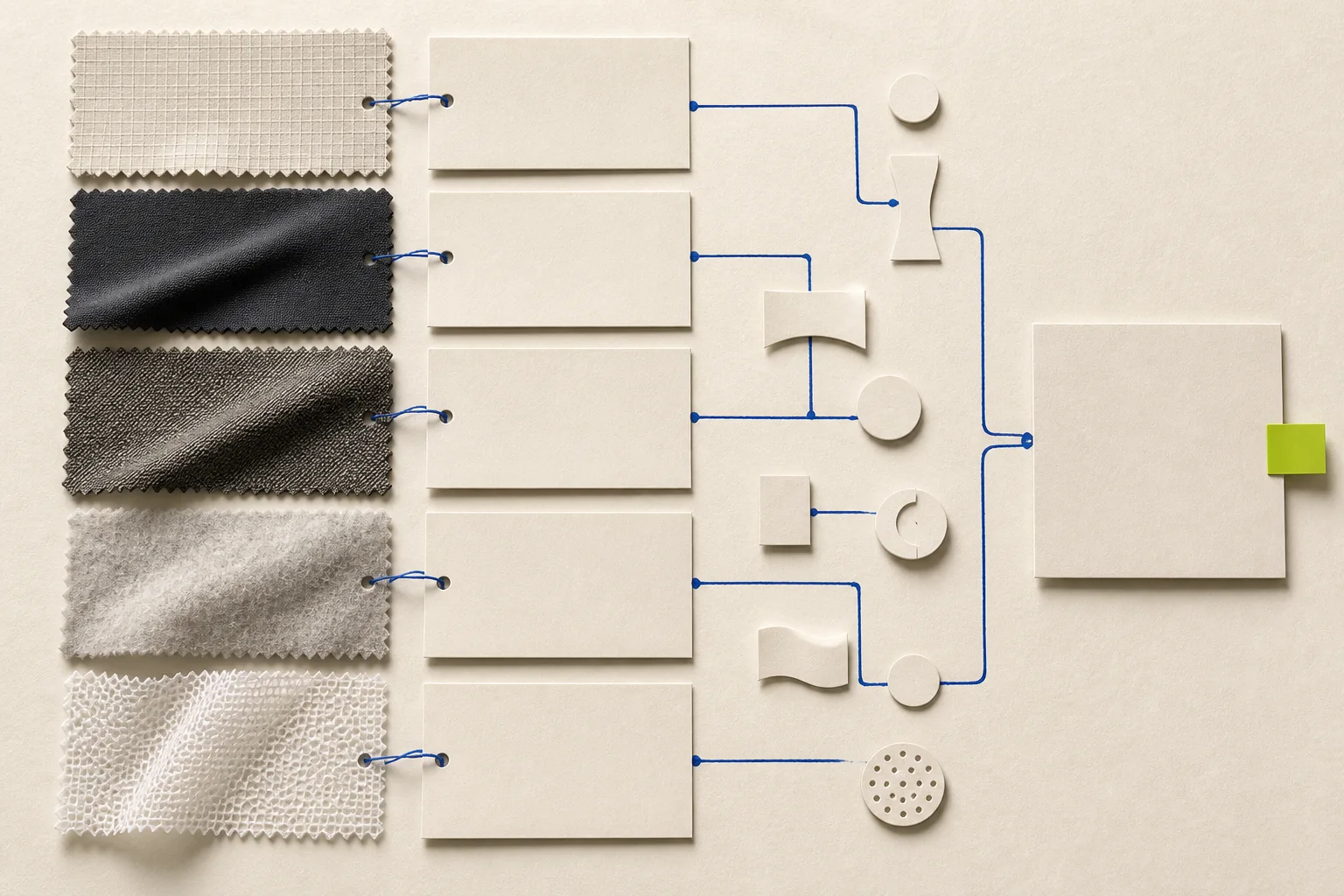
A technical fabric can be light, strong, quiet, smooth, dry, structured, elastic, or protective. None of those properties alone makes it feel premium. “Premium” is a human judgment formed by the relationship between intended use, sensory experience, garment construction, performance after wear and care, and the credibility of the product promise.
A heavier cloth can feel substantial in one jacket and cumbersome in another. A slick face can suggest refined mobility or cheap plasticity. High stretch without recovery can feel impressive on the first pull and disappointing after use. The evaluation must begin with the garment and user context, not a universal score.
Write the use case before touching the swatch
Define the intended product, layer, climate, activity, duration, fit, contact points, care method, and expected life. Then describe the experience in observable terms. For a travel shell, the brief might call for low-bulk drape, low audible rustle, controlled surface friction, comfortable next-to-skin contact at the collar, recovery after packing, and acceptable appearance after repeated care.
Avoid translating “luxury” directly into a material specification. Ask what the customer should perceive and what failure would look like. The same membrane, coating, knit structure, or finish can behave differently after lamination, seam sealing, printing, washing, or garment assembly.
Control specimen identity
Every swatch needs an identifier connected to supplier, article or quality number, fiber statement, construction, finish, color, lot or batch when available, receipt date, and revision. Record whether the specimen is greige, finished yardage, lab dip, sample yardage, production yardage, or cut from a garment.
Condition and test specimens under the method’s requirements. Do not compare an unconditioned sample from a humid delivery with another that has rested in a controlled laboratory. Record face and back, warp or wale direction, cut location, pretreatment, and number of replicates.
The point is not paperwork for its own sake. Without specimen control, a “better hand” decision may describe different finishes, lots, colors, or states rather than a meaningful material difference.
Measure the physical structure
Mass and thickness influence perception but are not synonyms for quality. ASTM’s textile standards catalog identifies D3776/D3776M for fabric mass per unit area and D1777 for thickness. The current catalog also lists methods for air permeability, breaking force, stretch, abrasion, pilling, snagging, and other fabric properties.
Record the exact method edition, option, apparatus, conditioning, specimen count, units, result distribution, and lab. A single number without method context is not comparable. Small-swatch results may not represent an entire lot, and a supplier value from a technical data sheet may use a different method or tolerance.
Construction details help explain the hand: yarn type and size, filament count, twist, weave or knit structure, density, gauge, elastomer content, coating or membrane, adhesive, finish, and surface treatment. Microscopy or cross-sectional inspection can be useful, but interpretation belongs to a material specialist.
Match performance tests to the promise
AATCC’s current standards list includes methods for colorfastness, water repellency, liquid moisture management, wicking, drying, dimensional change, and other textile behaviors. ASTM’s catalog includes Martindale abrasion and pilling methods. ISO 15487 specifies an evaluation of appearance after domestic washing and drying, including color change, pilling, fuzzing, smoothness, seams, creases, and component damage.
Select tests from the intended use and claim. A water-repellency spray result does not establish waterproofness, hydrostatic resistance, breathability, or durability after laundering. AATCC’s explanation of TM22 describes it as a controlled comparison of a wetted pattern and notes its usefulness as a quick screening method for resistance to surface wetting. Do not expand that result into a broader promise.
Likewise, abrasion cycles are meaningful only with method, endpoint, specimen, and requirement. More cycles do not automatically mean a nicer hand, better drape, or appropriate garment. Technical quality involves tradeoffs.
Evaluate hand with a controlled sensory panel
Human touch is evidence when the protocol is explicit. It is not replaced by an image or a language model.
Create a small lexicon before the panel. Terms might include surface smoothness, friction, compressibility, fullness, bending resistance, drape, cool or warm initial touch, cling, stretch effort, recovery feel, noise, and perceived dryness. Define each term with anchors so “soft” does not mean five different things.
Blind the sample identity where practical. Standardize sample size, orientation, conditioning, handling sequence, time, and environment. Randomize order to reduce carryover. Collect individual ratings before discussion, note panel training, and preserve disagreements. A designer, technical developer, quality specialist, athlete, and target customer may value different properties; that difference is insight, not noise to erase.
Compare the flat fabric and the finished prototype. Seams, edge finishes, linings, pockets, trims, pattern shape, ease, adhesive, and wash can change the experience. A premium swatch can become an uncomfortable garment, and a modest-looking swatch can perform beautifully once engineered.
Test after care and use simulation
The first touch is only one state. Evaluate appearance, hand, dimensions, recovery, repellency, color, pilling, odor retention, delamination, seam behavior, and component damage after the care cycle and use simulation relevant to the product.
The FTC’s Care Labeling Rule guidance says manufacturers and importers need a reasonable basis for care instructions. This means care cannot be selected simply because it looks convenient on a product page. Confirm that the proposed process keeps the complete product from being harmed, using the evidence appropriate to the materials and construction.
Keep original readings, post-care readings, and observations linked to specimen and method. A percent change without uncertainty, replicates, or acceptance criterion can be misleading.
Safety and compliance are separate gates
Premium perception cannot override mandatory requirements. CPSC guidance on clothing textiles explains that 16 CFR part 1610 classifies flammability and prohibits dangerously flammable Class 3 textiles from wearing apparel. CPSC also describes certification responsibilities for products subject to applicable rules.
Actual scope depends on the product, user, construction, market, exemptions, and other requirements. Children’s sleepwear, general apparel, protective claims, chemical restrictions, and accessories may require different analysis. A performance test chosen for marketing does not replace a safety test or certificate.
A reproducible fictional evaluation audit
FashionMember created four invented specimens in content/data/FM-163-technical-fabric-evaluation.json. The script scripts/fm163-technical-fabric-evaluation-audit.php checks eleven evidence groups: identity, use, conditioning and method plan, mass and thickness, stretch and recovery, abrasion and pilling, moisture and water, thermal and air, colorfastness and care, safety, and sensory panel. It also requires an accountable owner and positive mass and thickness observations.
TF-01 shows an invented mass of 182 gsm, thickness of 0.62 mm, and a planned 20,000-cycle abrasion input. TF-03 shows 238 gsm, 0.91 mm, and 30,000 planned cycles. Both reach material-review only because all fictional planning fields are present.
TF-02 is held despite having numeric values because its method, recovery, abrasion, thermal, care, and sensory fields are open. TF-04 is held for missing identity, multiple evidence groups, owner, and positive observations. No value is a benchmark or real laboratory result, and no planned cycle count is a pass requirement.
The script cannot feel a textile, run a method, verify lab competence, judge safety, approve care, support a performance claim, or make a sourcing decision.
Build a material evidence packet
For each candidate, assemble:
- intended-use brief and failure modes;
- controlled specimen identity and chain of custody;
- construction and finish information;
- method-specific results with uncertainty and tolerances;
- sensory protocol, individual responses, and panel context;
- prototype and post-care evaluation;
- safety, labeling, and claim evidence;
- tradeoffs, open questions, owner, and decision date.
Then make the decision at garment level. Premium technical fabric is not the specimen with the most impressive list of test names. It is the material system that delivers the intended experience consistently, survives the relevant use and care, meets applicable requirements, and supports every claim with evidence.
Sources and verification
- ASTM textile standards catalog — official current catalog covering fabric mass, thickness, air permeability, stretch, abrasion, pilling, breaking force, and related methods.
- ASTM D3776 fabric mass overview — official method scope and sampling-option summary; full current method access may require purchase.
- AATCC standard test methods and procedures — official current index for colorfastness, repellency, moisture management, wicking, drying, and other textile methods.
- AATCC guide to water-repellency testing — official explanation of TM22’s controlled spray-screening scope and interpretation.
- ISO 15487:2018 — official standard abstract for assessing apparel and textile appearance after domestic washing and drying.
- FTC Clothes Captioning: Complying with the Care Labeling Rule — official U.S. guidance on care instructions and reasonable basis.
- CPSC Flammable Fabrics Act business guidance — official U.S. flammability and certification overview.
- CPSC General Certificate of Conformity guide — official certification explanation and fictional adult-apparel example; product-specific scope remains a human gate.
How this story was checked
- Sources
- 8 linked records · View list
- Last verified
- Reporting desk
- FashionMember Materials Desk
- Format
- Analysis
- AI assistance
- Used with editorial review; disclosed above.