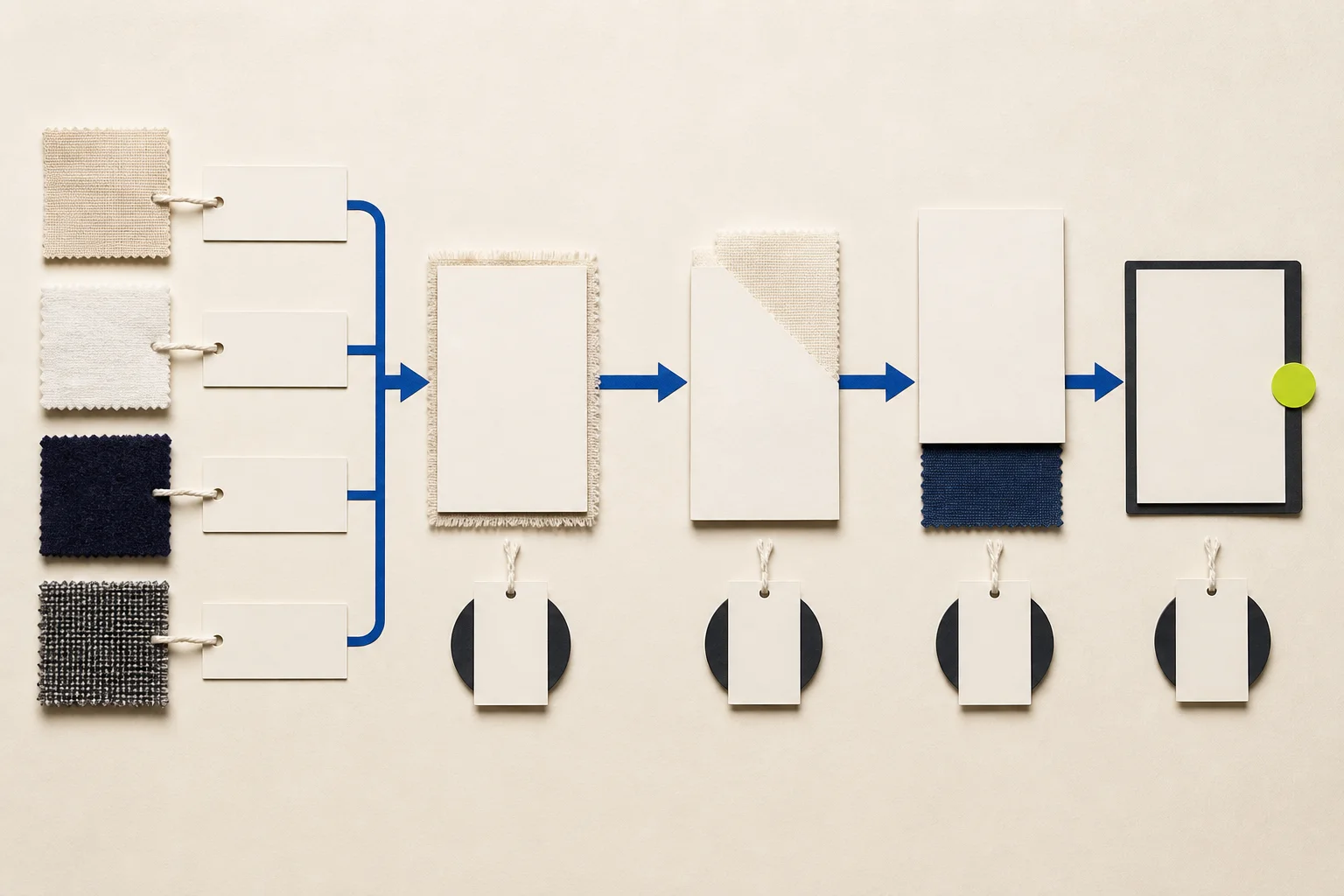
A supplier’s “low MOQ” can refer to a roll, a color, a style, a size run, a cutting lot, or an entire order. The number describes one supplier’s willingness to make, sell, dye, print, finish, cut, sew, pack, or ship a quantity under stated conditions; it says nothing by itself about material or quality.
A lower number can be completely workable. It can also hide a different material lot, unapproved subcontracting, unstable color, sample-room construction, missing tests, incomplete labels, high setup cost, or a delivery promise that depends on spare capacity. The practical objective is a small commitment with the same specification discipline.
This article is a sourcing method, not a supplier recommendation. FashionMember did not interview a supplier or worker, visit a facility, inspect a sample, run a test, confirm capacity, receive a quote, or place an order. Every commercial term and audit row discussed below is fictional until replaced by direct, authorized evidence.
Define what the minimum measures
Ask the supplier to express every threshold with a unit and scope. A fabric minimum may apply by construction, base cloth, finish, print, color, dye lot, roll, meter, or total order. A factory minimum may apply by style, color, size run, cutting lot, delivery, or season. Minimum order quantity, minimum color quantity, sample minimum, reorder minimum, surcharge threshold, and packaging minimum are not interchangeable.
Record the exact legal or operating entity making the quote, facility or facilities in scope, product version, unit, quantity, currency, validity period, included work, excluded work, lead-time basis, payment timing, freight term, and cancellation or change rule. Ask whether a lower minimum changes the price, material source, process, quality plan, sample status, test responsibility, packaging, schedule, or delivery method.
Do not convert “we can do 100” into a production commitment until the supplier answers: 100 of what, across how many variants, from which lot, made where, using which approved construction, by which date, at which landed cost, and subject to which written terms?
Lower complexity before lowering controls
Small runs become more feasible when the product uses existing, repeatable inputs and processes. Consider an in-stock material in a verified lot, a standard color, established trim, fewer variants, a stable block, conventional finishing, reusable packaging, and one delivery window. This is not an argument for a generic product. It is an argument for spending complexity where the customer can perceive and value it.
Avoid casually splitting a very small quantity across many colors and sizes. Each split can create cutting, sewing, labeling, packing, inspection, and leftover-material consequences. Preserve the intended customer and size access when simplifying; reducing the size range is not a neutral efficiency if it excludes the people the product is supposed to serve.
Ask what the supplier already runs well and what creates setup. A transparent setup charge may be safer than a nominally low unit price recovered through unknown material substitution or rushed labor. Evaluate total commitment and usable units, not price per ordered unit alone.
Freeze a sample with a versioned approval record
The approved sample should connect to a written specification, bill of materials, pattern or dimensions, construction details, tolerances, color or appearance reference, trims, labels, packaging, and revision identifier. Photograph or otherwise document the sample with permission, but do not rely on a photograph to prove hand feel, dimensions, construction, composition, or performance.
Mark whether each sample is a concept, fit, size set, preproduction, test, shipment, or other sample. Confirm which materials and processes match production and which are substitutes. A beautiful development sample made by a senior sample maker from available fabric is not evidence that the production line and production lot will reproduce it.
Use a signed or otherwise authenticated approval log: item, version, evidence reviewed, exceptions, approver, date, and next gate. Silence is not approval. If the supplier proposes a change, stop the affected work until the new material, cost, schedule, testing, labeling, and product implications are reviewed.
Protect the material lot
Small quantities are especially exposed to remnants, stock service, split lots, and discontinued inputs. Request the material identity, supplier and mill or converter relationship where appropriate, lot or batch reference, available quantity, reservation period, composition evidence, finish, shade continuity, width, yield assumptions, condition, storage history when relevant, and replenishment status.
Inspect and test a representative physical sample. If production may use several rolls or lots, define shade grouping and cutting controls. Keep a retained reference and receiving criteria. “Same quality” needs measurable attributes and an authorized comparison method, not visual reassurance from a screen.
When a material claim affects labeling, safety, customs, marketing, or customer use, map the supporting document to the exact input and product. A certificate with no product, lot, facility, method, date, scope, or issuing-party connection is not sufficient evidence.
Keep safety, labels, and care product-specific
The Consumer Product Safety Commission explains that small-batch manufacturer status does not remove applicable product-safety requirements. It may change certain third-party testing obligations for eligible registered manufacturers and products, but requirements that remain applicable still have to be met. Children’s products retain tracking-label requirements.
Determine the product, intended user, foreseeable use, market, hazards, and applicable rules before deciding the test and certificate path. Do not ask a supplier to “test to U.S. standards” without identifying the actual requirements, sample plan, method, laboratory responsibility, acceptance criteria, records, and change triggers.
The Federal Trade Commission’s apparel-labeling resources cover fiber content, country of origin, manufacturer or dealer identity, and care instructions under applicable rules. Labels need evidence from the actual product and supply chain. A low run does not justify guessing composition, reusing a care instruction from another fabric, or making a local or environmental claim from a vendor nickname.
Make quality proportional to risk, not order size
Write the quality plan before production. It can include incoming-material review, first-piece approval, in-process checks at selected operations, measurement and construction review, function checks, appearance and workmanship criteria, labeling and packaging verification, final inspection, and disposition authority.
The plan should specify who checks, what version controls, which units or sample are examined, which method is used, what constitutes a defect, what happens when a limit is exceeded, and who can authorize repair, rework, concession, replacement, or cancellation. A tiny lot can justify examining every unit for selected critical characteristics, but 100 percent inspection is not a substitute for process control and cannot prove untested safety or performance.
Do not accept “AQL passed” without the lot, sampling plan, inspection level, sample size, defect classes, acceptance numbers, specification, inspector, date, findings, and disposition. A quality label without its evidence chain is decoration.
Verify capacity and subcontracting
A lower minimum may fit between larger jobs, which can be useful but creates schedule risk. Ask for the planned facility, operation sequence, critical materials, current capacity assumptions, queue, shutdowns, approval deadlines, and realistic recovery options. Confirm who owns the materials and work in progress at each stage.
Require written disclosure and approval of subcontracted operations. Identify the facility, scope, records, quality responsibilities, labor and safety due diligence, traceability, and change process. Supplier registration, an audit date, or a platform profile does not prove current conditions. Direct facility and worker-informed review remains essential, with safe channels that do not expose workers to retaliation.
The GS1 Global Traceability Standard describes critical tracking events and key data elements for linking movements and transformations. A small brand does not need an elaborate platform to adopt the principle: identify the item and lot, record receipt and transformation events, connect inputs to outputs, and preserve the parties, places, dates, quantities, and documents necessary to trace a problem.
Compare landed commitment and cash exposure
Build cost from the current quote: materials, setup, development, sampling, testing, labels, packaging, freight, duties and customs work when applicable, inspection, payment fees, storage, damage, rework, and expected unusable units. Use a separate cash schedule for deposits, material commitments, sample charges, balances, freight, duties, and potential remedies.
The lowest quantity may have the highest landed cost per usable unit. A slightly larger shared material lot may reduce setup and shortage risk; a smaller finished-goods run may preserve cash. Model alternatives, but do not manufacture forecast precision. The decision still needs a demand range, margin objective, inventory exit path, downside reserve, and finance review.
Use a reversible first commitment
A first order should maximize learning without putting customers or workers at risk. Reserve material conditionally where possible, approve one version, complete required testing, verify labels, authorize a small controlled production lot, inspect early units, and hold a clear stop point before full completion or shipment.
Write the contingency: alternate approved input, repair capacity, replenishment option, delivery communication, refund or cancellation process, and decision owner. Do not promise a launch date from a vendor estimate before approvals, production, quality, freight, customs, receiving, and commerce readiness are connected.
A fictional low-minimum audit
FashionMember created four invented sourcing packets in content/data/FM-161-low-minimum-sourcing.json. The script scripts/fm161-low-minimum-sourcing-audit.php checks the fictional supplier identity, minimum definition, quote, material lot, sample, quality plan, product-safety path, labeling, traceability, capacity, subcontracting, change control, landed-cost and cash view, contingency, and owner.
Two rows reach sourcing-review; two are held. A passing row means only that the expected fields exist in this demonstration. It does not authenticate a supplier or facility, verify a worker condition, material, test, label, origin, claim, capacity, quote, order, payment, shipment, quality level, or buying decision.
The practical path to lower minimums is therefore disciplined specificity. Reduce avoidable variation, preserve the requirements that protect the product and people, and buy only after the small lot has an evidence chain as serious as a large one.
Sources and verification
- CPSC: Small Batch Manufacturers and Third-Party Testing — official eligibility and limits; small-batch status does not remove applicable requirements.
- CPSC: Business Education — official product-safety compliance entry point for manufacturers and importers.
- CPSC: Tracking Label FAQ — official children’s-product tracking-label overview.
- FTC: Apparel and Labeling — official apparel-labeling topic hub.
- FTC: Care Labeling Rule — official rule text and current status.
- FTC: Clothes Captioning—Complying with the Care Labeling Rule — official care-instruction compliance guidance.
- FTC: Threading Your Way Through Textile and Wool Labeling — official fiber, origin, and identity labeling guidance.
- GS1 Global Traceability Standard — standards-body model for critical tracking events and key data elements.
- U.S. Customs and Border Protection: Isotopic Testing Guide — official example of evidence complexity in certain origin and supply-chain reviews; not a universal apparel test requirement.
How this story was checked
- Sources
- 9 linked records · View list
- Last verified
- Reporting desk
- FashionMember Materials Desk
- Format
- Analysis
- AI assistance
- Used with editorial review; disclosed above.