On September 3, the Council of Fashion Designers of America Foundation and the Bezos Earth Fund named the first recipients of their Next Thread Initiative Scholarship. Twelve students at eight U.S. schools will receive support for the 2026–2027 academic year, including tuition help and a separate stipend for thesis materials and studio work. The CFDA announcement describes more than $500,000 in awards; a same-day Bezos Earth Fund profile describes the cycle as $500,000.
That small difference in wording is a useful reminder about philanthropic announcements: the headline number is a starting point, not an outcome. The larger question is what this money is meant to make possible. Next Thread is trying to move sustainable fashion from a values statement into the expensive, slow part of design education where fibers are tested, patterns are revised, and ideas encounter the limits of time, equipment, labor, and end-of-life realities.
The scholarship is therefore a funding test. It can remove a barrier between a student’s concept and a finished thesis. It cannot, on its own, prove that a material is safer, a process is lower impact, or a collection is ready for commercial production.
A program with two different clocks
The initiative has a three-year structure. CFDA’s overview sets aside $1.5 million for scholarships between 2026 and 2028, $3 million for awards to independent American designers and brands, and a further program of events and storytelling. The scholarship track is aimed at full-time undergraduate and graduate students pursuing sustainable fashion design. Its first class contains five rising seniors and seven master’s students, according to the CFDA announcement. Three recipients—Zion Burrell of FIT, Hera Ford of Parsons, and Grace Wang of NYU—were named Scholars with Distinction.
The student clock is immediate: tuition and thesis work happen during a single academic year. The industry clock is longer. The initiative’s designer awards and public programming are intended to run alongside the scholarship program, creating a possible bridge between emerging talent, independent businesses, and a wider audience. No public result yet shows whether that bridge will be built. The announced funding is an input, not evidence of a completed pipeline.
The partners also describe the payment differently. CFDA says awards were determined individually to help close each student’s remaining gap in tuition and fees. The Bezos Earth Fund’s September 3 insight says the $500,000 cycle covers each selected student’s tuition gap in full, with stipends for materials and studio work. We report both descriptions rather than converting them into an invented per-student average or a precise accounting figure.
The portfolio is a map of questions, not a catalogue of solutions
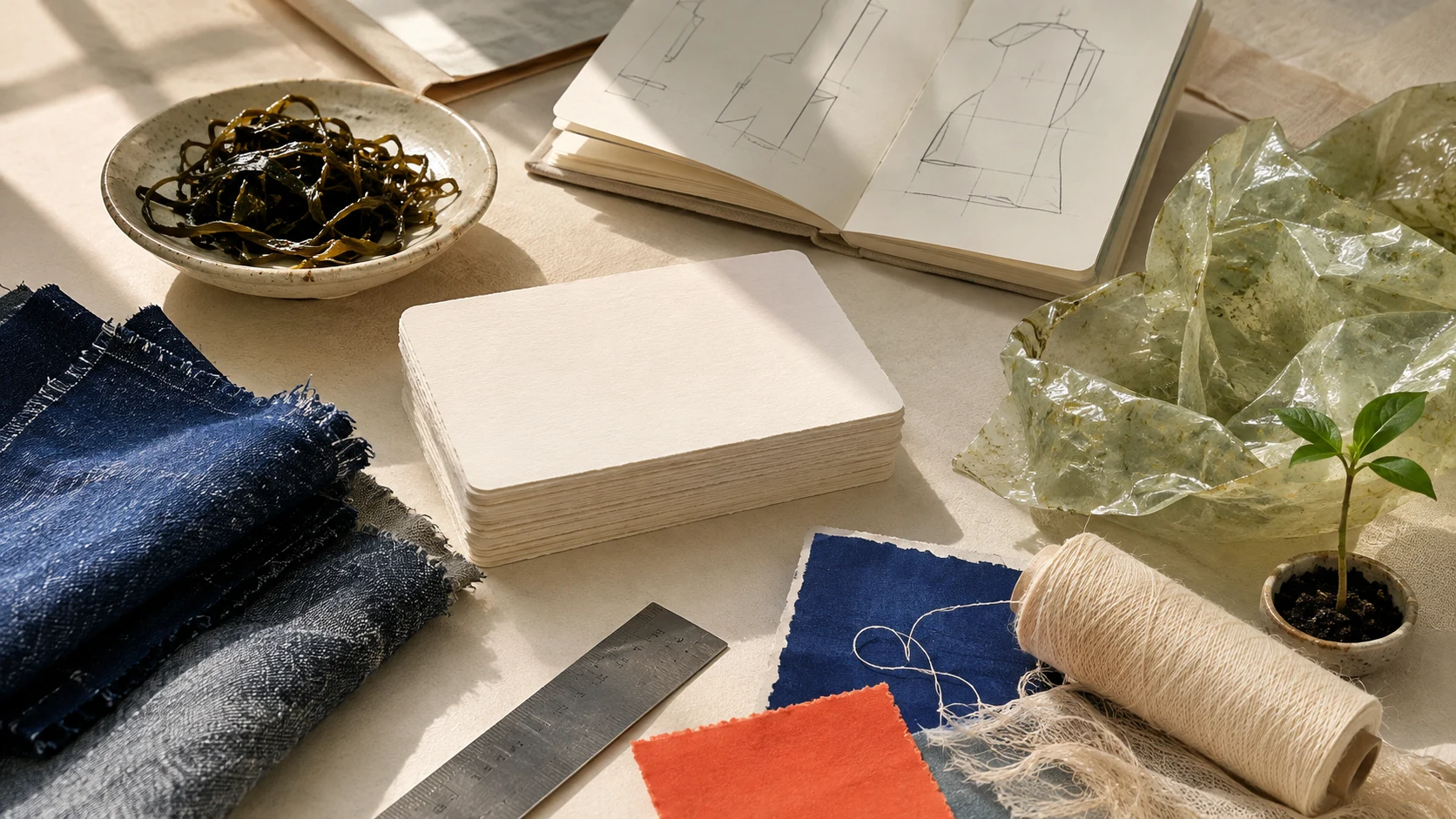
The program pages offer a striking range of starting points. Students are tending silkworms, growing and dyeing with indigo, developing bioplastics from gelatin, agar, and seaweed, turning invasive species into fibers and dyes, and working with deadstock, reclaimed denim, discarded quilts, rust, rainwater, and weathering. Other projects use zero-waste patternmaking or digital prototyping to rethink where a garment begins and what remains after cutting.
Those descriptions matter because they make “sustainable fashion” plural. A cultivated fiber, a reclaimed material, a dye experiment, and a pattern system raise different technical questions. They also carry different environmental boundaries. A bio-based material still needs a feedstock, a process, energy, water, binders, finishes, and a realistic route after use. A reclaimed textile still has a history, a variable condition, and a limited inventory. A zero-waste pattern can reduce cutting waste while leaving questions about durability, fit, labor, or the next product in the system.
The portfolio should be read as a set of hypotheses. It shows what designers are willing to investigate when materials and studio time are not treated as luxuries. It does not certify the claims those investigations may eventually make.
Why the money can change the work
Students often encounter sustainability at the exact moment when a concept becomes materially demanding. A biodegradable film may require repeated batches. A natural dye may need controlled tests to compare colorfastness. A digital pattern may need physical prototypes to reveal movement, seam stress, or a mismatch between a rendered surface and a sewn one. These are not glamorous stages, but they are where a speculative idea becomes legible to someone beyond the studio.
Next Thread’s additional stipend is important for that reason. It recognizes that sustainable materials and processes can carry a direct cost before they carry a market story. The stipend does not guarantee access to every machine, technician, or testing facility. It does create room for a student to choose a more rigorous experiment instead of abandoning it when the thesis budget tightens.
For schools, the program also signals that material practice belongs inside design education rather than in a separate sustainability elective. The recipient list includes fashion design, textiles, material science, communications, and design-and-society programs. The mix is not proof of an institutional transformation, but it points toward a more connected curriculum in which a silhouette, a fiber, a supply chain, and a public claim are considered together.
The gap between a thesis and a product
Industry readers should resist a familiar leap: student experimentation is not a substitute for production qualification. Before a new material can support a commercial claim, a brand needs a defined composition, repeatable process, performance tests appropriate to use, color and care data, supplier capacity, worker and chemical controls, cost and minimums, and a credible end-of-life description. It may also need market-specific labeling, safety, and advertising review.
The Bezos Earth Fund’s separate April 2026 materials program makes the same gap visible from another direction. Its $34 million in grants support research into fibers intended to improve cost, performance, and environmental attributes. The release emphasizes that designers need beautiful, high-performing materials; retailers need consistent quality at viable prices; and manufacturers need materials that fit existing equipment and infrastructure. That is a research agenda, not a claim that those materials are already ready for a collection.
Next Thread sits earlier still. Its scholars are building portfolios and thesis collections. The right question is not whether one project will “solve” fashion’s footprint. It is whether the funding helps a designer document enough of the problem to make a more honest next decision.
A practical scorecard for the next handoff
FashionMember’s editorial view is that every promising student project needs two records: a creative record and an evidence record. The creative record can hold the story of place, heritage, craft, or personal memory that makes the work meaningful. The evidence record should name the material inputs, process steps, tested properties, labor and equipment assumptions, expected use, care, repair, and end-of-life limits.
The records should meet at the handoff to a school exhibition, grant application, independent brand, or manufacturer. A designer should be able to say what was observed, what was measured, what remains unknown, and what would falsify the environmental promise. A buyer or partner should be able to ask for a sample, a test method, a bill of materials, and a repeatability plan without treating those requests as an attack on the creative idea.
That habit would make the scholarship valuable even when a particular experiment does not scale. A failed batch can still teach a student which variables matter. A beautiful prototype can still reveal that its finish blocks compostability. A zero-waste layout can still require a different labor calculation. The funding earns its keep when those lessons are recorded rather than hidden behind a final image.
What to watch through 2028
Our base scenario for the next two years is a stronger public vocabulary for sustainable design, with uneven progress from studio proof to commercial proof. This assumes the scholarship stipends arrive as described, the three-year program continues, and the scholars receive opportunities to show their work. Visibility should rise before production data, repeat orders, or independent impact assessments exist.
An upside case would show several projects moving into carefully bounded pilots: a named material specification, repeatable samples, disclosed testing, and a partner able to describe cost, labor, care, and end of life. It would also show the designer-award track sharing methods rather than only finished images. A downside case would be a sequence of attractive showcases with no record of what happened after graduation, or a drift toward broad “green” language that outruns the evidence.
The forecast is falsifiable. Watch for the next scholarship cycle’s selection brief, public descriptions of designer-award recipients, thesis documentation that includes methods and limits, and any independently reviewed performance or life-cycle work. Also watch whether schools keep equipment, material libraries, and technical support available after the grant period. A single exhibition cannot answer those questions; a pattern of documented handoffs can.
The Next Thread scholars are not being asked to decorate a prewritten sustainability story. They are being given time and money to make the story more complicated. That is the useful promise. If the program succeeds, its legacy will be less a list of miracle materials than a generation of designers who know how to carry a beautiful idea—with its receipts, caveats, and repair plan—into the next room.
Sources and verification
- CFDA: Meet the inaugural CFDA x Bezos Earth Fund Next Thread Scholarship recipients — 3 September 2026 announcement, recipient count, schools, award descriptions, distinctions, and initiative funding context.
- CFDA: The Next Thread Initiative Scholarship Award — scholarship scope, eligibility, tuition and fee treatment, stipends, and program brief.
- CFDA: CFDA x Bezos Earth Fund The Next Thread Initiative — three-year partnership structure, $1.5 million scholarship allocation, $3 million designer-award allocation, and public programming.
- Bezos Earth Fund: From Silkworms to Seaweed — same-day partner profile of the 12 scholars, the first-cycle funding description, selection criteria, and project examples.
- Bezos Earth Fund: $34 million in new fashion-materials grants — April 24, 2026 research-grant context on performance, cost, manufacturing integration, and life-cycle questions.
- FashionUnited: CFDA and Bezos Earth Fund name inaugural Next Thread scholarship recipients — independent 3 September 2026 coverage of the partnership, scholarship purpose, eligibility, and education context.
This article separates CFDA and Bezos Earth Fund descriptions from FashionMember analysis. It does not claim that any scholar’s material, process, or collection is commercially ready, safer, lower impact, compostable, or independently validated. It does not infer an exact per-student award from the partners’ slightly different descriptions of the first-cycle total. The synthetic cover is not a photograph or evidence of a real school, scholar, material, grant, or product. This is general editorial analysis, not legal, financial, safety, or environmental-assurance advice.
How this story was checked
- Sources
- 6 linked records · View list
- Last verified
- Reporting desk
- FashionMember Materials Desk
- Format
- Analysis
- AI assistance
- Used with editorial review; disclosed above.