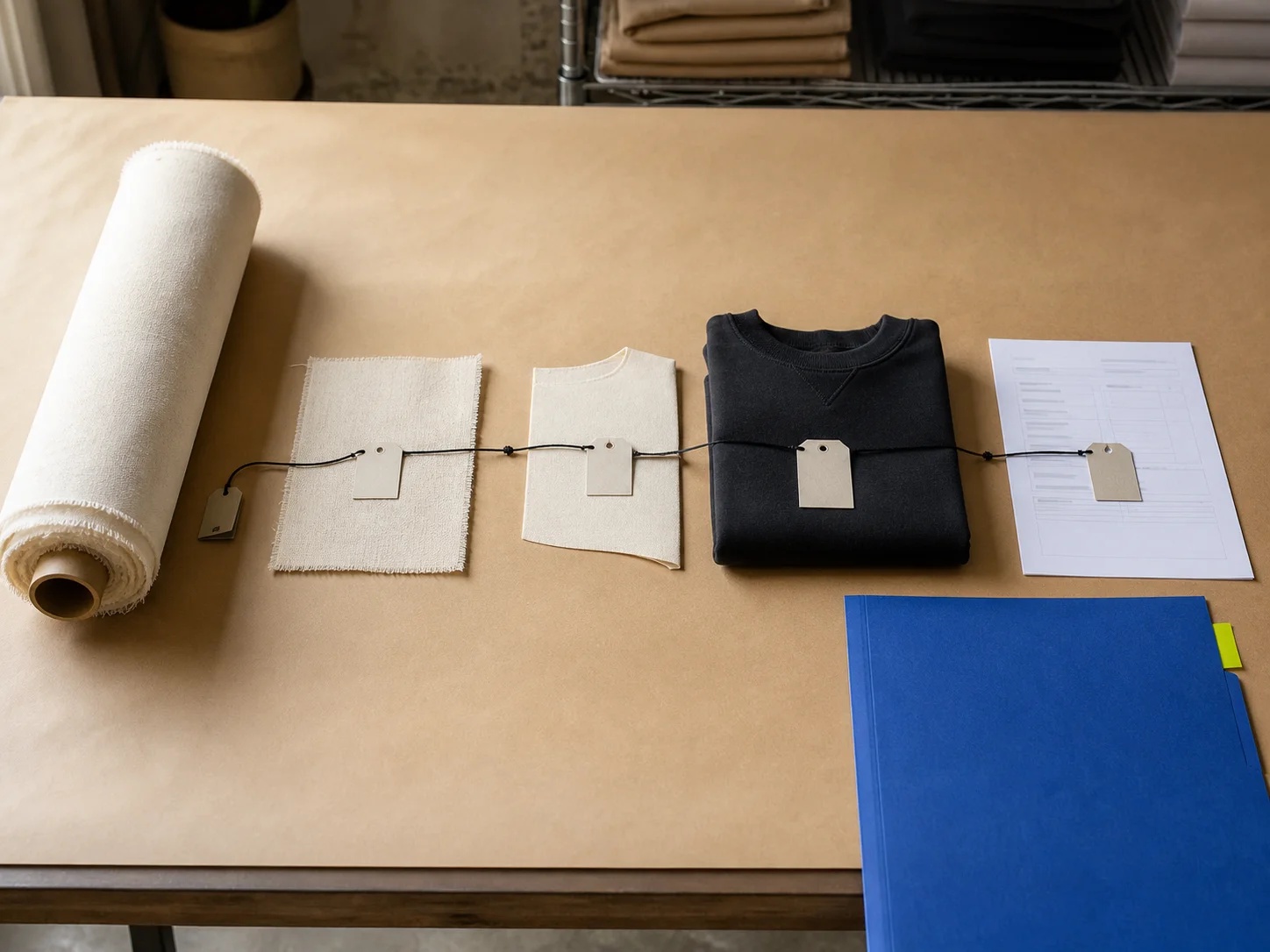
When a fashion team receives a traceability request, the first reaction is often to search backward: open old email threads, ask the supplier for a certificate, and reconstruct which mill, facility, material lot, or subcontractor belonged to a finished style.
That detective work is expensive because the identifying information was not required when the order began.
A purchase order is not a full traceability system. It does not prove that every declaration is accurate, and it cannot replace inspections, transaction records, due diligence, or customs documentation. It can, however, establish the identifiers and evidence obligations that every later record needs to reference. Better traceability therefore begins before goods move.
Trace the object, transaction, place, and event
Useful tracing depends on distinguishing four things:
- the object: fiber batch, fabric lot, trim, work-in-progress bundle, carton, finished SKU, or serialized item;
- the transaction: purchase order, sales order, invoice, packing list, or transfer;
- the place and party: legal entity, mill, dyehouse, cut-and-sew facility, warehouse, or store;
- the event: ordered, produced, transformed, packed, shipped, received, inspected, or returned.
The GS1 Global Traceability Standard describes critical tracking events and key data elements, including identifiers, dates, locations, responsible parties, and input-output relationships for transformations. The GS1 EPCIS 2.0.1 standard provides a model for visibility-event data—what happened, when, where, and in what business context.
A small label does not need to implement EPCIS to learn from that structure. Its PO should still use stable identifiers and make each supplier connect its response to the same order, style, material, location, and lot.
Put stable IDs before descriptive names
Names change and repeat. “Black jersey,” “main factory,” or “style 102” may mean different things across seasons or systems. Assign durable internal identifiers and preserve supplier identifiers alongside them.
For each ordered component or finished good, capture:
- internal purchase-order number and line number;
- internal style, SKU, color, size, and season identifiers;
- supplier legal entity and supplier account ID;
- supplier product or material code;
- manufacturing and processing facility IDs where known;
- material lot, dye lot, batch, production order, and carton IDs as applicable;
- unit of measure and ordered quantity;
- revision number and approved change date.
Identifiers should travel onto the acknowledgement, invoice, packing list, receiving record, inspection result, and any certificate or declaration. If a document cannot be matched to the PO line and lot it supports, it is evidence in search of a product.
Make facility disclosure an order requirement
The party sending the invoice may not be the place doing the work. A PO should state which production and processing locations require disclosure, when subcontracting requires written approval, and how changes must be reported.
Depending on the product and risk, the list may include spinning, weaving or knitting, dyeing and finishing, printing, cutting, sewing, washing, embroidery, packaging, and final assembly. Do not demand every possible tier without a plan for using or protecting the data. Define the relevant scope and confidentiality process.
The OECD guidance for responsible garment and footwear supply chains frames due diligence as risk-based and ongoing. A facility list is therefore an input to due diligence, not proof that risk has been eliminated.
Attach evidence requirements to the correct line
A generic “supplier must comply” clause does not tell operations what to collect. Build an evidence schedule tied to product and material lines.
It can specify:
- fiber-content or material declaration;
- country-of-origin support;
- transaction or chain-of-custody record;
- certificate number, scope, site, and validity period;
- test report with method, sample identification, and date;
- restricted-substance or chemical-compliance declaration;
- social-compliance record required by the company’s risk process;
- bill of materials or transformation record connecting inputs to outputs;
- authorization for subcontracting or facility changes.
For each item, name the issuer, acceptable format, due date, owner, retention period, and rejection condition. A certificate should be checked against the facility, product, process, and dates it actually covers.
Preserve transformations
Fashion products change form repeatedly. Fiber becomes yarn; yarn becomes fabric; greige fabric is dyed; pieces are cut; bundles are sewn; garments are washed, finished, packed, and combined into cartons.
Traceability breaks when the relationship between input and output identifiers disappears. Require a transformation record at relevant stages: input lot or batch, quantity consumed, output lot or production order, quantity produced, date, facility, and responsible party. Record loss, scrap, blend, split, merge, rework, and substitution rather than silently overwriting the original plan.
The data does not need to be complicated at first. A controlled spreadsheet can be better than an expensive platform filled with unlinked names. The important test is whether a reviewer can move in both directions: from finished unit or lot to inputs, and from an affected input lot to every output that used it.
Treat changes as new evidence events
Late substitutions are common. A mill changes, a dye lot is replaced, a trim is unavailable, or production moves to another facility. If the PO is updated but evidence is not, the claim and compliance record may now describe the wrong item.
Use change control with:
- requested change and reason;
- old and proposed identifiers;
- affected quantities, dates, markets, and claims;
- required new tests, declarations, approvals, or costing;
- named approvers;
- revised PO version;
- downstream systems and documents to update.
Do not allow chat approval to become the only surviving record.
Customs requests reveal the cost of missing links
U.S. Customs and Border Protection’s forced-labor frequently asked questions state that importers must exercise reasonable care over supply chains and understand where and how merchandise is made, in whole or in part. CBP also describes supporting-document submissions when goods are detained. The exact legal and evidentiary requirements depend on the merchandise and enforcement context, so importers need qualified customs and legal advice.
The operational point is narrower: a brand cannot produce a coherent supply-chain record on demand if its orders never required facilities, lots, and documents to use a common reference.
International product-information requirements add another reason to design durable records. The European Commission’s overview of the Ecodesign for Sustainable Products Regulation explains that the framework introduces digital product passports and enables product-specific information requirements. It does not mean every fashion product already has the same passport obligation. Teams should follow delegated measures and implementation dates rather than treating a future framework as a finished textile specification.
A minimum traceability-ready PO schedule
Add a structured attachment with these fields:
po_number and revision
po_line and internal_product_id
supplier_legal_entity_id
supplier_product_id
approved_facility_ids and roles
material_and_component_ids
required_lot_or_batch_ids
required_evidence_by_line
subcontracting_and_change_rules
acknowledgement_due_date
evidence_due_date
retention_owner
exception_and_approval_log
Then test one order. Select a finished lot and trace backward to material and facilities. Select a material lot and trace forward to finished output. Record every missing link, ambiguous identifier, inaccessible document, and manual translation. Fix the PO template and receiving process before buying software.
Know the limit of the document
A detailed PO can still contain false data. It does not validate a supplier’s statement, reveal an undisclosed subcontractor, establish legal admissibility, or prove an environmental or labor claim. Verification, risk assessment, audits, testing, worker-centered due diligence, and professional review may still be required.
The purchase order’s job is simpler: make the expected chain explicit before production starts and give every later fact a stable place to attach.
Sources and verification
- GS1 Global Traceability Standard 2.0 — official standard for critical tracking events, key data elements, identifiers, locations, and transformations.
- GS1 EPCIS 2.0.1 — official visibility-event data standard.
- U.S. Customs and Border Protection: Forced Labor Frequently Asked Questions — official U.S. customs guidance; confirm the live page and its revision date when applying it to a current shipment.
- OECD: Responsible garment and footwear supply chains — government-backed sector due-diligence guidance.
- European Commission: Ecodesign for Sustainable Products Regulation overview — official overview of the framework and digital product passport direction; product-specific requirements are not inferred here.
How this story was checked
- Sources
- 5 linked records · View list
- Last verified
- Reporting desk
- FashionMember Materials Desk
- Format
- Analysis
- AI assistance
- Used with editorial review; disclosed above.