The LA Fashion District is not one store, one building, or one kind of buying trip. It contains contemporary showroom buildings, wholesale businesses, fabric and notions sources, retail areas, and other districts and services spread across many downtown blocks. A first-time buyer should make the mission narrower than the map.
This guide was researched remotely on September 1, 2026. FashionMember did not verify a business, route, parking space, transit condition, accessible path, appointment, product, or term on site. Directory listings and transportation information are starting points, not guarantees. Reconfirm every intended stop, arrival plan, and access need with the responsible source before travel.
Define which trip you are taking
Write one primary purpose: wholesale apparel appointments, year-round showroom buying, fabric and notions sourcing, retail research, or another defined task. These experiences can have different credentials, hours, order practices, and access conditions. Mixing them without a plan can consume a day in transit without answering a buying question.
The LA Fashion District’s current buyer-information page explains the wholesale context. Its contemporary-showroom page lists major multi-line buildings including California Market Center, Cooper Design Space, Gerry Building, Lady Liberty, and The New Mart. The general and fabric-and-notions directories support discovery across other categories. None of those lists proves that a business is currently open, suitable, authorized to represent a brand, accessible, or available to meet.
Create an itinerary only from directly confirmed stops. Save the official listing, access date, verified contact, response, address, suite, hours relevant to the visit, appointment time, product purpose, and any arrival or access instructions.
Prepare credentials before building a route
The district’s buyer guide says wholesale vendors typically ask for a business license or seller’s permit, a business tax identification number, and two or three purchase invoices related to the industry. It also notes that registration is handled separately by each showroom building and that appointments are recommended outside Market Week.
Treat those as common guidance, not a universal promise. Ask the exact building or business what it requires. Use official current registration paths and minimize sensitive data. Confirm who receives a document, why it is needed, how it is retained, whether fields can be redacted, and what alternative is available.
California’s Department of Tax and Fee Administration explains that a resale certificate is for property purchased for resale in the regular course of business and lists the information required. A seller’s permit, resale certificate, business license, tax identification number, and buyer badge are different records. Eligibility to enter an event does not determine tax treatment for every purchase.
Plan by zone, not by popularity
Plot the confirmed stops by practical zone: contemporary showroom buildings, wholesale streets or buildings, materials and notions, and any service stop. Then sequence the route around fixed appointments. Leave sufficient time for walking, building check-in, elevators, product review, meals, and structured notes.
The district parking page says the area has more than 110 surface lots and parking structures. That is a broad planning resource, not a promise that a selected lot has space, a particular rate, a valid entrance, or the right operating hours. The transportation page and LA Metro rider and schedule pages can support an alternative arrival plan. Recheck service and route details on the travel date.
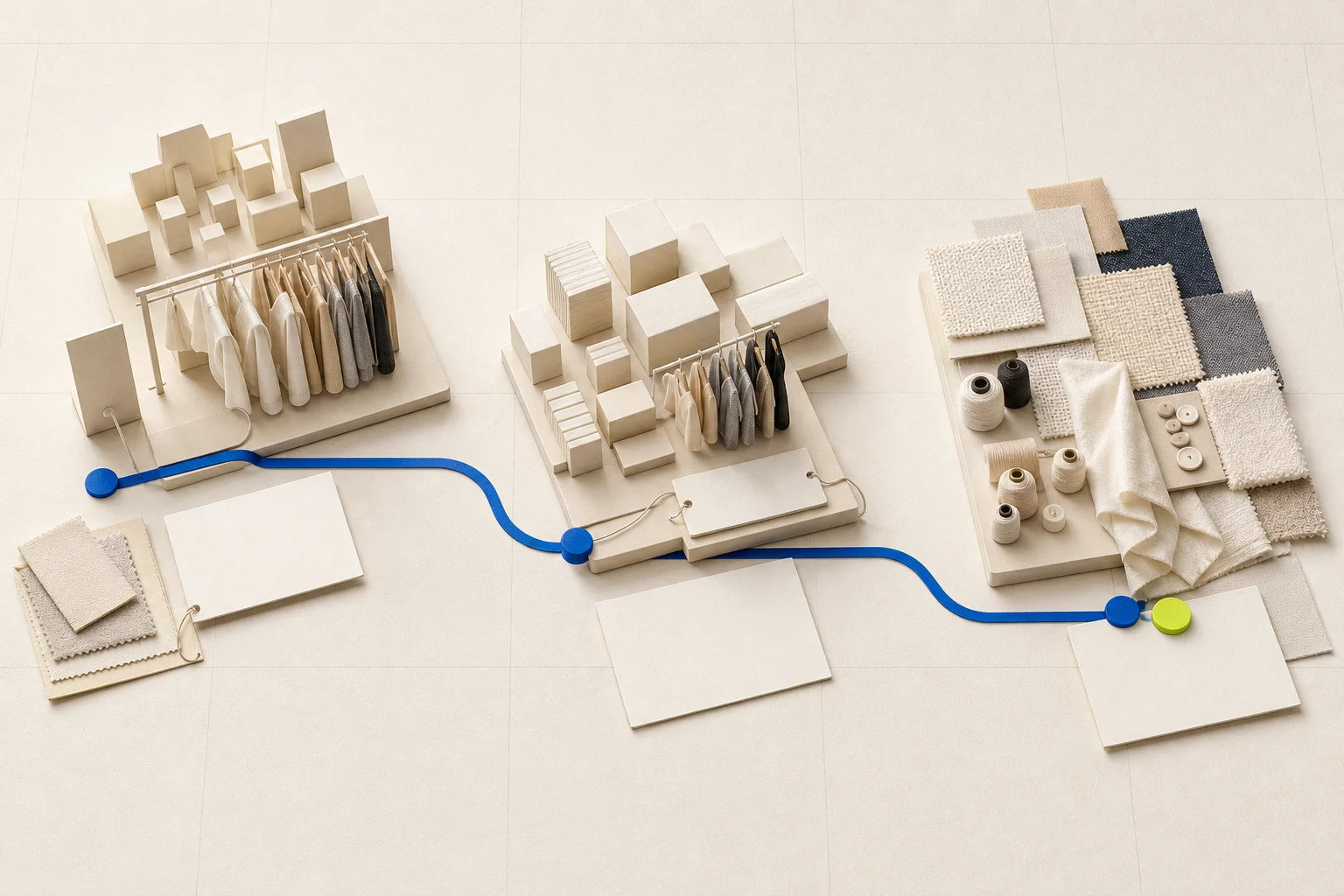
Do not publish or follow an AI-generated street map as if it were navigation. Use current official maps and live conditions, and verify the entrance and suite directly. The abstract image accompanying this article contains no real street geometry or directions.
Confirm accessibility and basic trip conditions
Ask each building or business about the accessible route from the selected arrival point, elevators, restrooms, seating, service animals, communication accommodations, and the meeting space. Document the office or person that responded. ADA.gov explains general Title III responsibilities for businesses open to the public but does not certify an individual route or location.
Also review the practical conditions of the itinerary: daylight and weather, walking distance, device battery, secure handling of business documents and samples, hydration, and a check-in plan for the team. Use current public-safety information and personal judgment rather than treating a content article as real-time safety guidance.
Give every stop a buying objective
A stop without a question becomes browsing. Write a short brief for each appointment or business:
- customer, channel, climate, category, price architecture, and size needs;
- current inventory and the exact assortment gap;
- target season, delivery window, and open-to-buy boundary;
- styles, materials, constructions, or services to evaluate;
- minimum, pack, reorder, cancellation, return, damage, and payment questions;
- product data, images, rights, care, origin, safety, and claim evidence needed;
- the person allowed to select, negotiate, and commit.
For fabrics and trims, add width, weight, composition, color, finish, stretch or performance, minimum, roll or piece length, lot continuity, sampling, testing, availability, replenishment, and traceability questions. A swatch and a verbal description are not the same as a verified specification.
Record facts at the product level
Use stable identifiers. For finished goods, capture style, color, size, pack, quantity, sample versus production status, wholesale price and currency, inventory status, cutoff, ship window, origin, care, and claims. For materials, capture the supplier’s reference, construction, composition, color or lot reference, dimensions, minimum, price basis, and lead time.
Mark every note as observed, stated, written, received, pending, or contradicted. Ask before photographing a showroom, product, person, line sheet, price sheet, or badge. Permission to view merchandise is not permission to publish it.
Before any commitment, reconcile seller identity, variants, quantities, price, discount, freight, delivery, cancellation, substitution, return, damage, claim, and payment terms. Separate selection from order authority. Do not store card, bank, tax, or credential data in editorial notes. FashionMember does not create or alter orders, invoices, or payments.
End the day with fewer open loops
For every stop, record the participants, meeting time, products or materials reviewed, documents received, permitted images, unanswered questions, next action, owner, and due date. Reconcile a proposed buy against inventory, open-to-buy, cash, delivery calendar, and product strategy after the meeting.
Correct a directory observation only after the responsible business or district source confirms it. A FashionMember recommendation or field guide naming businesses would require direct confirmation within a stated window, on-site work, permissioned imagery, accessibility review, a no-pay-to-rank policy, and a visible last-verified date.
A reproducible fictional itinerary gate
FashionMember created four invented itineraries in content/data/FM-191-first-buyer-itinerary.json. The deterministic script scripts/fm191-first-buyer-itinerary-audit.php checks for a defined trip scope, official district sources, credentials, resale basis, separate building registrations, confirmed stops, arrival and accessibility contacts, a zone route, buying objectives, product and terms questions, order authority, source capture, human field verification, an owner, and positive stop counts.
LAFD-01 and LAFD-03 reach itinerary-review because every fictional stop is confirmed and all required controls are present. LAFD-02 is held because only three of nine stops are confirmed and several critical fields are open. LAFD-04 is an empty control and is held.
The result is not a verified itinerary. It does not establish a business, credential, registration, route, parking space, accessible path, appointment, product, term, order, invoice, payment, safety condition, or permission to enter or buy. It demonstrates the minimum evidence structure a human buyer should review.
Sources and verification
- LA Fashion District: Buyer Info — official district guidance on wholesale credentials, building registration, and appointments.
- LA Fashion District: Contemporary Showrooms — official district overview of the multi-line showroom cluster.
- LA Fashion District shopping directory — official discovery directory; entries require current direct confirmation.
- LA Fashion District fabric and notions directory — official materials discovery source; product and business details require verification.
- LA Fashion District parking — official district parking overview; availability, entrances, hours, and rates can change.
- LA Fashion District transportation — official district transportation orientation; recheck current services.
- LA Metro: Riding Metro — official regional rider information.
- LA Metro schedules — official current schedule entry point; check the travel date.
- CDTFA Publication 103: Sales for Resale — official California resale guidance.
- ADA.gov: Businesses That Are Open to the Public — official federal accessibility overview; not field verification of a location.
How this story was checked
- Sources
- 10 linked records · View list
- Last verified
- Reporting desk
- FashionMember Field Guide Desk
- Format
- Explainer
- AI assistance
- Used with editorial review; disclosed above.