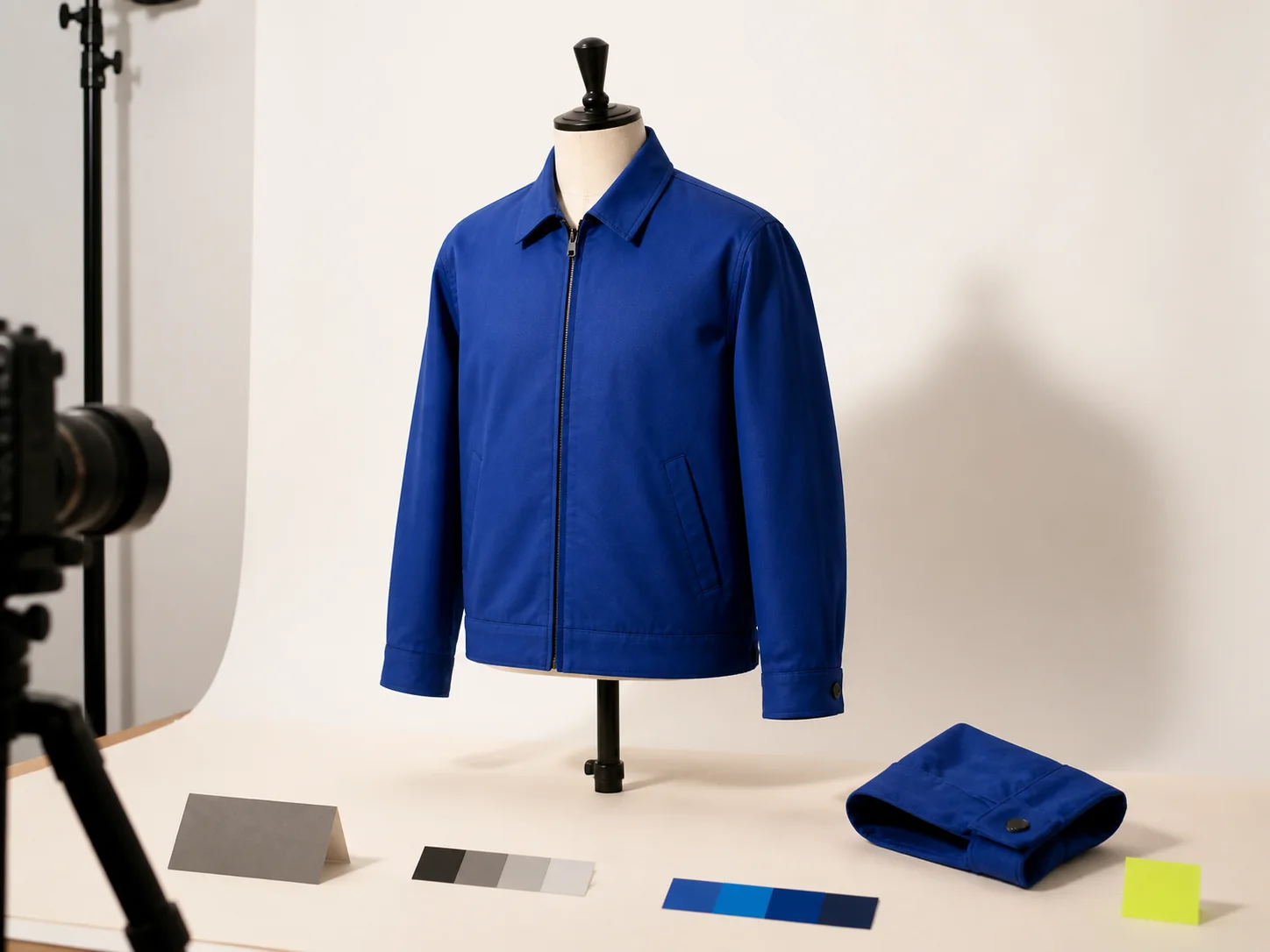
There is no special camera angle that guarantees an AI system will recommend a garment. Product discovery depends on a larger system: accurate product data, crawlable pages, variant consistency, image quality, accessibility, structured markup, feed compliance, page context, and the behavior of each platform.
That is useful news for an independent brand. The best starting point is not a speculative “AI-optimized” aesthetic. It is an honest, repeatable image set that answers a shopper’s questions and gives machines fewer opportunities to connect the wrong image to the wrong product.
Give the main image one job
The primary image should identify the product and variant clearly. Show the full silhouette, correct color, visible material character, and important construction without promotional overlays or distracting staging.
Google Merchant Center’s current image-link specification requires the submitted image to match the product and variant and sets technical and presentation rules. The page now announces a 500-by-500-pixel minimum for all products beginning January 31, 2027, while recommending larger images where possible. Requirements can change, so teams should check the live specification at export time rather than relying on this article.
For apparel, build a main frame with:
- the entire product visible;
- a neutral, uncluttered background;
- consistent camera distance and perspective across variants;
- accurate color under controlled light;
- enough resolution for texture and construction;
- no text, badges, watermarks, borders, or props that hide the item;
- a filename and URL tied to the correct product and variant ID.
Do not digitally repair a sample until it no longer represents what will ship.
Build a sequence around customer questions
One clean packshot cannot explain drape, scale, opacity, pockets, closures, lining, texture, or fit. Create a planned sequence instead of taking miscellaneous extras.
A useful apparel set may include:
- primary full-product view;
- back view;
- side or three-quarter view where shape requires it;
- worn view with representative styling and fit context;
- material and surface detail;
- closure, pocket, trim, or hardware detail;
- interior, lining, or construction view;
- scale or size-context image;
- packaging only when it helps the purchase decision;
- alternate-media frame for motion or 360-degree use.
Every image should add information. Ten nearly identical poses create cost without reducing uncertainty.
Google Search Central’s image SEO guidance recommends standard HTML image elements, relevant page context, descriptive filenames and alt text, high-quality imagery, responsive delivery, and metadata that identifies a preferred image. It also states that selection and presentation in search are automated. Following the guidance improves eligibility and understanding; it does not guarantee indexing, placement, or traffic.
Keep the image and product record synchronized
Machine interpretation becomes fragile when the photograph, file, page, structured data, and commerce feed disagree.
Use a durable image record containing:
- asset ID and source filename;
- product, style, SKU, color, size, and season IDs;
- image role and sequence position;
- view, crop, background, and model or form context;
- photographer or generator and creation date;
- rights owner, license, expiration, and usage limits;
- retouch history and approval;
- AI-generation or AI-edit disclosure where applicable;
- alt text, caption, and page destination;
- master dimensions, rendition dimensions, format, and checksum;
- publication and takedown status.
Generate web renditions from a controlled master. Do not make blue-jacket-final-final2.jpg the only link between a file and the catalog.
Write alt text for the image’s purpose
Alt text is not a keyword container. It communicates the image’s function or meaning in its context.
The W3C Web Accessibility Initiative’s alt decision tree distinguishes informative, functional, text-containing, complex, redundant, and decorative images. A product image that helps a shopper identify a garment usually needs a concise description of relevant visible information. A redundant decorative thumbnail may need an empty alt attribute. A linked image may need text that communicates the destination or action.
For example, “Cobalt zip-front jacket with pointed collar and straight hem, front view” communicates more than “jacket image,” while avoiding unsupported claims about softness, sustainability, or fit. Detail images should name the detail: “Close view of the jacket’s woven cuff and dark snap.”
Do not repeat the entire product title, price, and promotional sentence in every alt attribute. Do not describe race, gender, disability, body type, or other personal characteristics unless they are relevant, respectful, accurate, and editorially necessary.
Record rights and provenance separately from description
Descriptive metadata explains what an image shows. Rights metadata explains who can use it and how. Provenance records how it was created or modified. These functions overlap but are not interchangeable.
The IPTC Photo Metadata Standard provides fields and guidance for descriptive, administrative, and rights information. The C2PA specification defines tamper-evident Content Credentials for media provenance. C2PA itself cautions that provenance is not a value judgment about whether content is good or true. A valid credential can supplement—not replace—accurate captions, rights records, disclosure, and editorial review.
Google’s guidance on generative AI content emphasizes accuracy, quality, relevance, context about automation, and metadata for generated imagery. If a brand generates or substantially alters a product image, the public presentation must not misrepresent the actual item.
A controlled file-level preflight
FashionMember used the fictional cobalt jacket image accompanying this article as a source asset for a limited preflight. This was not a test of Google indexing, a vision model, search ranking, ad approval, conversion, or user comprehension.
The preflight checks whether a proposed image package can maintain:
- a stable product ID across filenames and records;
- a primary rendition large enough for the current destination rule;
- an editorial landscape rendition without treating it as the commerce main image;
- role-specific alt text rather than one repeated description;
- a rights and generation disclosure;
- a checksum that identifies each exported file;
- explicit failure for an undersized or unmatched rendition.
The result is binary at the workflow level: a candidate either has the required file, dimensions, product link, role, alt decision, rights record, and disclosure, or it remains blocked. Passing this preflight makes the package reviewable. It does not predict discovery performance.
Test against the destination, not a universal checklist
For each channel, archive the exact specification URL and check date. Validate the live product page, feed, structured data, robots access, responsive renditions, image URL, cache behavior, and variant selection.
Then add human review:
- Can a shopper distinguish color and material?
- Is the product scale honest?
- Are fit and styling images representative rather than deceptive?
- Does the image reveal details likely to affect a return?
- Does keyboard and screen-reader navigation make sense?
- Are disclosure and captions visible where context requires them?
- Can the team correct or remove the asset everywhere it appears?
If an image is rejected by a platform, record the destination, rule, asset version, date, and correction. Do not generalize one platform outcome into a claim about “AI search.”
The durable principle
Photograph the product so a person can make a better decision. Structure and deliver the image so systems can connect it to the right page and variant. Preserve enough metadata that an editor can explain what it shows, who made it, what changed, and whether it can be used.
That combination is less glamorous than an optimization trick. It is also more likely to survive the next platform update.
Sources and verification
- Google Search Central: Image SEO best practices — official guidance on discovery, page context, filenames, alt text, quality, responsive delivery, and preferred-image metadata.
- Google Merchant Center: Image link specification — current image requirements and an announced 2027 size change; confirm the live specification before changing an export.
- W3C WAI: Alt Decision Tree — official accessibility guidance for contextual text alternatives.
- IPTC: Photo Metadata — official descriptive, rights, and administrative image-metadata standard resources.
- C2PA Specifications — official provenance and Content Credentials specification.
- Google Search Central: Guidance on generative AI content — official guidance on quality, context, disclosure, and metadata for automated content.
content/data/FM-198-photo-test.csv,content/data/FM-198-photo-test/, andscripts/fm198-image-preflight.php— FashionMember’s archived fictional candidate set, declared outcomes, and reproducible file-level preflight.
How this story was checked
- Sources
- 6 linked records · View list
- Last verified
- Reporting desk
- FashionMember Field Guide Desk
- Format
- Explainer
- AI assistance
- Used with editorial review; disclosed above.