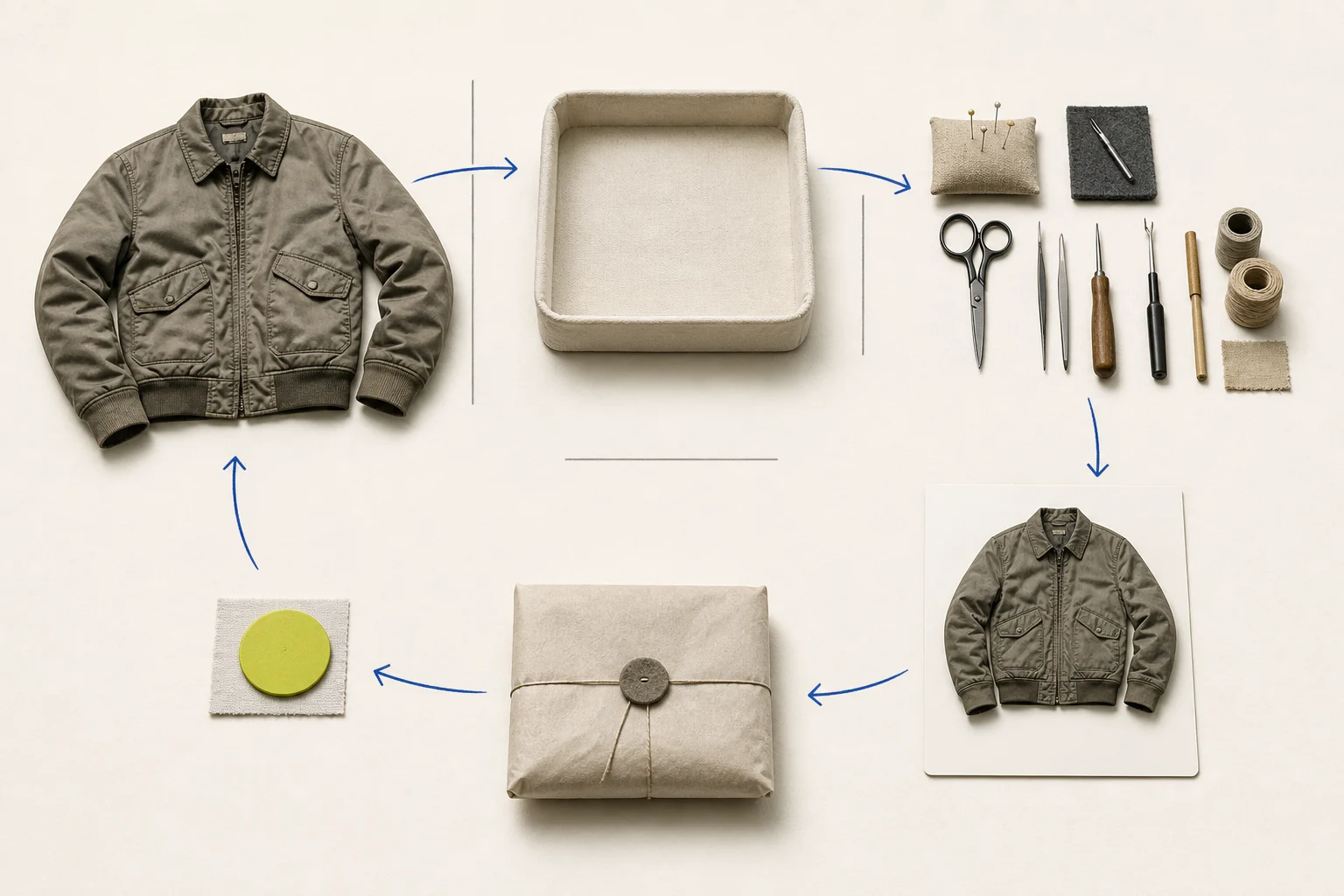
A branded resale page can look deceptively simple: send an item, receive credit, and let someone else buy it. Behind that interface sits a second operating system. The product must be identified, accepted, transported, inspected, graded, cleaned or repaired where appropriate, photographed, priced, stored, sold, fulfilled, returned, supported, and eventually routed again.
That is why resale belongs in brand strategy. It affects the original product record, material and construction choices, warranty and repair policy, store operations, customer credit, pricing, data governance, environmental claims, and the relationship between first and later owners.
Current first-party programs demonstrate several operating patterns. Patagonia Worn Wear accepts eligible used Patagonia clothing and gear for merchandise credit, sells inspected used products, publishes repair guidance, and routes ineligible items according to customer choice and program rules. Levi’s SecondHand lets U.S. customers bring eligible denim categories to participating stores for a digital gift card and sells preworn Levi’s products online. ThredUp’s 2025 Form 10-K describes a managed resale marketplace plus Resale-as-a-Service offerings that can include clean-out services, white-label shops, client-provided worn goods, and cross-listing.
These examples establish that branded resale is operating now. They do not prove that every program is profitable, environmentally superior in every case, or right for every brand.
Decide what the program is meant to do
Resale can serve different objectives:
- recover supply of recognizable products;
- create a lower-price entry to the brand;
- issue credit that supports a future relationship;
- extend product use and support repair;
- learn which products retain demand, condition, and value;
- offer customers a controlled alternative to third-party marketplaces;
- reduce uncertainty around authenticity and product identity;
- build service after the first sale.
The objective determines the model. A brand can operate the program, use a managed partner, power a peer-to-peer listing layer, accept trade-ins only, sell archive or damaged-stock products, or combine several paths. Each choice changes custody, economics, customer support, data rights, tax treatment, and liability.
The resale loop starts before the first sale
A durable program needs stable product identity. Preserve style number, season, material, color, size, care, repair history, and authorized imagery where lawful. Labels and construction need to survive use well enough for later identification. A digital record should never promise authenticity or condition that the intake process cannot verify.
Design decisions also shape the second life. Replaceable hardware, accessible seams, repairable components, durable labels, spare parts, and clear care can lower friction. This does not mean every garment must be engineered for infinite circulation. It means the business understands which products are likely to remain functional and what it will do when they do not.
Patagonia’s current program accepts functional products in good condition, applies category and condition exclusions, and can return or seek another route for ineligible gear. Levi’s limits eligible trade-in categories and conditions, uses store appointments, and distinguishes wearable from unwearable items. Those rules are part of the product promise, not administrative fine print.
A store-credit loop is a commercial mechanism
Trade-in value is not the same as resale price, original retail price, or environmental value. Credit can reduce cash payout, encourage a new or used purchase, and keep the customer inside a brand ecosystem. It can also create deferred obligations and disappointment when condition or category rules reduce the offer.
Publish eligibility, estimate ranges, fees, inspection authority, timing, rejection paths, credit restrictions, expiration where applicable, and customer recourse. Track issued, redeemed, expired, and outstanding credit. Separate gross merchandise value, revenue recognition, seller or customer payouts, processing expense, and returned orders according to the model and professional accounting advice.
Platform scale does not remove unit complexity
ThredUp reported 1.65 million active buyers, 6.075 million orders, and $310.8 million in continuing-operations revenue for 2025. Its filing also states that every unique item requires inspection, evaluation, photography, pricing, a unique SKU, and fulfillment. Its RaaS risk discussion is unusually useful: partner acquisition takes resources, client programs may not create high-quality supply or repeat buyers, and white-label shops can be discontinued.
The strategic lesson is not to imitate the scale. It is to recognize the work. An independent brand should model intake acceptance, processing time, sellable yield, photography and listing cost, storage, markdown, customer support, return rate, credit redemption, and unsold routing before announcing a program.
Brand control and partner capability must be explicit
A managed partner may provide logistics, software, authentication workflows, payments, or customer support. The brand still needs clear accountability. Who owns the customer relationship? Who can use images and data? Who sets price? Who decides condition? Who handles a disputed item? Who makes environmental claims? Who supports recalls or safety notices?
Map the data flow before integration. Minimize personal data, define retention, restrict access, and preserve consent. A product history should not become a customer-surveillance history.
Environmental claims require more than circulation
Keeping a usable product in service can be a meaningful objective. It does not justify an unqualified claim that every resale transaction “saves” a fixed amount of carbon, water, waste, or production. Results depend on product, use, transport, processing, packaging, return behavior, substitution, allocation method, and study boundary.
The FTC Green Guides describe principles for clear qualification and substantiation of environmental marketing claims. A brand should state whether a figure comes from its own lifecycle assessment, an external study, a product-specific model, or a general estimate. Preserve version, geography, date, assumptions, functional unit, reviewer, and uncertainty. Avoid converting a company estimate into a universal fact.
Measure the whole loop
A resale scorecard should connect six stages:
- Supply: submitted units, acceptance rate, product mix, condition, and source.
- Processing: cycle time, labor, repair, cleaning, imaging, and listing completeness.
- Merchandising: price, markdown, availability, size, content, and time to sale.
- Customer: buyer cohort, new-to-brand status, service contacts, completed returns, and kept sales.
- Economics: net revenue or commission, payout or credit, fulfillment, returns, storage, write-down, and contribution.
- Next route: repeat resale, repair, return to owner, donation, recycling, or disposal with evidence.
Do not report listed inventory as recirculated product. Do not report submitted units as accepted. Do not report orders before cancellations and completed returns as kept sales. Do not report a recycling intention as a verified outcome.
A reproducible fictional resale audit
FashionMember created four invented program packets in content/data/FM-136-resale-strategy-audit.csv. The script scripts/fm136-resale-strategy-audit.php checks whether a fictional packet documents program objective, product identity, intake consent, condition rules, custody, pricing, credit terms, partner roles, privacy, unit economics, completed returns, unsold routing, environmental substantiation, interviews, source dates, conflicts, and human review.
Two complete fictional packets reach strategy-review; two remain on hold. Every brand, platform, customer, product, credit, payout, order, return, environmental figure, interview, and outcome is fictional. The audit does not validate a real resale program.
A strategy survives beyond launch
The decisive questions arrive after the first campaign: Are accepted products processed on time? Do customers understand value and condition? Are return reasons improving product design? Does credit bring customers back without hiding program cost? Can the brand support recalled, damaged, or inauthentic items? Are environmental statements still true under the current method?
Resale becomes strategy when first-life design, later-life service, economics, evidence, and accountability connect. A branded shop can be part of that system. It is not the system by itself.
Sources and verification
- ThredUp: Fiscal 2025 Form 10-K — audited marketplace, RaaS, operating-process, metric-definition, revenue, risk, and continuing-operations context dated March 2, 2026.
- Patagonia Worn Wear: FAQ — current first-party trade-in, inspection, credit, returns, repair, geography, and product-condition rules.
- Patagonia: Trade In — current first-party mail and store intake, credit, eligibility, and rejected-item options.
- Levi’s: SecondHand Program — current first-party program scope, U.S. availability, product categories, fulfillment, and return policy.
- Levi’s: Stores and Trade-In FAQ — current first-party appointment, eligible-condition, category, credit, and routing rules.
- FTC: Green Guides — authoritative U.S. environmental-marketing guidance and substantiation context.
- FTC: Environmental Claims Summary — official qualification and claim-specific business guidance.
How this story was checked
- Sources
- 7 linked records · View list
- Last verified
- Reporting desk
- FashionMember Business Desk
- Format
- Analysis
- AI assistance
- Used with editorial review; disclosed above.