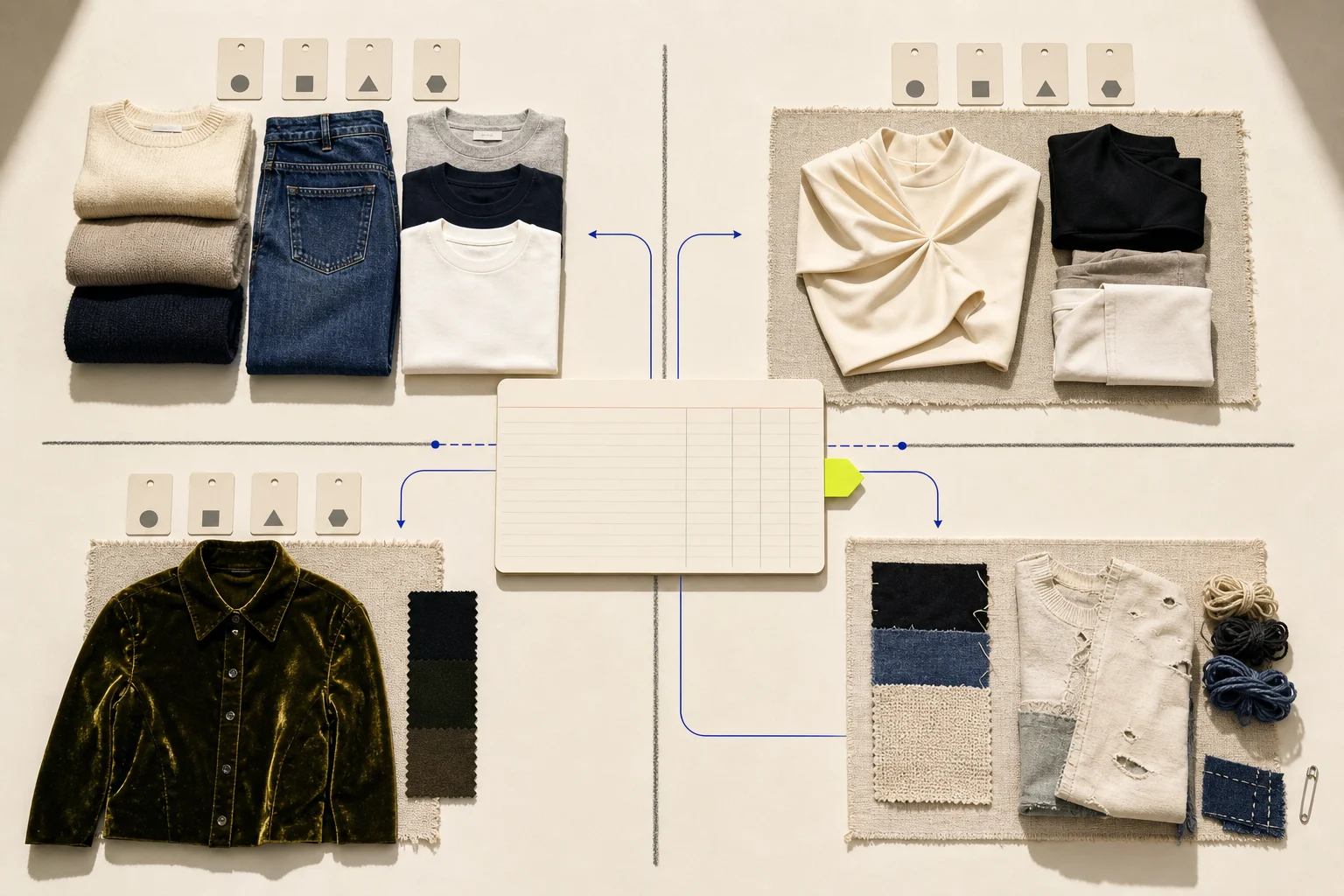
A boutique can appear full and still be short of the products customers want. It can post strong gross sales while cash is trapped in aged sizes, duplicated colors, late seasonal deliveries, or returns that have not yet matured. “Healthy mix” therefore cannot mean one universal allocation such as 60% basics and 40% fashion.
It is better understood as a control system. The store knows what it owns, what it owes, what is available to sell, what has been committed, what is arriving, what has sold at full and promoted prices, what has returned, and which decisions can still change.
FashionMember has not received a consenting boutique dataset for this article. The framework below is an editorial methodology, not a case study of a real business and not accounting or tax advice.
Start with four inventory jobs
A practical mix separates inventory by the job it is meant to perform:
- Core: repeatable products with stable fit and replenishment logic. Core protects availability but can become invisible dead stock when a merchant mistakes habit for demand.
- Fashion test: small, deliberate bets designed to learn. Tests need a defined question, launch window, and repeat or stop rule.
- Seasonal and occasion: time-sensitive products whose value can fall quickly after a weather, holiday, event, or delivery window.
- Exit: aged, damaged, returned, incomplete, or strategically discontinued units with an approved action and financial owner.
These are operational roles, not permanent product identities. A tested trouser can graduate to core. A core color can move to exit after fit, demand, or assortment changes. A seasonal product that reappears every year still needs date-specific receipt and exit rules.
Count variants, units, and dollars separately
An assortment can be broad in styles but shallow in units, or narrow in styles but deep in inventory cost. Report at least three views:
- Option mix: unique styles, colors, sizes, and variants offered.
- Unit mix: physical units available, committed, incoming, damaged, and on hand.
- Cost mix: cash or liability tied to those units, using the business’s consistent accounting method.
Add a fourth view for realized selling value after discounts, refunds, and allowances. List-price retail value is not cash. Gross sales before completed returns are not kept demand.
Size integrity deserves its own line. A style with one residual size is technically in stock but may be commercially broken. Color duplicates and pack ratios can also hide risk inside an apparently healthy SKU total.
Sell-through is useful only with its formula attached
Shopify’s current inventory documentation defines its sell-through report as quantity sold divided by quantity sold plus ending inventory for the selected period. It notes that restocks are reflected, negative ending quantities are treated as zero, untracked inventory is treated as zero sold, and the most recent report normally has a processing delay. Its quantity-sold fields do not reflect certain adjustments such as returns.
Square describes sell-through as inventory received from a vendor compared with what sold during a period and lets retailers filter by date, location, category, item, and SKU. Square also publishes broad rule-of-thumb thresholds. FashionMember does not adopt those thresholds as a universal boutique standard. A new seasonal delivery, a replenishable sock, a special-order dress, and a slow high-margin object require different horizons and decisions.
Every internal dashboard should display the exact numerator, denominator, date window, location scope, treatment of transfers and returns, and whether canceled or fraud orders are excluded. Two systems can show different sell-through numbers for the same business without either calculation being mathematically wrong.
Healthy inventory protects both demand and cash
A useful weekly review can move through six questions:
1. Is the record trustworthy?
Reconcile physical counts, purchase orders, receipts, transfers, sales, cancellations, damages, returns, and manual adjustments. Shopify warns that deleted locations and products can affect historical reporting and that negative inventory can result from overselling or missing tracking. A neat dashboard is not proof of clean data.
2. What is selling and staying sold?
Track units sold, realized price, discounts, completed returns, exchanges, and kept units by cohort. Allow the return window to mature. A launch can look successful before late refunds reveal size, quality, or description problems.
3. Where is availability broken?
Separate a true stockout from a broken size run, one unavailable color, an unreceived transfer, or a website-sync error. Estimate lost opportunity cautiously; do not treat every unavailable page view as a guaranteed sale.
4. What can still repeat?
Record vendor minimums, case packs, lead time, cancellation terms, expected arrival, landed cost, and the last useful receipt date. A fast seller with a late repeat is not automatically a good reorder.
5. What must exit?
Give aged inventory a named action: remerchandise, transfer, bundle, mark down, repair, return to vendor, donate, recycle, or write down with professional accounting guidance. “Wait” should have an expiration date.
6. How much open-to-buy remains?
Reserve capacity for known commitments, freight, duties, returns, and operating cash before allocating new orders. A merchandise opportunity is not healthy if it creates a payment or liquidity problem.
Accounting records are a boundary, not a decorative metric
IRS Publication 334 explains that businesses producing, purchasing, or selling merchandise generally keep inventory, while qualifying small business taxpayers may use permitted alternatives that still clearly reflect income. When inventory is used, beginning and ending values help determine cost of goods sold, and practices must be consistent.
FashionMember’s editorial mix chart is not a substitute for a retailer’s books, tax return, inventory method, accountant, or legal obligations. Never copy customer, payment, tax, bank, credential, or invoice data into an editorial fixture. Use de-identified exports with written permission and minimum necessary fields.
The chart should show decisions, not just slices
The planned inventory-mix visual should not be a static pie chart. A more useful design combines four layers:
- current units and cost by inventory job;
- aged and broken-size exposure;
- open purchase commitments and expected receipt dates;
- next actions with accountable owners and deadlines.
Show uncertainty and missing fields. Separate received units from purchase orders. Separate gross sales from completed returns and kept sales. Mark products whose comparison windows are not mature. A chart that forces every unit into a confident category can be less useful than one that makes data gaps visible.
A reproducible fictional inventory audit
FashionMember created four invented boutique packets in content/data/FM-130-boutique-inventory-audit.json. The script scripts/fm130-boutique-inventory-audit.php checks whether a fictional packet documents consent, date and location scope, SKU and variant identity, physical reconciliation, landed cost, purchase commitments, inventory jobs, size integrity, sell-through formula, promotions, completed returns, kept sales, aging, exit actions, open-to-buy, accountable ownership, and human review.
Two complete fictional packets reach mix-review; two remain on hold. All boutiques, vendors, products, customers, quantities, costs, orders, receipts, returns, invoices, margins, cash positions, and decisions are invented. Passing the audit does not mean the illustrated mix is optimal.
Health is the ability to respond
The healthiest assortment is not always the one with the highest short-window sell-through. A store may intentionally hold core availability, protect a known event window, or fund a long-lead product. Nor is low stock automatically disciplined; chronic stockouts can weaken service and distort the apparent productivity of the remaining units.
Inventory health is the ability to see the position accurately and act before choices disappear. The merchant can repeat what is working, stop what is not, preserve cash, maintain useful breadth, and explain why every meaningful inventory block is present. That standard must be tested with a consenting retailer’s real methodology before FashionMember publishes a real case study.
Sources and verification
- Shopify Help Center: Inventory Reports — current official inventory-report definitions, limitations, formulas, latency, and negative-inventory treatment.
- Square Support: Sell-Through Reports — current official report scope, received-versus-sold framing, filters, and platform benchmark context.
- IRS Publication 334 (2025) — current federal small-business inventory, consistency, cost-of-goods-sold, and gross-profit framework; not individualized tax advice.
- IRS: How Should I Record My Business Transactions? — official recordkeeping context.
- U.S. Census Bureau: Manufacturing and Trade Inventories and Sales, June 2026 — aggregate current inventory-sales context; not boutique SKU or category-mix evidence.
- U.S. Census Bureau: Monthly Retail Trade Definitions — official retail-estimate definitions and scope limitations.
How this story was checked
- Sources
- 6 linked records · View list
- Last verified
- Reporting desk
- FashionMember Business Desk
- Format
- Analysis
- AI assistance
- Used with editorial review; disclosed above.